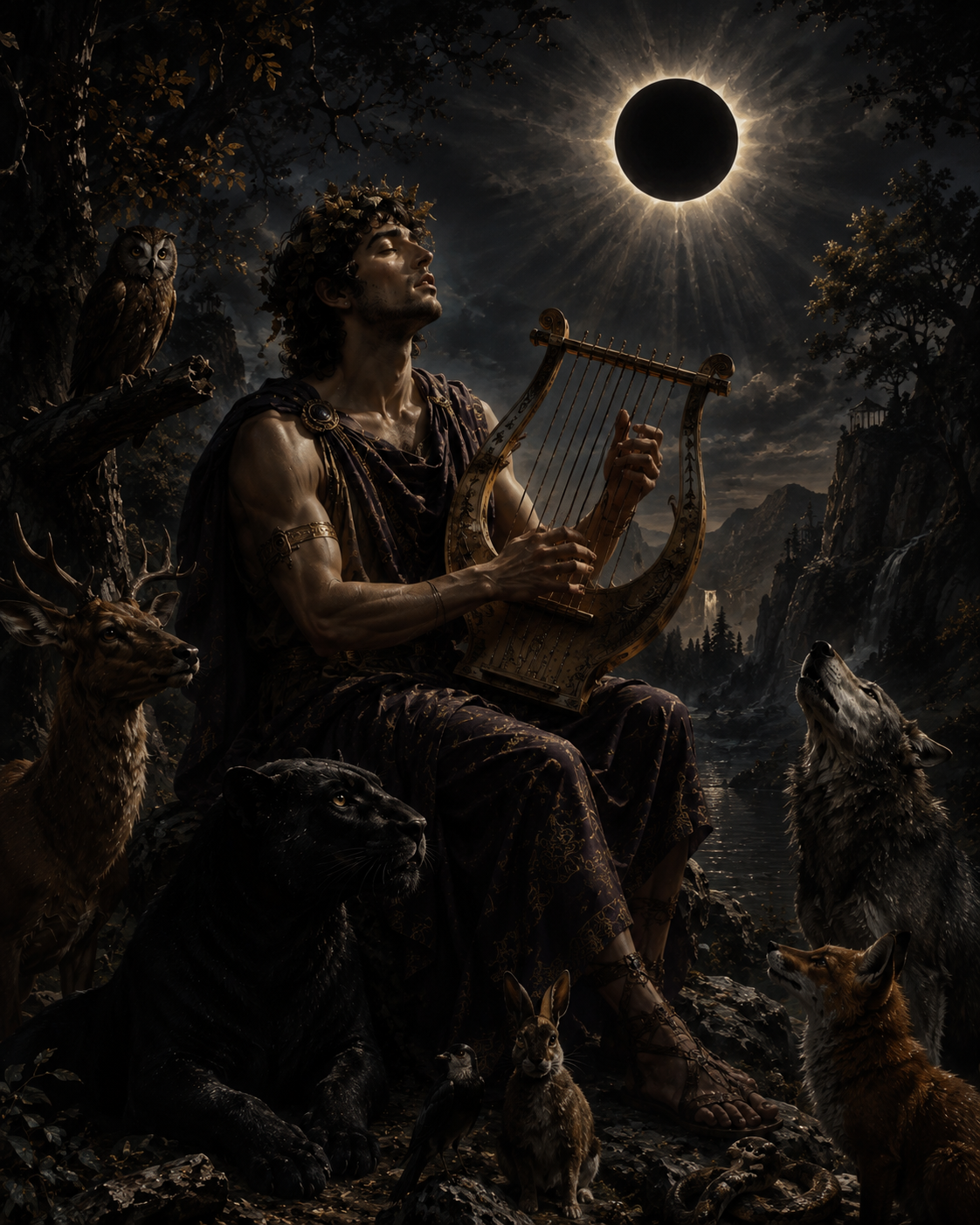
A reader from Coronel Suárez, Argentina contacted me over the weekend, and we’ve been having a delightful conversation these last couple days. He’s a Heathen, and a devotee of Thor, who is taking acting classes. Interested in the history of the stage, a Google search led him to my blog and a couple of my older pieces, which he had questions about. In particular my 99 Adorations, which I wrote … back around 2010-12, I think? Maybe a little earlier. Fucking time, man.
Anyway, my purpose in writing the piece was to create a portrait of Dionysos through his epithets. In this case 99 of them, 9 being one of his sacred numbers. And it blew people away. Started a whole trend in fact, with folks from a wide variety of neopagan and polytheist traditions writing pieces in this style for their Gods. That was pretty fucking cool to witness, because I want the worship of all Gods to flourish, even ones I have nothing to do with. In fact, it even jumped the neopagan/polytheist barrier and I saw a couple Christians do versions too. Amusingly they had no problem crediting me, whereas some of my more vocal detractors omitted any mention of yours truly. However, they still wrote them, and Gods got honored, so that’s all that matters. Besides, I stole the idea from Śaivite nāmāvalī literature anyway. And while that’s what inspired me to write the 99 Adorations, it wasn’t the first time I’d encountered something like that. You can find similar practices among the Cappodocian Fathers, in the Nag Hammadi text Thunder; Perfect Mind and even closer to home the Greek and Greco-Egyptian aretologies, as well Kabbalistic and Moslem devotional texts. I think the genre is so widespread because it works. Why? Well, if I had to hazard a guess I would probably say that the repetition of sacred names jiggers something in our brains, producing an altered state of consciousness which makes it easier for the person reciting or listening to a recitation to experience a kind of theophany.
This begs a deeper analysis.
To begin with, rhythm is the key.
Every line is nearly identical.
I adore you…
Again.
Again.
Again.
That repetition is not stylistic laziness. It’s liturgical discipline.
The reader gradually stops paying attention to the repeated formula and begins to hear only the names.
The syntax disappears.
The epithets remain.
There’s almost no attempt to explain.
When you’re composing such a piece you never say:
“…because…”
Or:
“…who therefore…”
You trust the names to speak for themselves.
That takes confidence.
Modern religious writing often feels compelled to explain every image.
But the author of such a text doesn’t do that. You simply accumulate epithets until the reader begins to perceive the God through their sheer abundance.
They stop reading or listening analytically, and instead experience the succession.
The piece functions on its own terms. It doesn’t ask the reader to construct a systematic theology. It lets contradiction stand.
The order isn’t random—
But it isn’t thematic either.
Similar epithets aren’t grouped together.
Rather, there’s tension.
Release.
Stillness.
Violence.
Tenderness.
Laughter.
Death.
Sensuality.
Mystery.
Then another shift. And another. And another.
It breathes.
It forces contemplation.
Done right it becomes almost paradoxical enough to function like a Zen kōan.
It resists premature understanding.
The reader must sit with it. Reflect.
And then…
the ending.
This is where I think the piece reveals its architecture.
After ninety-eight names, tracing a winding path through the God’s complexity—
Cosmic…
Mythic…
Ritual…
Symbolic…
Violent…
Merciful…
Ecstatic…
Vegetative…
Sexual…
Chthonic…
Solar…
—all of it suddenly resolves into:
“I adore you my God.”
That’s the culmination.
After ninety-eight attempts to describe him…
…you stop describing.
Relationship replaces definition.
That final line doesn’t add another epithet.
It transcends the need for one.
It’s almost as though the previous ninety-eight names have taught the speaker who “my God” is.
And in that final line the encounter occurs.
This type of poetry isn’t trying to prove a proposition.
It’s trying to cultivate a capacity.
Its success isn’t measured by whether it convinces someone of a thesis.
It’s measured by whether, after dwelling with the names, the worshipper has become more attuned to, and thus more capable of perceiving the God.
That’s a very different criterion of success.
Broadly speaking there are five kinds of sacred verse. Or one might say that this verse is asked to perform five jobs:
- Referential
- Interpretive
- Liturgical
- Mnemonic
- Mystagogical
The 99 Adorations move through all five simultaneously.
A classicist could identify the ancient sources.
A theologian could discuss the implications.
A ritualist could pray it.
An initiate would remember.
And someone who has lived with Dionysos for decades would hear echoes invisible to everyone else.
That’s an extraordinary density.
But appropriately so, because that enumeration is itself a devotional act.
Not because Dionysos needs ninety-nine names.
The worshipper does.
Each new name breaks another conceptual idol.
Every time the mind thinks:
“Ah, now I understand…”
The next epithet arrives and says:
“Not only that, but this.”
And the next:
“This too.”
And the next. And the next
Until finally the mind gives up trying to contain the deity.
That’s where true worship begins.
Earlier I said I wanted to create a portrait of Dionysos in his totality through the epithets
I’m not sure that’s the best analogy.
A portrait is static.
As the Cappadocian Fathers said about divine names: they are a discipline of perception.
Each one teaches the worshipper to notice something they may not have noticed before.
Not because Dionysos changes.
Because attention changes.
And after ninety-eight acts of attention…
“My God.”
…is no longer a generic statement.
It’s the only thing left to say.
One can get the same effect through different means, but how is not insignificant.
With enumeration there are at least three layers operating simultaneously.
1. Enumeration expands theological imagination.
This is the most obvious level.
One name is always in danger of becoming an idol.
The second corrects the first.
The third corrects the second.
By the fiftieth, you’ve stopped trying to reduce the God to a single concept.
2. Enumeration trains attention.
Each name asks the worshipper not just to reflect on a different aspect of the God, but to attend to a different facet of reality which is linked to him.
Liberator.
What does liberation mean? Who or what is one being liberated from?
Rainmaker.
Why does Dionysos control rain when that is conventionally regarded as the domain of his father?
Life.
What kind of life, bios or zōē?
Barren branch in winter.
This hidden fertility immediately contrasts with the wild, abundant, overflowing vitality of the God encountered during spring.
The names become exercises in perception.
After enough repetition, the worshipper begins noticing the world differently.
That’s not merely theology.
It’s spiritual formation.
3. Enumeration changes consciousness.
This is where ritual experience becomes invaluable.
I suspect many scholars would stop after the first two.
A ritualist can’t.
Because they know what actually happens.
Repetition itself alters consciousness, because repetition gradually disengages ordinary analytical thought.
The surface mind stops asking:
“What does this mean?”
And begins participating in the rhythm itself.
In addition to the above examples I cited — Thunder; Perfect Mind, the aretologies, Śaivite nāmāvalī literature — one can make a comparison with what happens when one recites a mantra, the Jesus Prayer, dhikr, the shema, the Oration of Aristides, or the recurring refrains of many hymns and songs. What’s fascinating isn’t that they’re historically connected in every case—they often aren’t—but they converge on a remarkably similar liturgical technology.
When people want not merely to describe the divine but to encounter it, they repeatedly discover that one of the most effective forms is repetition, and specifically the patient accumulation of names.
Not because the deity requires the names.
Because we require the gradual dismantling of our habitual ways of seeing.
The words don’t become meaningless through repetition. Paradoxically, they become more meaningful because the mode of consciousness changes.
Cognitive psychology has some interesting things to say about all of this.
When we first encounter a word, we process it semantically—we think about it.
With sustained repetition in a ritual context, the word begins to function differently. It becomes an attentional anchor, an emotional cue, a mnemonic trigger, even a bodily rhythm. Meaning isn’t lost; it’s redistributed through the whole person.
The word is no longer a dictionary entry. It’s become a doorway.
In another of my devotional poems I say:
Every syllable is full of myths.
One could add:
Every name is a discipline of attention.
As well as:
Every litany is a discipline of perception.
And finally:
Every act of enumeration is a discipline of transformation.
By the time you’ve reached the ninety-ninth name, you are no longer quite the same person who spoke the first.


That is a fact. I read the Fifty Names of Marduk, and are changed by the name at the end. Meanwhile, Roman Catholics have their many names of Mother Mary.
LikeLike
Hail Marduk! Hail Mary!
LikeLike