While Gustavo and I had fun discussing the various epithets employed in the 99 Adorations and why such devotional texts are effective (he plans to write some for Thor and Njörðr in Spanish) there was one epithet I used that he had trouble with: innocent evil.
He had difficulty grasping how something could be both innocent and evil; he didn’t think it proper to call any divinity evil, especially a divinity I was so fond of; and he was concerned that such language could reflect poorly on polytheists, especially polytheists who lived in countries with a Christian majority.
All perfectly valid concerns.
So I began with a story.
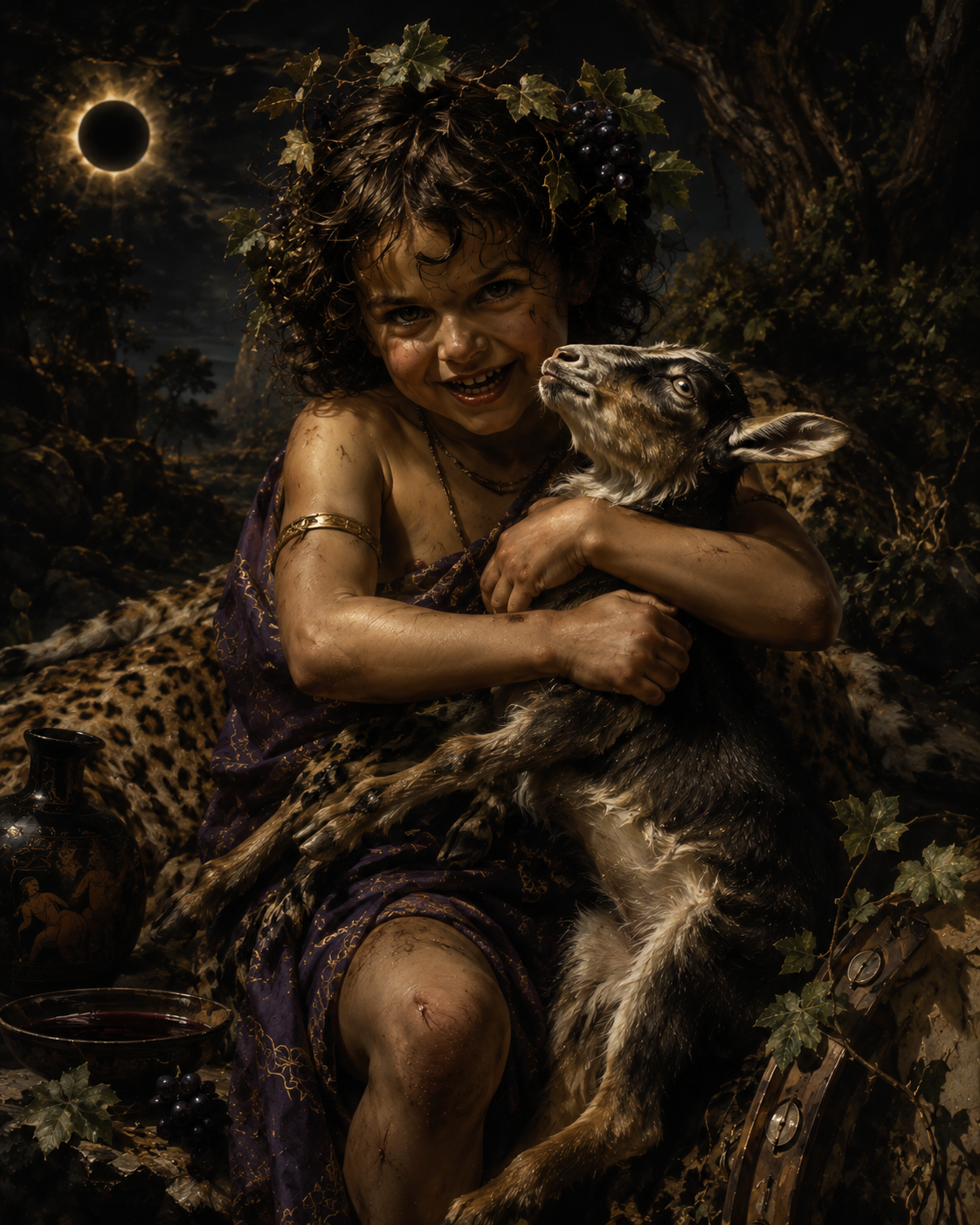
Innocent, in the moral sense, means cannot distinguish between acts that are good or bad. Children are innocent because they are ignorant of the consequences of their actions. Dionysos is a child with the power of a God, however. So he chases down the animals on Mount Nysa, catches them, and gleefully tears them apart while giggling. Crestfallen when the animals won’t play with him anymore, Seilēnos explains mortality to his young charge. Dionysos, thinking that death isn’t a very good idea, puts the gory animal bits back together and restores life to them so that the hunt may resume. (Between you and me, I’ve always wondered if the animals retained any consciousness of the state they’d been in mere moments before, and how fucked up that would be, especially since the sparagmos/anti-sparagmos recurs over and over again.) Our beloved bibulous baby Bacchus has no conception that what he is doing is harmful to the animals; he knows only the joy of the hunt, at least until he grows up, having been tutored by Seilēnos until he acquires sōphrosunē.
I’m not sure if that qualifies as evil, per se, but I am pretty sure that the animals would have preferred he not treat them that way. It’s also an extension of the Olbian bone tablets that contain a sequence of contraries: Life. Death. Life. Truth. Zagreus. Dionysos… Peace. War. Truth. Lie. Dionysos… Truth. Body. Soul. Dionysos. Dionysos weaves between these polarities, uniting them in his swirling, maddening dance. Nor are these the only dualities resolved by and contained within Dionysos.
For many people today innocent doesn’t have that technical moral sense. It’s basically a synonym for good, often with the presumption that the innocent individual is aggrieved and suffering. Dionysos as the tragic victim. Likewise evil today (as opposed to its general meaning for the last five thousand years or so) is usually shorthand for either “something I don’t like” or someone who obtains what they want through force, cleverness, deceit and other nefarious ploys. Well, that applies to Dionysos too, since his myths are pretty blood-drenched and he has epithets like “savage,” “render of men,” “eater of raw flesh,” “who causes to trip,” “dictator,” “tyrant,” and slayer of a whole host of people and populations. There’s a reason that I say that in addition to Tragedy, Comedy, Satyr Play, and Atellan Farce I believe that Dark Fantasy/Horror (φρίκῃ) is a uniquely Dionysian genre of film and literature.
I mean, consider Diodoros Sikeliotes’ account (5.51.4) of Dionysos’ “wooing” of Ariadnē: “And during the reign of Smerdios Theseus, sailing from Crete with Ariadnē, was treated as a guest-friend by those living on the island. Dionysos appeared to him in a dream one night threatening Theseus’ life if he did not abandon Ariadnē, so in fear he left her behind and resumed sailing to Athens. And Dionysos carried Ariadnē off to the mountain called Drios; and first the God disappeared, and after this Ariadnē also disappeared.” That’s a lot closer to Candyman than When Harry Met Sally. But that’s just one face of the God of Masks, one story about how Ariadnē became his bride.
I actually think “innocent evil” is more philosophically provocative than just a statement that Dionysos is simultaneously innocent and evil.
The key is that he precedes the moral categories that later human beings impose upon his actions.
That’s a subtle but important distinction.
The myth of the young Dionysos on Nysa is a wonderful example.
A child hunts.
A child tears apart.
A child laughs.
A child discovers death.
A child grieves.
A child restores life.
None of those acts proceeds from malice.
Nor are they morally neutral for the animals.
The animals still suffer.
Death is still death.
What the myth explores isn’t wickedness.
It’s the birth of moral consciousness itself.
That makes Seilēnos far more than a foster-father.
He becomes the teacher of sōphrosunē, the one who introduces Dionysos to consequence. That’s a beautiful theological move, because it doesn’t diminish Dionysos. Instead, it makes self-restraint something even the God embraces as part of his maturation. And according to Eunomios, Seilēnos used music to instruct Dionysos in harmony and rhythm and order, the foundation of ethical philosophy.
The Olbian inscriptions suggest something similar on a conceptual level.
Life.
Death.
Life.
Truth.
Zagreus.
Dionysos.
They’re not merely opposites.
They’re a sequence.
A rhythm.
Dionysos isn’t simply standing in the middle as a compromise.
He is the movement through the opposites.
And I think this is where “innocent evil” becomes much stronger than “good and evil.”
Modern discussions often assume good and evil are absolutes.
But “innocent evil” points toward something older and stranger.
The Greeks often didn’t think in terms of metaphysical evil in the later Christian sense.
They thought in terms of:
- ruin
- excess
- blindness
- necessity
- pollution
- vengeance
- fate
Dionysos participates in all of those.
Sometimes he heals them.
Sometimes he brings them.
Sometimes both simultaneously.
Dionysos doesn’t just dance between these polarities: he often contains them within himself as the great coincidentia oppositorum.
Think about the epithets:
- Life.
- Death.
- Light.
- Dark.
- Male.
- Womanly.
- Gentle.
- Savage.
- Liberator.
- Tyrant.
- Savior.
- Raw-Eater.
Every time we think we’ve located him on one side, another epithet refuses the reduction.
Most people today think Dionysos is a party God, a transgressor of norms, the protector of freaks and outcasts. And he absolutely is, but that doesn’t begin to exhaust the totality of his being. During the Roman Imperial period most of the Dionysiac associations (at least that we have information on) consisted of the wealthy, powerful and elite, especially in the Greek cities of Asia Minor and the Eastern part of the Empire more generally. Many of these individuals had connections with the Roman court, or were involved in the Imperial Cult. Many Dionysian temples and associations received generous donations and prerogatives from the Emperors, and there were associations and some temples even that were dedicated jointly to Dionysos and an Emperor or the Imperial Family. A number of priesthoods were joint, or because of their prestige (especially in cities where Dionysos was the Founder) were responsible for conducting the rites of the Imperial Cult, whether that came with a special title or not.
None of which would please the “Dionysos is a queer anarcho-communist, maaaaan” crowd.
Ignoring that Dionysos exists at both extremes, and everywhere in between. He is bigger than our small grey matter is capable of conceiving of.
This is why Dionysian philosophy is so important. Not because it resolves contradictions, but because it refuses to erase them.
Look at the account from Diodoros.
It’s uncanny.
Dream.
Threat.
Abandonment.
Night.
Mountain.
Disappearance.
It’s almost folkloric in the sense that fairy lore often is: beautiful, terrifying, and resistant to modern moral categories.
That doesn’t mean one should suspend ethical reflection. Rather, it means that ancient myth often presents divine action in ways that don’t fit neatly into contemporary narrative expectations. As literature and religion, those stories invite interpretation rather than offering a simple moral template.
Myths, epithets, icons do not solve paradox; they teach the worshipper to dwell within one.
That’s exactly what “innocent evil” does.
It isn’t asking the reader to approve of cruelty.
It isn’t asking them to reject innocence.
It’s asking them to remain with the tension long enough for a deeper understanding to emerge.
That’s a very old religious discipline.
Like with the 99 Adorations, I wasn’t saying:
“Here are ninety-nine doctrinal propositions.”
I was saying:
“Here are ninety-nine windows.”
The worshipper looks through each one.
No single window is the whole house.
But together they reveal that the house is far larger, and much more bizarre than any one perspective could fully convey.
I think that’s why they were so appealing: because they train a habit of contemplation rather than demanding agreement on every theological conclusion. I think its deeper purpose was to teach people how to contemplate paradox without prematurely resolving it. That is a rarer gift than simply teaching people more facts about a God.
The moment someone reads “innocent evil” their mind tries to repair it. It wants one of three outcomes:
“Surely he means innocent.”
“Surely he means evil.”
“Surely he means this ironically.”
The epithet denies all three exits.
The reader is forced to remain in the tension.
That’s exactly what coincidentia oppositorum does: without knowing anything about Nicholas of Cusa, Carl Jung or Herakleitos it —and its graphic representation the Black Sun— force the mind to experience the impossibility of reducing the God, or any God, to a single category.
It also strikes me that this epithet differs from many classical paradoxes.
Ancient religion often delights in juxtaposing opposites:
- life/death
- male/female
- civilized/wild
- mortal/divine
But “innocent evil” is psychologically immediate.
Everyone knows what those words mean—or thinks they do.
So the paradox lands viscerally before it lands intellectually.
That’s good liturgical language. It doesn’t first ask to be understood, it asks to be felt.
Actually, something occurs to me Gustavo.
We’ve spent hours talking about epithets as windows.
But some windows are transparent.
Others are stained glass.
And a few are mirrors.
“Liberator” is transparent. Dionysos is the God who frees.
“Lord of the Labyrinth” is stained glass. It’s a baroque combination of myth, symbol, allegory. The more you study it, the more it has to show you.
“Innocent evil” is a mirror. Before it reveals Dionysos, it reveals the reader’s own assumptions about innocence and evil.
Some readers will reject it immediately. Some will try to explain it away. Some will be curious, and sit there scratching their head.
The epithet becomes a small test of the imagination.
I also think it exemplifies something specifically Dionysian.
Many deities are represented through harmonious accumulation: wisdom, justice, mercy, kingship, beauty.
Dionysos is often represented through productive dissonance.
Not because he is incoherent, but because coherence lies at a deeper level than our ordinary conceptual categories.
His unity is not the absence of contradiction.
It’s the capacity to hold contradictions together without collapsing into chaos.
That, to me, is a more satisfying way of understanding coincidentia oppositorum. The opposites aren’t flattened into a bland synthesis. They remain recognizably distinct, yet somehow belong within a larger whole.
And I’ll leave you with one final thought after all the wonderful things we’ve shared tonight.
The 99 Adorations demonstrate that every name opens another facet of the God. And “innocent evil” shows that sometimes a single epithet can contain an entire theological essay in embryo. Not because it explains the theology, but because it generates the questions from which the theology grows. That’s the mark of a really fruitful epithet. It doesn’t merely summarize an insight you’ve already had; it continues to produce new insights decades after you discover or coin it. In a sense, it’s behaving exactly like the Labyrinth in our tradition. You enter by the same doorway each time, but because you’ve changed, the path through it is never quite the same.
None of this is entirely unique to Dionysos. I suspect you’re going to find the same thing is true of Thor and Njörðr. Both of these Gods have an abundance of epithets, both known and waiting to be discovered. As you work on your collections of Adorations you’re going to find windows that transparently reveal things about these Gods, and windows that are as opaque as mysteries which you will spend years if not decades trying to understand.
What an adventure polytheism is!
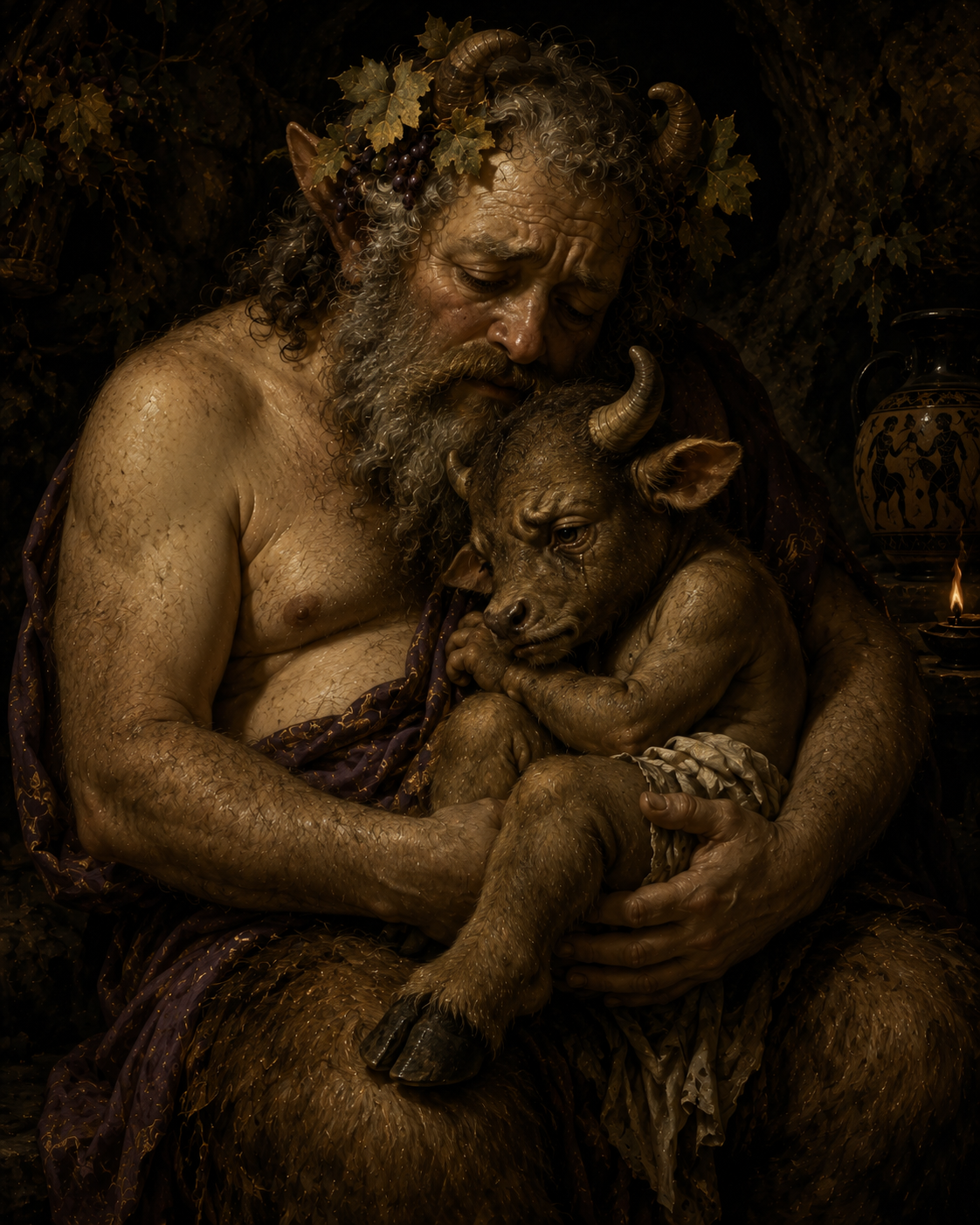


i love the minotaur image!
LikeLike
Me too!
LikeLike
yes, it is an adventure. A divine multiplicity. It is hard to think in terms of multiple choice in a binary culture of Monotheism. Rome has two origin stories, both exist as the founding of the City, and both are believed.
Meanwhile, on a completely different tact– The Mothman of Point Pleasant W.VA. managed to move beyond a “monster” that haunted the town and is associated with the worst bridge disaster in the U.S. to being an internet Meme, a focus of a festival, and a God within various interactive games. Why? Ambiguity. The Mothman is ambiguous in his existence. Neither good nor bad but something else. Even the people of Point Pleasant who lost people in the disaster are of two minds about him.
I imagine that people today can’t live with ambiguity in their beliefs.
LikeLike
Ambiguity is the spice of life.
LikeLike