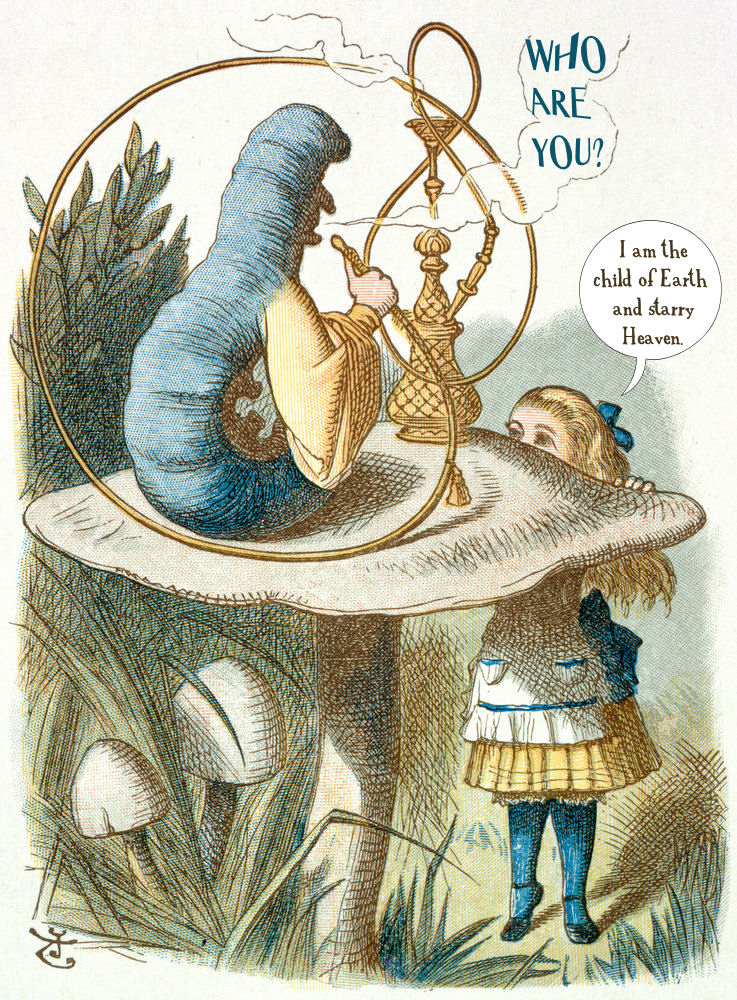
In Starry Bull theology the question, “Who are you?” becomes much more than a password. It is the decisive spiritual question. Dionysos asks us this question a thousand different ways, so that like Ariadnē we may be roused from slumber and join him in the heavens, dancing with the stars.
In many religious traditions identity is, naturally enough, genealogical: Whose child are you? Which people do you belong to? But in the gold tablets the initiate’s answer breaks that frame:
Γῆς παῖς εἰμι καὶ Οὐρανοῦ ἀστερόεντος.
“I am a child of Earth and Starry Heaven.”
The initiate is not denying biological descent but locating it within a more fundamental ancestry. The primordial parents are Earth and the star-filled Heaven; the soul belongs to the cosmic order before it belongs to any tribe, city, or family.
But it gets even more interesting with the soul’s next confession:
Ἀστέριος ὄνομα.
“My name is Starry.”
That transforms what is merely descriptive in the first declaration into a new identity. The initiate no longer merely comes from Starry Heaven; they become Asterios. The Minotaur—not as a monster to be slain, but as the hidden Dionysian figure dwelling at the heart of the Labyrinth. Here, “Starry” is not a claim of status but a declaration that one’s deepest identity is no longer exhausted by ordinary descent. The initiate has entered a lineage that begins not with a human ancestor but with the first differentiation of the cosmos and culminates in communion with Dionysos.
In the classical story Theseus reaches the center to kill the the man-rending (Άνθρωπορραίστης) and -devouring (Άνθρωποοφαγος) Bull of Minos imprisoned inside the endlessly shifting maze. In our tradition at the center the initiate realizes that they have become the monstrous Bull— or phrased another way they recognize that the Bull at the center is the deepest truth of the self in communion with Dionysos. The Labyrinth ceases to be a prison and becomes an initiatory path that leads to the stars. The soul’s trials are interpreted through Dionysos’ own passion, death, and return. That gives suffering a participatory rather than merely punitive meaning. It isn’t valuable because suffering is intrinsically good; it becomes meaningful because it is joined to the God’s own story.
This is reinforced by the distinction between ἀστερόεντος (“starry,” applied to Heaven) and Ἀστέριος. Why this is such an important distinction is that:
- ἀστερόεις / ἀστερόεντος describes the objective reality: the star-filled Heaven from which the initiate claims descent.
- Ἀστέριος is personal. It is a name, with a story. It is what the initiate becomes.
One is the cosmos; the other is the transformed person, and that’s a beautiful progression.
As the Greek makes clear (Παραδόσεως τοῦ Ἀστερόεντος Ταύρου) the tradition itself belongs to the Starry Bull— the cosmic, mythic Dionysos. But each initiate gradually becomes Asterios, bearing within themselves the image of that Bull. The tradition preserves the memory of the cosmic archetype; initiation shapes persons into its likeness.
That is a subtle distinction, but an important one. It means the tradition is not named after its members. It is named after the reality toward which they are being conformed. The image of the chorus of stars is, in many respects, the culmination of the whole system. It recalls the ancient Greek sense that the stars are not inert objects but part of a living, ordered cosmos. In our theology the initiate’s final destiny is neither disembodied contemplation nor endless repose, but participation in the ecstatic life of Dionysos: dancing, singing, feasting, eros, and fire. That is recognizably Dionysian while also giving the eschatology a distinct shape.
Haides is not a horrible place like the Christian Hell. It is a place where the soul may rest and recover from the traumas of life. This is why the soul is drawn to the waters of Lēthē, which is like anesthesia, so that they may heal and recover before returning to the world of the living. But we are a different breed. We don’t want to forget, because in that forgetting you lose who you are. But that is a costly choice. Memory preserves not only ecstasy but grief, shame, loss, longing, and every scar that made one who one is. The initiate refuses anesthesia, not because suffering is desirable, but because love itself requires remembrance. That’s actually a profound inversion. Lēthē is still mercy. Mnēmosynē is simply a greater vocation. So we drink from the Well of Memory, that we may preserve our joys and our sorrows, our frailty and our strengths, our losses and successes. Only by accepting this may we transcend and join the company of Bacchic mystics, “with wine as our fortunate reward” as the gold leaves put it.
Of course the true opposite of Lēthē isn’t necessarily Mnēmosynē— it’s ἀλήθεια. The Greek word literally means “un-forgetting, un-concealment.” Memory is the means. Truth is the end. The initiate drinks from Memory so that Truth may become possible. Not merely factual truth. The truth of one’s own being.
The cosmology, anthropology, initiation, ethics, and eschatology all reinforce one another rather than existing as isolated symbols. More, the central images recur at every level, and each recurrence deepens their meaning rather than merely repeating them. Like “My name is Starry.” one of the tags that recurs in our tradition is the phrase Πάντα χωρεῖ or “everything dances” which shows up everywhere from Herakleitos to Jim Morrison. “Everything dances” is a wonderful theological statement because it doesn’t deny suffering. It says that suffering itself belongs to a larger choreography. Dionysos is almost never portrayed as abolishing tragedy. He transforms its meaning. Semelē dies. Zagreus is torn apart. Ariadnē is abandoned. Erigonē hangs herself. Yet none of these endings remains an ending. Not because they are erased. Because they are incorporated into a larger pattern. The dance never excludes death; it carries death with it.
Another tag is “Circles, etc.” or “Circles. Fucking circles.” as an acknowledgment of the cyclical and repeating nature of things. But also a playful recognition of the often surprising and confusing manner in which this occurs, because things both repeat and are constantly new, with infinite variation. Or as the rest of Herakleitos’ dictum goes καὶ οὐδὲν μένει “and nothing remains the same.” That’s where the tension lives. Everything circles. Nothing remains. Those are not contradictions. The circle is never the same circle. The dancer returns to the same place with different feet. The initiate hears the same question repeated— “Who are you?” —but every answer is truer than the last. The same lesson appears with different phrasing. The same symbol reappears in another myth. The same conversation returns years later in another key. The same God asks the same question from another direction. “Circles. Fucking circles.” isn’t just a joke, but perfectly captures something that is difficult to express in elevated theological prose. There is a genuine spiritual experience of realizing, “Why am I here again?” Not as failure. As recognition. That phrase gives people permission to smile at recurrence rather than resent it. It keeps cyclical time from becoming merely solemn, and restrictive— but instead experienced as something alive, something dancing.


Beautiful.
LikeLiked by 1 person
Thank you!
LikeLike