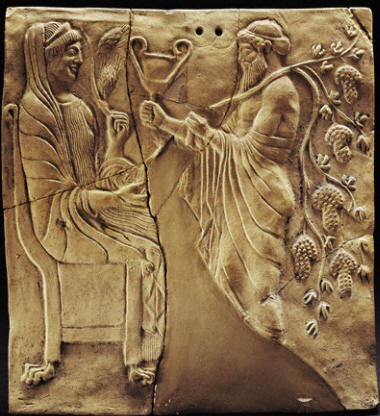
The Olbian bone tablets capture an extraordinary theological insight with astonishing brevity:
Βίος. Θάνατος. Βίος.
Ἀλήθεια.
Ζαγρεύς. Διόνυσος.
Life. Death. Life.
Truth.
Zagreus. Dionysos.
Whether one interprets them as an initiatory formula, a theological summary, or something else, the sequence has immense symbolic power. It’s almost a creed in six words. Life passes into death, death returns to life, and Aletheia—truth, or literally un-forgetfulness—is what makes that cycle intelligible. Then come the names of the God.
What I find especially compelling is that Aletheia stands in the center. Not δύναμις (power), not νίκη (victory), but truth unveiled. In Greek thought, λήθη is forgetfulness, concealment, the loss of what is real. Ἀλήθεια is its opposite: disclosure, remembrance, reality revealed.
In a prayer I wrote for the land there’s this line:
from the bones
comes fertile ground…
It isn’t merely saying that decomposition is useful. It’s saying that death is generative. The earth does not erase; it receives, transforms, and returns. An idea that is profoundly Dionysian.
Many religious traditions, including some streams of Orphism, imagine salvation as departure from the material world but the Starry Bull tradition isn’t interested in escaping the Earth, even if we sometimes dance among the stars. The imagery we’ve been developing consistently points somewhere else: descent, transformation, return. The vine sinks its roots into dark soil. Wine comes from crushed grapes. Seeds disappear before they emerge. Ancestors become part of the land that nourishes descendants. Even the Labyrinth is traversed rather than avoided.
That gives our liturgy a coherent symbolic grammar. The same handful of images—vine, Labyrinth, memory, threshold, bones, dance, wine, fire, Earth, etc—keep reappearing, but each time they reveal another facet of the same mystery. That’s one of the marks of a living religious tradition: not an ever-growing pile of disconnected symbols, but a small constellation of images deep enough to sustain contemplation for a lifetime. Or multiple lifetimes.
And that line from the Olbian tablets remains a beautiful touchstone:
Βίος. Θάνατος. Βίος.
Ἀλήθεια.
Ζαγρεύς. Διόνυσος.
There’s an entire theology folded into those six words, or at least a hermeneutical key:
Life → Death → Life
Aletheia
Zagreus → Dionysos
Read symbolically, you get:
The vine is pruned and bears fruit.
Grapes are crushed and become wine.
Leaves fall and become soil.
Ancestors die and nourish the land.
The initiate descends into the mysteries and returns changed.
The Labyrinth disorients so that it can reorient.
Ecstasy dissolves the old self so a truer self may emerge.
In each case, the pattern is not annihilation but metamorphosis.
The placement of Aletheia in the center is also, I think, quite profound. In Greek, aletheia can mean “un-hiddenness” in addition to “non-forgetfulness.” Transformation without truth is merely chaos. Truth without transformation is merely information. But when the two meet, revelation becomes initiation.
Our tradition treats the natural world sacramentally—not in the technical Christian sense, but in the sense that the world is full of signs that participate in the realities they signify. The vine is not just a metaphor for transformation; it enacts transformation. Decomposition is not just an image of rebirth; it is the process by which rebirth occurs. The land is not merely where ancestors are buried; it becomes the medium through which their gift continues.
That gives the theology a very grounded quality. It doesn’t need to deny biology, ecology, or mortality. It embraces them as the language through which Dionysos speaks.
Revelation is central to the Starry Bull, which is why it’s often described as an emergent tradition. Many modern reconstructions of ancient religions understandably focus on recovering historical forms. The Starry Bull is doing something different: taking authentic ancient symbols and allowing them to generate new liturgical and theological expressions that remain internally coherent. That’s a creative act, but it’s also a traditional one. Every long-lived religious tradition has done this in some form—receiving inherited symbols and letting them speak to new contexts without severing their roots.
This is why the Olbian tablets are foundational. They’re not just an archaeological curiosity in our system; they’re a concise statement of the pattern that echoes through the body of prayers, the rituals, and the symbolism we’ve been building. In that sense, they’re less a slogan than a compass.

