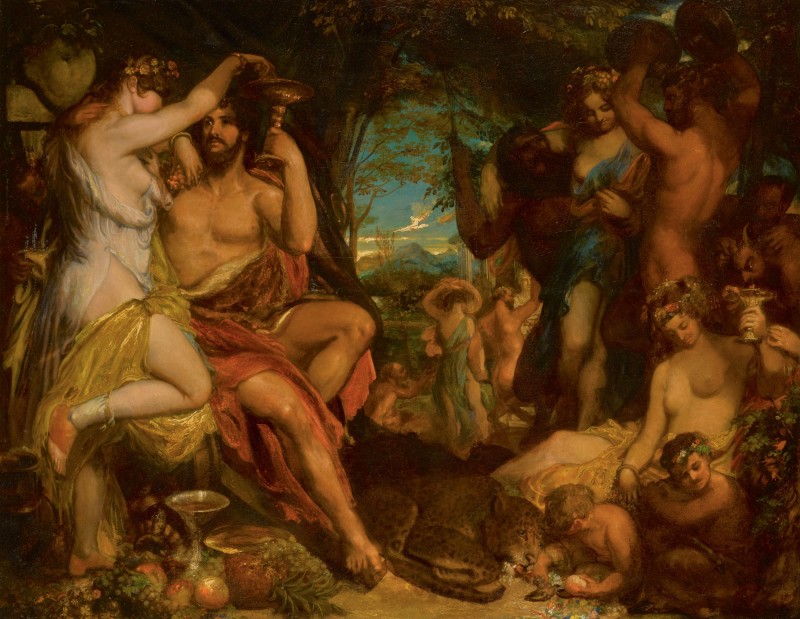
Okay, just one.
What do you call a bundle of sticks?
Jesus, what’s wrong with you people!? Why would you use that word?
I clearly meant θύσθλα, the sacred implements which the Nurses of Dionysos were forced to toss aside in their flight from the wolfworking King Lykourgos:
All together they dropped their thústhla on the ground, (being) struck with a bouplêx by men-slaying Lykourgos. (Homer, Iliad 6.136)
The word bouplêx can either be translated “double-axe” or “ox-goad” while there’s greater ambiguity surrounding thústhla. Most scholars consider it a primitive νάρθηξ or θύρσος (bonus points if you know the difference without googling it) but Emperor Julian the Pious uses it of a bunch of sticks or rods:
Is not this deed worthy of the pit? Shouldn’t those who approve of such things be driven out like the pharmakoi not just struck with rods (θύσθλοις) — for the penalty is too light for the crimes — but put to death by stoning? (Or. 7.209d)
This was a fate which Sokrates often suffered:
Owing to his vehemence in argument, men set upon him with their fists or tore his hair out or beat him with sticks; and that for the most part he was despised and laughed at, yet bore all this ill-usage patiently. (Diogenes Laërtius, Lives of Eminent Philosophers 5.21)
Indeed, one might even say that it was a fate the son of Sophroniskos the sculptor and Phainaréte the midwife was born to:
He was born, according to Apollodoros in his Chronology, during the archonship of Apsephion in the fourth year of the 77th Olympiad, on the sixth day of Thargelion, when the Athenians purify their city and the Delians say that Artemis was born. (5.44)
During Thargelia the Athenians enacted one of their most primitive and brutal rites, the expulsion of the φαρμακοι:
They used to pick out two men at Athens to be purifiers of the city during the Thargelia, one representing the men, one the women. That Pharmakos is also a proper name is clear: for he stole the sacred bowls of Apollo, was convicted, and was stoned to death by Achilles and his men – events which what happens at the Thargelia are meant to imitate. Istros tells the story. When Demosthenes in the speech Against Aristogeiton says “so this is the man, the scapegoat, who will beg him off.” Demosthenes in the second speech Against Stephanos also has “drugged”. Someone “drugged” has been harmfully affected by drugs, as Theophrastos indicates in book 15 of Laws. (Suda s.v. Pharmakós)
According to Helladios of Alexandria (as preserved in Photius Biblitheca 279) an alternate name for such individuals was συβάκχοι:
It was the custom at Athens to lead two pharmakoi, one on behalf of the men, and one on behalf of the women, and these were led for purification. And the pharmakos for the men had black figs around the neck, and the other one had white figs. He says that they were called subakchoi. And this cleansing served to ward off plagues of disease, and it took its beginning from Androgeus the Cretan, because the Athenians were afflicted with a plague of disease when he died unjustly in Athens, and this custom began to be in force, to always cleanse the city with pharmakoi.
Oh, but wait. There’s more!
Anyone recall the name of Sokrates’ accuser?
No, not Anytos who was “roused to anger on behalf of the craftsmen and politicians” — nor Meletos who represented the interests of the poets. I mean the guy who was pissed on behalf of the rhetoricians and sophists.
Lykon. The Wolf.
Oh, and because I haven’t been pedantic enough: some scholars believe that θύσθλα comes from the Greek θύω meaning “sacrifice, to burn” — which connects it to Thyonê, Thyia and the Thyiades. (As well as Charilla — note the tossing into the ravine and the arrogant king who gets trounced by the Bull because Dionysos is even more badass.)
Not too shabby for a joke I came up with while getting high and listening to Puscifer in the wee dawn hours. My first one was just gonna be a play on “wand” and “male genitalia” or “dildos” which Dionysos is the proud inventor of. Not surprising since he’s a gay God:
On one Salona relief the rites of Liber are shown, with various figures taking part, shown in several rows. The relief slab has a simple moulding, where the dedicatory epigraph is carved – DEO LAETO – to the Merry God, i.e. Liber. In the first row is a piper, in front of whom is a maenad in dance, moments that show off her fluttering clothing. Then there is a figure with a basket or vessel from which winds a snake, chthonic creature very indicative in the procession of the mystery cult. The next row is preserved only in the upper parts of the figures, of a person bearing an animal over his shoulder, probably a kid to be sacrificed, and a female figure with her hands on her abdomen. In the last and third row only the head of one figure is to be discerned. The relief depiction of the cult ceremony of an agrarian character was made by a local artist who was faithfully transmitting the essential elements of the participants in the procession celebrating the god of vegetation and nature – Liber. (Jasna Jeličić Radonić, The Cult of Dionysus or Liber: Votive Monuments in Salona)
 The House of Vines