Author: thehouseofvines
Hail Charilla! May you never thirst!
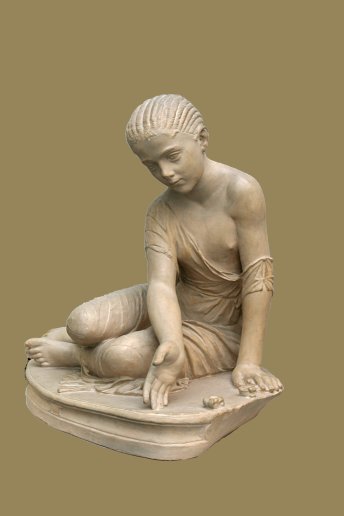
Plutarch, Aetia Graeca 12
The Delphians celebrate three festivals one after the other which occur every eight years, the first of which they call Septerion, the second Heroïs, and the third Charilla. The greater part of the Heroïs has a secret import which the Thyiades know; but from the portions of the rites that are performed in public one might conjecture that it represents the evocation of Semele. The story of Charilla which they relate is somewhat as follows: A famine following a drought oppressed the Delphians, and they came to the palace of their king with their wives and children and made supplication. The king gave portions of barley and legumes to the more notable citizens, for there was not enough for all. But when an orphaned girl, who was still but a small child, approached him and importuned him, he struck her with his sandal and cast the sandal in her face. But, although the girl was poverty-stricken and without protectors, she was not ignoble in character; and when she had withdrawn, she took off her girdle and hanged herself. As the famine increased and diseases also were added thereto, the prophetic priestess gave an oracle to the king that he must appease Charilla, the maiden who had slain herself. Accordingly, when they had discovered with some difficulty that this was the name of the child who had been struck, they performed a certain sacrificial rite combined with purification, which even now they continue to perform every eight years. For the king sits in state and gives a portion of barley-meal and legumes to everyone, alien and citizen alike, and a doll-like image of Charilla is brought thither. When, accordingly, all have received a portion, the king strikes the image with his sandal. The leader of the Thyiades picks up the image and bears it to a certain place which is full of chasms; there they tie a rope round the neck of the image and bury it in the place where they buried Charilla after she had hanged herself.
Hail to all the Tarantati whose names have been lost to us! May you never thirst!
Athanasius Kircher, Magnes sive de arte magnetica opus tripartitum pg. 759
Some tarantati let themselves hang from the trees by ropes, showing great enjoyment at such suspension – those stricken with this passion are usually the ones bitten by tarantulas in the habit of hanging the strings of their webs from trees.
Giorgio Baglivi, Dissertatio de anatome, morsu et effectibus tarantulae pg. 313
Those who have been bitten by the tarantula shortly thereafter fall to the ground half-dead, with a loss of strength and senses, with difficult breathing or moaning, often immobile and lifeless. With the beginning of the music, little by little these symptoms are attenuated, and the patient begins to move his fingers, his hands and then his feet, followed by other limbs; as the melodic rhythm becomes more pressing, the movement of his limbs gradually increases. If the patient is lying on the floor, he springs up to start the dance, sighs, and begins to contort himself in very strange ways. These first dances often last two or three hours: and after having rested briefly on the bed to wipe away his perspiration and to restore his strength, the patient resumes dancing with the same vigor. This can take place as many as a dozen times per day. The dances begin around dawn and continue without pause until around one in the afternoon. Sometimes they are compelled to stop, not because of their tiredness, but because they have perceived some dissonance in the musical instruments, a dissonance which, when it is perceived, provokes deep sighs and stabs of pain in the patient’s heart. They sigh and grieve at length until they resume dancing, the harmony having been reestablished. Around midday they rest from the music and dance. They put themselves to bed until their perspiration is over and then they refresh themselves with broth or over light food, given that the very serious lack of appetite which afflicts them would not permit them to take more substantial food. Around one o’clock in the afternoon, or at the latest around 2, they resume their dances with the same vigor. These dances last until evening, whereupon they have another light meal and then finally fall asleep. These dances usually continue for four days; rarely do they go beyond the sixth day. It is uncertain when the end will occur, since many continue to dance until they feel free of the symptoms, which usually takes place after the third or fourth day.
Anna Caggiano, Folklore Italiano 6.72
All the wives offer – understood as a loan – handkerchiefs, shawls, scarves, petticoats and linens of every color, pots of basil, lemon verbona, mint and rue, mirrors and baubles, and last but not least a great tub full of water. The surroundings are decorated in this way, and when everything is ready the victim of the bite, dressed in gaudy colors, chooses as she pleases ribbons, handkerchiefs and shoes that remind her of the colors of the tarantula and she adorns herself with them while waiting for the musicians.
Nicola Caputo of Lecce, De Tarantulae anatomie et morsu pg. 201
They customarily adorn the bedroom dedicated to the dance of the tarantati with verdant branches outfitted with numerous ribbons and silken sashes in gaudy colors. They place similar drapery throughout the room; sometimes they prepare a sort of cauldron or tub full of water, decorated with vine leaves and green fronds from other trees; or they make pretty fountains of limpid water spout, capable of lifting the spirits, and it is near these that the tarantati perform the dance, seeming to draw the greatest delight from them, as well as the rest of the setting. They contemplate the drapes, the fronds, and the artificial rivulets, and they wet their hands and heads at the fountain. They also remove damp bands of vine leaves from the cauldron and strew them all over their bodies, or – when the vessel is large enough – they plunge themselves inside, and in this way they can more easily bear the fatigue of the dance. It often happens that those who go dancing through the towns and hamlets accompanied by the usual music are brought to an orchard, where, in the shade of a tree, near a pond or brook offered by nature or prepared through craft, they abandon themselves to the dance with the greatest delight, while groups of youths in search of pleasure and pranks gather near. Among the latter mingle more than a few who are approaching old age and who, contemplating with serious curiosity the melodic frolicking, seem to exhort the youths with unspoken admonishment.
Ludovico Valletta, De Phalangio Apulo 76-77
With regard to the astonishing and complex agitation of the entire body, not long ago I personally saw a woman stricken with the poison who, although prey to the delirium of a violent fever, and her mind possessed with horrible phantasms – or rather, she was assaulted by a host of insolent demons – at the sound of the musical instruments she nonethless abandoned herself to a dance that was so excited, to such a frenetic agitation of her limbs and whirling her head, that my own head and eyes, enthralled by the same agitation, suffered from dizziness. This woman had suspended a rope from the ceiling of her humble dwelling, the end of which, just touching the floor in the middle of the room, she tenaciously squeezed between her hands; throwing herself upon it, she abandoned herself with the weight of her whole body, her feet planted on the floor, turning her head to and fro, her face glowing, with a surly look. I was deeply astonished, not being able to explain why the dizziness provoked by that rapid and violent head shaking did not make her reel and fall to the ground. Due to this agitation and the incredible exertion borne, the woman’s whole body and above all her face were covered with abundant perspiration; reddened by such strenuous agitation, she ran gasping to a great tub full of water prepared at her request, and she completely submerged her head in it, whence the cold water gave her some relief from the heat with which she blazed.
The tarantati rejoice at the sight of limpid waters, of artificial springs that flow with a soft murmur into a tub prepared for this purpose, gratifying themselves with the green fronds freshly picked from the trees and strewn here and there in the space dedicated to the dance in order to represent a forest
Ludovico Valletta, De Phalangio Apulo 92
The families of the tarantati hire the musicians, to whom many gifts are given and a great deal of drink is offered in addition to the daily compensation agreed upon, so that they may take some refreshment and thus play the musical instruments with greater vigor. It follows that a man of modest conditions, who laboriously earns a living with the diligent fatigue of his arms, in order to be cured of this illness, is often forced to pawn or sell objects of fundamental necessity, even if his household furnishings are shabby, in order to pay the aforementioned payment. It must be considered that no one would want to expose himself to this misfortune if he could combat the poison in another way, or if he did not feel compelled to dance from the bottom of his heart. I will spare the details of the many other aids and expedients the poison victims use to raise and cheer their melancholy spirits during the dance, items also needed for one reason or another. For instance there are artificial springs of limpid water constructed in such a way that the water is gathered and always returns to flow anew; these springs are covered and surrounded by green fronds, flowers and trees. Further, lasses dressed in sumptuous wedding gowns have the task of dancing with the tarantati, festively singing and playing the same melody with them during the dance; then there are the weapons and the multicolored drapery hung on the walls. All of these, and many others, cannot be procured without payment.
Hail Maleotos’ daughter; may you never thirst!

Etymologicum Magnum 62.9
Aletis: Some say that she is Erigone, the daughter of Ikarios, since she wandered everywhere seeking her father. Others say she is the daughter of Aigisthos and Klytemnestra. Still others say she is the daughter of Maleotos the Tyrrhenian; others that she is Medea, since, having wandered after the murder of her children, she escaped to Aigeus. Others say that she is Persephone, wherefore those grinding the wheat offer some cakes to her.
Hail Ariadne! May you never thirst!

Plutarch, Life of Theseus 20.1
There are many other stories about these matters, and also about Ariadne, but they do not agree at all. Some say that she hung herself because she was abandoned by Theseus; others that she was conveyed to Naxos by sailors and there lived with Oinaros the priest of Dionysos, and that she was abandoned by Theseus because he loved another woman.
“everything dances”
Unlike the folk Catholic feast of Ss Peter and Paul, after which we’ve modeled our observance, the date of the Ἀλέτιδεια is calculated according to the lunisolar calendar of the Bakcheion and so wanders about a bit (which is appropriate concerning the meaning of the name.) This year the Ἀλέτιδεια happens to fall on the Summer Solstice and so I wanted to do something special for it. Although I’m still on hiatus because of the broken back and mountain of projects I’m going to share the story of an Aletide each day, including a couple of the male ones. Hail Dionysos, and hail his Wandering Ones!
Update, of a sort
Those of you who read my wife’s blog know that I’m not on hiatus just because of the mountain of projects I’ve got but I am happy to report that great progress has been made, particularly with the Bacchic Orphic soul-parts. This is necessitating a complete redesign of the Starry training program and has opened up some systems that’ll be applicable on both the Bull and Bear sides of the tradition. No matter how serious my condition gets or how many obstacles are thrown in my way I won’t let anything stop this work from reaching fruition. I don’t know how long it’ll take me to get back to posting regularly or to answering all the emails that have accumulated, but know I carry you guys in my heart and mind.
In the meantime, here’s a song one of my favorite readers shared with me, which I think you’ll dig:
Be well and worship the Gods
I’ve got a lot of stuff going on right now which doesn’t leave much time or energy for producing original content so I’m putting The House of Vines on temporary hiatus. Catch ya on the flip side. Be well and worship the Gods.
Amazonomachia
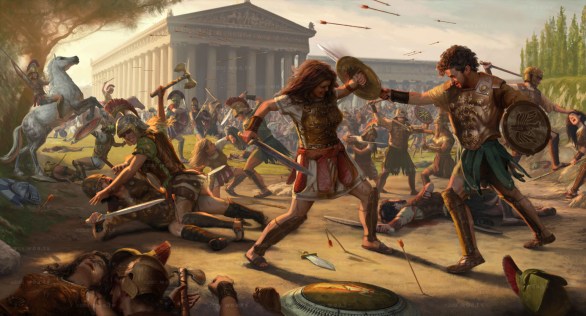
From what does the place Panhaema on the island of Samos derive its name? Is it because the Amazons sailed from the country of the Ephesians across to Samos when they were endeavouring to escape from Dionysos? But he built boats and crossed over and, joining battle, slew many of them near this place, which the spectators in amazement called Panhaema [‘Allblood.’] because of the vast quantity of blood shed there. (Plutarch, Greek Questions 56)
Pindar, however, it seems to me, did not learn everything about the Goddess, for he says that this sanctuary was founded by the Amazons during their campaign against Athens and Theseus. It is a fact that the women from the Thermodon, as they knew the sanctuary from of old, sacrificed to the Ephesian Goddess both on this occasion and when they had fled from Heracles; some of them earlier still, when they had fled from Dionysos, having come to the sanctuary as suppliants. However, it was not by the Amazons that the sanctuary was founded, but by Koresos, an aboriginal, and Ephesos, who is thought to have been a son of the river Kayster, and from Ephesos the city received its name. (Pausanias, Description of Greece 7.2.7)
As for Kronos, the myth relates, after his victory he ruled harshly over these regions which had formerly been Ammon’s, and set out with a great force against Nysa and Dionysos. Now Dionysos, on learning both of the reverses suffered by his father and of the uprising of the Titans against himself, gathered soldiers from Nysa, two hundred of whom were foster-brothers of his and were distinguished for their courage and their loyalty to him; and to these he added from neighbouring peoples both the Libyans and the Amazons, regarding the latter of whom we have already observed that it is reputed that they were distinguished for their courage and first of all campaigned beyond the borders of their country and subdued with arms a large part of the inhabited world. These women, they say, were urged on to the alliance especially by Athena, because their zeal for their ideal of life was like her own, seeing that the Amazons clung tenaciously to manly courage and virginity. The force was divided into two parts, the men having Dionysos as their general and the women being under the command of Athena, and coming with their army upon the Titans they joined battle. The struggle having proved sharp and many having fallen on both sides, Kronos finally was wounded and victory lay with Dionysos, who had distinguished himself in the battle. Thereupon the Titans fled to the regions which had once been possessed by Ammon, and Dionysos gathered up a multitude of captives and returned to Nysa. Here, drawing up his force in arms about the prisoners, he brought a formal accusation against the Titans and gave them every reason to suspect that he was going to execute the captives. But when he got them free from the charges and allowed them to make their choice either to join him in his campaign or to go scot free, they all chose to join him, and because their lives had been spared contrary to their expectation they venerated him like a God. Dionysos, then, taking the captives singly and giving them a libation (spondê) of wine, required of all of them an oath that they would join in the campaign without treachery and fight manfully until death; consequently, these captives being the first to be designated as “freed under a truce” (hypospondoi), men of later times, imitating the ceremony which had been performed at that time, speak of the truces in wars as spondai. (Diodoros Sikeliotes, Library of History 3.71)
Bright glory of the sky, come hither to the prayers which thine own illustrious Thebes, O Bacchus, offers to thee with suppliant hands. Hither turn with favour thy virginal face; with thy star-bright countenance drive away the clouds, the grim threats of Erebus, and greedy fate. Thee it becomes to circle thy locks with flowers of the springtime, thee to cover thy head with Tyrian turban, or thy smooth brow to wreathe with the ivy’s clustering berries; now to fling loose thy lawless-streaming locks, again to bind them in a knot close-drawn; in such guise as when, fearing thy stepdame’s wrath, thou didst grow to manhood with false-seeming limbs, a pretended maiden with golden ringlets, with saffron girdle binding thy garments. So thereafter this soft vesture has pleased thee, folds loose hanging and the long-trailing mantle. Seated in thy golden chariot, thy lions with long trappings covered, all the vast coast of the Orient saw thee, both he who drinks of the Ganges and whoever breaks the ice of snowy Araxes. On an unseemly ass old Silenus attends thee, his swollen temples bound with ivy garlands; while thy wanton initiates lead the mystic revels. (Seneca, Oedipus 405-430)
On its rich stream has Lydian Pactolus borne thee, leading along its burning banks the golden waters; the Massgetan who mingles blood with milk in his goblets has unstrung his vanquished bow and given up his Getan arrows; the realms of axe-wielding Lycurgus have felt the dominion of Bacchus; the fierce lands of the Zalaces have felt it, and those wandering tribes whom neighbouring Boreas smites, and the nations which Maeotis’ cold water washes, and they on whom the Arcadian constellation looks down from the zenith and the wagons twain. He has subdued the scattered Gelonians; he has wrested their arms from the warrior maidens; with downcast face they fell to earth, those Thermodontian hordes, gave up at length their light arrows, and became maenads. Sacred Cithaeron has flowed with the blood of Ophionian slaughter; the Proetides fled to the woods, and Argos, in his stepdame’s very presence, paid homage to Bacchus. (Seneca, Oedipus 467-486)
Another important piece of American history they don’t teach in the schools
The chapter from Gordon Rattray Taylor’s book I cited in a new expletive goes on to mention Father Divine. Man, that stirs up the memories.
Back when I used to hang out in the AOL chat rooms I had this friend who was into a mix of Hoodoo, Alchemy and Celtic reconstructionism. One of the spirits that he worked with was Father Divine.
Not a lot of folks were doing hero cultus back then, and if they were it was usually for a handful of popular figures from antiquity as opposed to the more recently deceased, so this element of his practice stood out for me. We had a lot of interesting conversations which inspired some of my own first forays into hero cultus.
He ended up dropping the Celtic and magical components and became a Christian spiritist at which point we lost touch, and now it’s been close to two decades since those conversations transpired. I’ve thought about him periodically over the years, wondering if he kept up his veneration of Father Divine and if the winding way of his life ever led back to the Gods.
Father Divine was quite the character, as you can see in this brief documentary:
And here’s a video made during the early days of his mission:
Another important piece of American history they don’t teach in the schools.
some tips on how to celebrate Agrionia alone

Agrionia, the festival of savagery, is coming up on 28 Kantharos (or May 20th, by the common reckoning.)
With the quarantine still in place throughout much of the country most of us aren’t going to be able to get together with our local thiasos and experience the violent collective frenzy and catharsis of this day.
But there’s still plenty that we can do.
In addition to the suggestions we’ve already provided at the Bakcheion here are some tips on how to celebrate Agrionia alone.
1) Make offerings to Orpheus, Medeia and Melampous.
2) Go out for a wild, rambling walk. Dance. Do drugs. Dress and act transgressively. And otherwise scale back normal Agrionia observances.
3) Isolate the shit that’s suppressed, toxic and holding you back internally and in your life, then bring it to the surface and ritually tear it apart.
4) Make a baby-shaped piñata, fill it with red-dyed corn syrup, and smash it to pieces.
5) Eat veal.
6) Reflect on the oppositions and polarities in Dionysos, and within yourself. Find a way to ritually or creatively express this.
7) Watch gory horror movies.
8) Research some aspect of the festival and make art inspired by it.
9) Chase random strangers through the streets with a sword.
a new expletive
Hey guys, I have a new expletive – Saint Fuck!
He’s one of the Phallic Saints of the Catholic Church.
Specifically Saint Foutin, the former Pothin or Pothinus, first bishop of Lyon. Over time the pronunciation of his name shifted and through folk etymology became linked to the verb foutre (“to fuck”).
Regarding these Phallic Saints Gordon Rattray Taylor writes in Sex In History:
The statues of these saints were usually equipped with large phalli: when the Protestants took Embrun in 1585, they found the people worshipping the phallus of St. Foutin and pouring wine on it, whence his sobriquet, le saint vinaigre. Women wishing to conceive would make use of the phallus in the same way that Roman wives would, before entering the marriage bed, make use of the wooden phallus of Mutunus Tutunus. A large wooden phallus covered with leather was found in 1562 when the Protestants destroyed the church at Orange, which was doubtless used for similar purposes.
It is easy to fall into the error of thinking of all these ceremonies as having been simply quaint survivals, as we should now regard them today. But it cannot be doubted that they were perfectly real and extremely important at the time. Only if we accept the fact that there was a persistent conviction that phallic religion was the true religion, and that, in the last resort, the phallic deities were more powerful and more beneficent than the upstart Christian god, can we understand such things as the belief that one could avoid the plague by committing incest on the altar: for this was evidently an act which asserted in the strongest imaginable form one’s adherence to phallicism and mother worship, and at the same time one’s contempt for the cruel father-deity who had sent the plague.
Phallic practices continued long after the end of the Middle Ages. In 1786, the British Minister in Naples wrote to the president of the Royal Society explaining how, in a little explored part of Isernia, he had found the peasants worshipping “the great toe of St. Cosmo” (i.e. the phallus) with appropriate rites. During the three-day feast, peasants, chiefly women, would present waxen ex votos, kissing them before giving them to the priest and saying “Santo Cosimo benedetto, cosi lo voglio” (Blessed St. Cosmo, that’s how I want it to be). Men would present their afflicted members to the priest to be anointed with oil, and 1,400 flasks of oil were consumed every year for this purpose.
There was also Saint Guignolé (Winwaloe), first Abbot of Landévennec, who acquired his priapic status by confusion of his name with gignere (Fr. engendrer, “to beget.”) Though immensely popular with the people, his shrine was destroyed in 1793.
Here’s a picture of his statue from the chapel of Prigny in Loire-Atlantique:
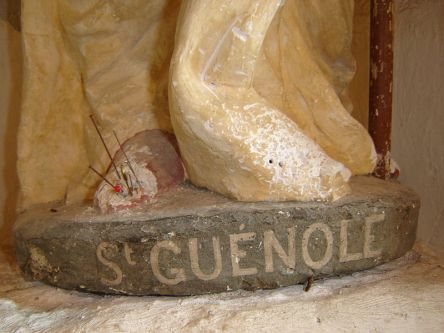
Local girls would pierce Saint Guignolé’s feet, believing that this ceremony would help them find their soul-mate.
Which reminds me of the squilling of Pan:
Theocritus, a native of Syracuse, preserved local traditions in his writings and recorded the oldest known reference to squilling in the third century BCE. “This do, sweet Pan, and never, when slices be too few/ May the leeks of the lads of Arcady beat thee black and blue.” (VIII 106-109) If the kill was small, or worse yet, the hunters returned empty handed, the young men of the village would ceremonially circle around a statue of Pan and use large bulbous onions attached to their stalks, “squills,” to whip Pan around the shoulders and genital area.
When considered out of context, whipping one’s God into helping seems a crude and bizarre rite. However, it gave the young hunters an outlet for their fears and anxieties, reminded them of their society’s understanding that sustenance and life itself are gifts of the Gods, and aligned them as the sons of Pan who, like them, was a hunter and so must be invulnerable to pain, hardship and loneliness. “Wilhelm Mannhardt put forth the theory that the scapegoat is ‘originally’ the vegetation spirit, who must be whipped, chased, and even killed in order to be invigorated, to be born afresh.” (Walter Burkert, Structure and History in Greek Mythology and Ritual p. 68) Whipping was understood to stimulate life-giving power when performed with fertilizing boughs, as are those of the squill. Lewis Richard Farnell writes: “The object of this discipline was not punishment and insult, but stimulative magic whereby the life-giving power of the deity might be restored.” (Sukey Fontelieu, The Archetypal Pan in America: Hypermasculinity and Terror)
There were many others as well, such as St. Guerlichon, or Greluchon, at Bourg Dieu — whose name has become a synonym for prostitute; St. Gilles at Cotentin; St. Rene in Anjou (by a confusion with reins, kidneys — the supposed seat of sexual power) and so forth.
So hail Saint Fuck, and may the blessings of fertility and renewal be yours!
Apocalypse bingo
So far we’ve had a global pandemic, locusts ravaging Africa and the Middle East, numerous earthquakes, volcanic eruptions, and devastating storms, economic collapse and a sharp turn towards authoritarianism in many countries, increased international tensions, skyrocketing levels of unemployment, suicide and homelessness, a looming famine the likes of which we’ve never seen before and the Pentagon confirmed that UFOs are real.
Did I leave anything out?
Oh yes, murder hornets is currently trending on Twitter, right behind #noahschnappisoverparty.
This is because Asian murder hornets have invaded Washington state and begun decimating the local honeybee population.
The Asian hornets are reportedly enormous, with queens growing as long as two inches. According to the Times, the hornets utilize their mandibles, which are shaped like spiked shark fins, to decapitate worker bees, clearing hives within hours and feeding honeybee thoraxes to their offspring. The hornet’s venom causes unbearable pain for larger victims who are stung, which reportedly feels like hot metal being driven through one’s skin. They also can break through beekeeper suits, presenting a real threat to not only honeybees but also their keepers.
That’s some real nightmare fodder there, huh?
But wait, they’re just getting started:
Scientists say the Asian giant hornet’s life cycle begins in April. Researchers told WSU that is when the queen wakes up from hibernation and scouts out spots to build underground nests and grow colonies. Todd Murray, WSU Extension entomologist and invasive species specialist, told WSU Insider the “shockingly large hornet” is a “health hazard, and more importantly, a significant predator of honey bees.”
But murder hornets become most dangerous from late summer to early fall, when they ravage through honey bee populations. WSU researchers said the hornets attack the bee hives, decapitating and killing the adults and eating the larvae and pupae. Just a few of the hornets can completely destroy a hive in a matter of hours.
We are so fucked.
Fun fact, though – did you know that hornets are sacred to Dionysos?
From Marianna Scapini’s The Symbolism of the Hornet in the Greek World:
The ancient sources, to summarise, clearly describe the behaviour of the hornet as very similar to that of Maenads–and above all of the murderous Maenads in rage. According to the ancients the hornet twists and twirls around, lives in the mountains, does not move in hierarchical groups, is without (male)-“kings”, and acts in a somewhat aggressive way, as it searches for raw meat. The detail of the cut off heads of other larger insects recalled by Pliny is particularly “Maenadic”, since decapitation was a typical act of the frenzied Maenads: it is sufficient to recall the Euripidean Agave with the head of her son Pentheus fixed on the top of her thyrsus (Eur. Bacch. 1139-43).
Lots more interesting stuff in there, definitely worth a read. Which you should have plenty of time for, since we are apparently never leaving our homes again, no matter how much work frees. (Despite being critical of the quarantine myself I would have loved to see the murder hornets descend on that crowd of cringey motherfuckers.)
But seriously, what new horror awaits us? My money’s on bloody rain, an attack on the electrical grid or jihadi tomfoolery. What’s your prediction?
Edited to add: No, wait. I’m changing my vote to hypnotoads.
Vínland History X
Here is a documentary clip about Thomas Morton that Tetra posted with the following commentary:
Here’s an interesting low-budget film on Thomas Morton and his prosperous Bacchic colony that flourished right here in Massachusetts until those Puritan bastards decided to make a nuisance of themselves yet again. It’s a shame the education system of the United States doesn’t teach about this wonderful man who embodied the American spirit of camaraderie and freedom more than dour Protestant rejects ever could.
Couldn’t agree more.
It’s especially cool to see what Merrymount looks like today.
And note that Morton wasn’t the only early American Dionysian. There was also Ephraim Lyon who in 1820 founded the Church of Bacchus in Eastford, Connecticut as well as his contemporary John Chapman, better known to history as “Johnny Appleseed.”
Hail Father Freedom!

Read something interesting this morning by Anthony Comegna:
In 1627, Thomas Morton and the residents, friends, and allies of Merrymount gathered together for a celebration of life and leisure. The settlement was a bustling little burgh, pleasantly situated on the fringes of Puritan Massachusetts Bay. Having prior felled one of New England’s many mighty pines, the revelers marked their New World holy day by building a grand Maypole. In a very conscious imitation of the ancient, pagan world, the crowd decked their construction in garlands and intertwined ribbons, topping the whole with a formidable set of antlers. Morton constructed what historian Peter Linebaugh claims were “the first lyric verses penned in America,” and he nailed the infamous (and excerpted) “Bacchanalian song” to the Maypole itself, in proud defiance of the Puritan norms prevailing elsewhere in Massachusetts.
In Merrymount, Native Americans and English lived alongside one another peacefully, they traded, they enjoyed mutual and consensual romantic and sexual relationships, and they intermixed philosophies and perspectives in convivial atmospheres like the Mayday festival. The Puritans viewed all of the above with nothing short of horror and contempt. Where the Merrymounters saw Natives as brothers and sisters, the Puritans saw Satan’s minions inhabiting the darkest corners of their New Israel. They called the Maypole “an Idoll,” and the free settlement “Mount Dagon.” As Linebaugh notes, in its short life, Merrymount had become “a refuge for Indians, the discontented, gay people, runaway servants, and what [Governor Bradford] called ‘all the scume of the countrie.’” Convinced that the free settlers and Mayday revelers were devils in human skins, Miles Standish and a Puritan contingent destroyed the settlement with fire, and the Maypole got the axe.
Bolded for emphasis.
That’s right. What may have been the first lyric verses penned in America were in honor of Dionysos!
That makes my heart all warm and tingly.
You can find more, including excerpts from Morton’s New English Canaan, here.
Happy Thomas Morton day!

From the Wikipedia article on Thomas Morton
Morton’s religious beliefs were strongly condemned by the Puritans of the nearby Plymouth Colony as little more than a thinly disguised form of heathenism, and they suspected him of “going native”. Scandalous rumours spread of debauchery at Merrymount, which they claimed included immoral sexual liaisons with native women during what amounted to drunken orgies in honour of Bacchus and Aphrodite, or as the Puritan Governor William Bradford wrote in his History of Plymouth Plantation, “They … set up a May-pole, drinking and dancing about it many days together, inviting the Indian women for their consorts, dancing and frisking together (like so many fairies, or furies rather) and worse practices. As if they had anew revived & celebrated the feasts of ye Roman Goddess Flora, or ye beastly practices of ye mad Bacchanalians.”
Morton had transplanted traditional West Country May Day customs to the colony, and combined them with fashionable classical myth, couched according to his own libertine tastes and fueled by the enthusiasm of his newly freed fellow colonists. On a practical level the annual May Day festival was not only a reward for his hardworking colonists but also a joint celebration with the Native Tribes who also marked the day, and a chance for the mostly male colonists to find brides amongst the native population. Puritan ire was no doubt also fueled by the fact that Merrymount was the fastest-growing colony in New England and rapidly becoming the most prosperous, both as an agricultural producer and in the fur trade, in which the Plymouth Colony was trying to build a monopoly.
The Puritan account of this was very different, regarding the colony as a decadent nest of good-for-nothings that annually attracted “all the scum of the country” to the area, or as Peter Lamborn Wilson more romantically puts it, “a Comus-crew of disaffected fur traders, antinomians, loose women, Indians and bon-vivants”. The second 1628 Mayday, “Revels of New Canaan”, inspired by “Cupid’s mother” — with its “pagan odes” to Neptune and Triton (as well as Venus and her lustful children, Cupid, Hymen and Priapus), its drinking song, and its erection of a huge 80-foot (24 m) Maypole, topped with deer antlers — that proved too much for the “Princes of Limbo”, as Morton referred to his Puritan neighbours.
The Plymouth militia under Myles Standish took the town the following June with little resistance, chopped down the Maypole and arrested Morton for “supplying guns to the Indians”. He was put in stocks in Plymouth, given a trial and finally marooned on the deserted Isles of Shoals, off the coast of New Hampshire, until an “English ship could take him home”, as he was believed too well connected to be imprisoned or executed (as later became the penalty for blasphemy in the colony). He was essentially left to starve on the island, but was supplied with food by friendly natives from the mainland, who were said to be bemused by the events, and he eventually gained enough strength to escape to England under his own volition.
The Merrymount community survived without Morton for another year, but was renamed Mount Dagon by the Puritans, after the Semitic sea god, and they pledged to make it a place of woe. During the severe winter famine of 1629 residents of New Salem under John Endecott raided Mount Dagon’s plentiful corn supplies and destroyed what was left of the Maypole, denouncing it as a pagan idol and calling it the “Calf of Horeb”. Morton returned to the colony soon after and, after finding that most of the inhabitants had been scattered, was rearrested, again put on trial and banished from the colonies. The following year the colony of Mount Dagon was burned to the ground and Morton shipped back to England.
seeds of hope
Two posts from my wonderful wife you should read.
First up, Galina shares what it’s like living with chronic pain.
And then there’s an update on our household’s effort to transform our land. I’m really proud and excited about how this is coming together.
To Columbia in tatters
Oh Columbia, Goddess of this wine-rich land, have mercy on us,
you who inspired the weak and scattered colonies to throw off
the yoke of British tyranny because the bastards proposed
a three per cent tax increase on tea, and forged from the ashy remnants
one of the mightiest nations Earth has ever known,
breathing sweet concord upon our founding Fathers
that they might draft an eminently wise, just, humane and stabilizing
set of documents to guide our youthful polity
in avoiding the excesses and errors of old Europe
who sent their best across the perilous seas
in search of wealth, liberty, opportunity
and everything else required to create a happy life
for themselves and those who would come after.
Oh Columbia, Goddess of this land where all men have equal standing
before the law, and wealthy women too, forgive the fool and coward
who would trade these precious gifts of yours for the illusion of safety
because the sophist, the politician, and the quack doctor
have pumped their brains so full of fear that they piss themselves
when someone near goes “achoo!”
Oh Columbia, who has sent her brave sons and daughters out
to fight the Nazi, Commie and Islamofascist,
turn your gaze from those now who are begging
the tech companies to surveil them,
who long to lick the jackboots of the cop
they were protesting just months before,
and who will eagerly snitch on their neighbors for the greater good,
all the while seeing no irony in calling themselves
proud and decent Americans.
To Apollon who smashes the crown
Hail to you indomitable Archer God
whose flaming arrows never miss their mark,
Healer who comes on the swift black wing of ravens,
Leader of the wolf-pack that hunts stealthily by Night
Ie ie Paian, Lord Apollon who smashes the crown.
Once you guided the long-haired Ionians beyond
even Alexandria Eschate, to the wastes of Serike
and its hundred kingdoms, where this strong and doughty
people distinguished themselves in the arts of Enyalios,
in the production of fine grape-wine and the breeding
of horses who ran like the winds, and just as tirelessly
Ie ie Paian, Lord Apollon who smashes the crown.
As you then protected them, I pray, protect our people today
dispensing blessings of wisdom, fortitude and immunity
so that neither the virus nor the moronic measures of the ruling class
can do our nation any more harm than they have already
Ie ie Paian, Lord Apollon who smashes the crown.
A myth in miniature
I’ve mentioned the Etruscan Goddess Esia a number of times recently (here in connection with Mount Aetna for instance, and here in connection with Óðinn.)
She is the counterpart of Cretan Ariadne, with some fascinating local additions:
Another specimen, of a Praenestine pear-shaped mirror but with Etruscan inscription, has the theme of the fate of Esia, a name unknown in Greco-Roman myth. E. H. Richardson argued that she was the equivalent of Ariadne, in a story of the latter’s death as caused by Artemis, and many have accepted her suggestion. She is held wrapped up like a dead soul by Artumes, who displays the arrows with which the goddess is accustomed to end the lives of young girls. Next to her stand Fufluns, the Etruscan Dionysos, a bearded male with a drinking cup, and a winged Menrva. Below, coming up from the ground, appears an oracular head. We do not know its message, but most likely it relates to the fate of Esia. It may be that Fufluns will receive her and bestow immortality upon her. Whatever the message, Fufluns and Menrva seem to react strongly: Menrva throws up both hands in a gesture of surprise (or dismay?) and Fufluns also raises one hand. We shall observe these gestures again in other scenes of individuals who are receiving a prophecy. (Nancy de Grummond, Mirrors, Marriage and Mystery)
Discussing this mirror I mentioned that I’d like to know more about the story depicted on it, and last night while reading about the Runes I stumbled across the following:
The Greek geographer Strabo informs us that the peoples of north-western Italy venerated Artemis most among all the gods and the inscriptions left behind there seem to corroborate his report. Among them is an inscription on an oddly, apparently fish-shaped, figurine cast in bronze with a hole in it for hanging, found by archaeologists among the remains of a religious sanctuary near the Alpine town of Sanzeno, near Trent. Probably an amulet rather than a votive, it features the names of four ancient mythological figures: Diana, Esia, Liber and Vesuna. Diana is of course the ancient Italian name for Artemis and the grouping on the amulet appears to be similar to that found on two ancient Italian mirrors where the mythological figures Minerva, Fufluns, Artemis and Esia are depicted in a scene together. The mirrors depict Esia as a shade brought by Artemis to Fufluns in the company of the goddess Minerva. Liber and Fufluns are both archaic Italian names for the Greek god Dionysus and Esia is the Etruscan name for Ariadne, the daughter of Minos of Theseus and the Minotaur fame. Greek mythology also tells us that Artemis killed Ariadne, but that Dionysus (Artemis’ brother) later married her; so the Sanzeno sequence of names appears to be an attempt to represent this scene (or perhaps rather this relationship) in a highly abbreviated manner. It too, then, appears to represent some sort of divine narrative charm concerning Artemis, albeit a highly abbreviated one, used to make an item holy or powerful. Given space is usually in short supply with the loose items typically used as amulets, the inscriptions that they carry are often abbreviated; so the possibility that any listing of divine figures on a runic amulet is part of a divine charm of some sort should not be dismissed lightly. (Mindy MacLeod and Bernard Mees, Runic Amulets and Magic Objects)
This brings up so many questions.
Who is Vesuna, for one, and what role did she play in Esia’s story?
If the inscription is a kind of shorthand for a magical spell, what was it’s purpose?
Why was the figurine fish-shaped?
A quick google revealed that Vesuna is an indigenous Italic Goddess venerated by the Marsi, Volscians and Umbrians who was originally partnered with Pomonus Popdicus, the protector of fruit trees and gardens. (She is described as being “of” or “belonging to” him – Vesune Puemunes Pupřikes – implying a hierarchical relationship with this male double of Pomona the orchard Goddess.) Later during the Roman period dedications were made to Vesuna alongside Ceres and Juno Lucina.
There is some speculation that she is the Celtic Vesunna worshipped in Roman Gaul (and particularly the area surrounding the city Périgueux, which she was the patron of.) She seems to be a Goddess of abundance and good luck, as well as lakes and other bodies of water, with her symbols being the cornucopia and sistrum, on account of which she was syncretized with Isis.
Though important enough to be mentioned in the Tabulae Iguvinae no myths have come down concerning Vesuna (or Vesunna) so we can only speculate about the role she played in Esia’s story as found on the bronze fish figurine.
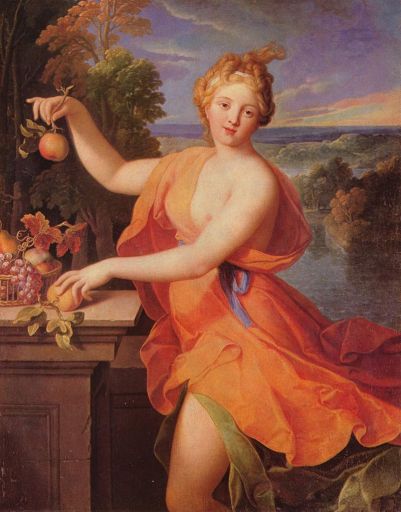
However it suggests to me an encounter with Mêla the Golden Apples among the Toys of Dionysos.
And since the findsight of the inscription was in the territory of Rhaetia, my mind drifts to things Germanic and especially Iðunn, and because of the bronze fish Loki. But I could just be reaching.
 The House of Vines