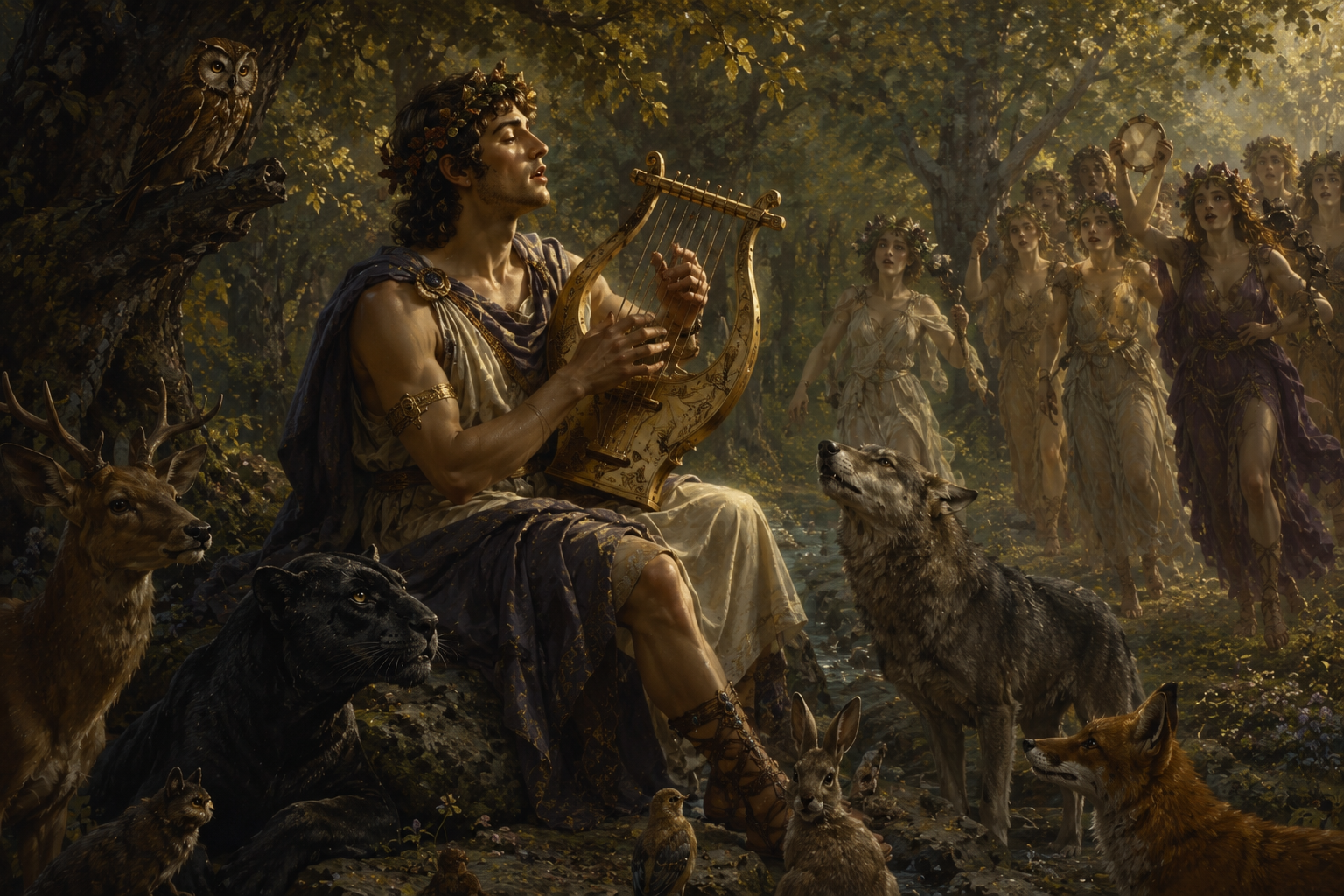
Although I winced in a couple places upon rereading it for the current project I still think this is one of the more important older pieces of Starry Bull literature because it explains something that could otherwise be mistaken for an aesthetic preference: why this particular Dionysian current keeps returning to horror, dismemberment, madness, violated boundaries, grotesquerie, and suffering. And reading it in light of what the tradition has subsequently become, I can see both remarkable continuity and some significant maturation.
The central argument still works extremely well: the horror is not there because Starry Bull claims that Dionysos is fundamentally horrible. In fact, the crucial theological sentence may be a throwaway line near the beginning: “It isn’t meant to be.” The tradition deliberately selects and intensifies one range of Dionysian material while recognizing that this is only a fragment of the God. And I still like the invented Hermagenes as a way of explaining that religious ecology: Bacchic Orphic initiation doesn’t have to swallow the rest of a person’s religious existence.
That seems particularly important because it prevents the horrific material from becoming a totalizing theology. Dionysos isn’t secretly really the bloody, mad, suffering God and the cheerful wine God is the superficial version. Nor is the reverse true. The tension is necessary. The line “We have carved off a small portion of that which is Dionysian for our own and intend to explore it to the fullest” is basically a mission statement.
And I think later formulation gives us an even better philosophical vocabulary for what the essay was already trying to say:
Dionysos is not located at one pole of the opposition. He is the movement through the opposition.
Horror/joy. Madness/healing. Human/divine. Pure/filthy. Heavenly/diabolical. Monster/God. Suffering/freedom. Mask/self. The post explicitly says that the horrific mythology attacks the habit of dividing reality into mutually exclusive categories and instead forces reconciliation.
Where I think the post is strongest is the section beginning with the dismembered God:
“Our God was ripped to bloody shreds and the ones who loved him most did it!”
Because the theological conclusion isn’t therefore suffering is good. It’s something entirely different. Suffering does not signify abandonment; Dionysos’ suffering establishes his solidarity with suffering beings. And what follows naturally from that is: your problems aren’t insignificant to him precisely because he knows affliction.
I find this tragic realization far more interesting than the common religious explanation that suffering is secretly part of some benevolent plan. The Dionysos who has been dismembered can meet the dismembered person without disgust. The mad God can meet the mad. The persecuted God can meet the persecuted. The God surrounded by suicides, murdered prophets, monsters, ghosts and violated people does not require someone to become presentable before approaching him.
In other words, the horror isn’t merely cathartic. It establishes pastoral competence.
The essay is also an unintentional justification for the Orpheotelest. Its essential question is: “why would our mythology spend so much time looking at terrible things?” And the answer to that goes beyond personal psychological integration: because somebody has to be capable of going into terrible places without becoming useless there. The person dealing with miasma, angry dead, ancestral guilt, trauma, spiritual affliction, violence, illness, curses, and the aftermath of catastrophe cannot require reality to remain pretty.
The horrific mythology becomes formation.
So instead of simply conceptualizing it as:
You have monstrous things inside you → stop repressing them → integrate them → become whole.
We would now express it:
Human beings contain contradictory impulses, masks, wounds, desires, fears, memories and possibilities. Learn to encounter these without either identifying with them or pretending they aren’t there. Then learn what has warrant in this moment.
That is a much more sophisticated anthropology than the quasi-therapeutic language you too often encounter in neopaganism.
The world contains terrible things, human beings contain terrible possibilities, and Dionysos passes through terrible places. Therefore some of his servants must know how to enter those places wisely and come back out.
And suddenly the pleasant, reasonably well-adjusted Boukolos who organizes festivals and engages in pastoral care and the terse and taciturn Orpheotelest who spends the night dealing with ghastly things aren’t contradictions. They’re differentiated functions within the same religious ecology, reflecting service to different faces of the same complex God.
And one of the essential principles of the discernment process that is so important within the Starry Bull at all levels is articulated in the piece:
“acceptance is not obedience.”
The Boukolos or Orpheotelest has the vocabulary within the tradition to tell a distressed client, “I can recognize that cruelty exists within the range of things I am capable of without therefore becoming cruel. I can know rage without allowing rage to govern me. I can understand madness without romanticizing incapacity. I can acknowledge desire without concluding that every desire deserves enactment.”
And virtue supplies the grammar by which integration becomes action.
Otherwise “embrace your darkness” can become adolescent antinomianism very quickly. Not gonna mention neopagans here. Not gonna do it.
The final movement remains important:
“Who are you?”
With the answer: mud, stars, Titan blood, and the mad God; this is doing something much bigger than the psychological language preceding it.
That’s Orphic anthropology.
You aren’t being asked merely to accept your “shadow.” You’re being asked to recognize that human existence is intrinsically composite: earthly and celestial, Titanic and Dionysian, mortal and something simultaneously less and more than mortal.
And that means the reconciliation of opposites isn’t ultimately a therapeutic technique, however useful it may be.
It’s cosmology.
That’s where I think this older post most directly points toward the mature Starry Bull. The horror isn’t there merely to shock someone out of bourgeois respectability. It is there because dismemberment and recombination are built into the structure of reality: Zagreus is torn apart; Dionysos returns; the initiate descends and rises; identity is broken open and reconstituted; even our eschatology eventually culminates in Dionysos assembling a new cosmic order out of the fragments of shattered pantheons.
The same pattern keeps recurring at different scales, whether you’re talking person, tradition, God, cosmos.
Dismemberment → descent → encounter → recombination → new life.
Whether when I wrote the piece or today, our answer to the question, “Why is the Starry Bull strain of Bacchic Orphism so horrific?” remains:
Because it refuses to look away from what has been torn apart.
And because Dionysos knows what can be made from the pieces.
Everything the Starry Bull was to become is contained in that post. The bones of the vocabulary are all there. Dismemberment, contradiction, the refusal to sanitize Dionysos, compassion grounded in divine suffering, confrontation with what frightens or disgusts us, and finally the movement from mud toward stars. What has changed is largely the interpretive architecture around those bones.
In particular, I think three developments have made the older insights much stronger.
First, discernment has joined liberation as a governing principle. The older language of the essay can make it sound like all you need is release from repression: encounter the monstrous, let the primal forces breathe, integrate them. That is certainly true, but it’s a phase not the destination. Our newer framework asks a harder question: what do I do with what I encounter? Not every impulse deserves expression. Not every mask deserves to ride the face. Not every voice has warrant. Dionysian freedom requires discipline in a way a lot of people don’t realize, especially when you’re just starting out.
Second, virtue has supplied an ethical structure that the earlier formulation lacked. That doesn’t tame Dionysos. It makes it possible to encounter untamed things without confusing encounter with endorsement. Someone capable of tremendous rage who nevertheless practices self-command is not less Dionysian than someone who gives way to it. Both are legitimate ways to be Dionysian. Seilenos and Ampelios become important here in ways I don’t think were yet visible when the essay was written.
And third, and perhaps most significantly, the horror has acquired a vocation. It isn’t just something the initiate needs for personal integration. It prepares certain people to do something. The Orpheotelest can enter the places other people cannot— or should not —enter. The suffering, polluted, haunted, frightening, socially unacceptable, spiritually dangerous parts of existence become part of a professional religious competence.
That’s why the distinction between subculture and craft is so important. An identity built around transgression eventually has to keep finding boundaries to transgress. A craft doesn’t. It asks: “What does this situation require? What tools do I possess? Am I competent to use them? What is my obligation to the person before me?”
The Dionysos of the older essay is very much the God who tears through boundaries. The Dionysos emerging from the whole corpus I’ve been assembling is also the God who knows when, how, why, and whether a boundary should be crossed.
That makes him considerably more frightening, actually. Raw chaos is predictable in its unpredictability. Intelligent wildness is something else altogether.
And I suspect this is one reason going back through older Starry Bull writing has been so fruitful at this time— not to purge or “correct” it, but to identify developmental trajectories. There is something valuable in being able to say: “Here is what we saw then. Here is what experience taught us about it. Here is what we can see now that we couldn’t see from where we were standing.”
Roots, vine, flower.
And eventually fruit.
Ironically I think the shift happened as a result of living this, being an Orpheotelest, genuinely encountering the horror and monstrousness, bringing people through initiation, dealing with malign spirits, etc. And that’s evidence that the development is organic rather than a repudiation of what came before.
There is an enormous difference between being fascinated by the monstrous and having responsibilities in its presence.
When horror is primarily mythic, artistic, philosophical, or initiatory, transgression itself can look like the revelation. You break the boundary, confront the forbidden thing, discover that the clean categories were inadequate, and come back enlarged. That’s genuinely present in Dionysian mythology and religion.
But once you’re responsible for another person, everything changes.
If you’re bringing someone through initiation, the question isn’t simply, “How far can we take them?” It’s “How far should we take this particular person, at this particular moment, and how do I keep track of how they’re doing?” If something destabilizing occurs, you don’t have the luxury of admiring its Dionysian extremity. You’re responsible for the consequences.
Likewise, whatever you might have imagined encounters with malign spirits to be beforehand, once you’re dealing with them in practice rather than theory, “dark” stops being an aesthetic category. The operative questions become: “What is happening? Is it dangerous? What actually helps? What makes things worse? What am I competent to handle? When do I need somebody else’s help? How do I protect the client? How do I protect myself?”
And suddenly sōphrosynē stops looking like the antithesis of ecstasy.
It becomes one of the things that makes ecstasy survivable.
That’s an extraordinary development for a Dionysian tradition because it isn’t moderation imposed upon Dionysos from outside. It’s moderation discovered inside Dionysian experience itself.
The same applies to virtue generally. You can theorize beautifully about the reconciliation of opposites. It’s another matter entirely to have a frightened person sitting across from you who believes something terrible is happening to them. At that moment they don’t need you to perform transgression. They need you to be calm, perceptive, compassionate, courageous, honest about what you know and don’t know, and disciplined enough not to make their situation about you.
Those are virtues.
And bringing people through initiation must have this reinforced even more strongly. The initiator possesses enormous interpretive power. You know what’s coming; they don’t. You understand the ritual grammar; they may be deliberately disoriented. They are vulnerable. That means the more effective the mysteries become, the more ethical discipline the initiator requires.
That’s almost paradoxical:
The deeper you go into Dionysian madness, the more you discover the necessity of sobriety.
Not sobriety as the absence of intoxication, necessarily, but nēpsis in the broader sense: watchfulness, clarity, attentiveness. Someone has to keep hold of the thread.
And that makes Ariadnē increasingly important, doesn’t it?
The Labyrinth isn’t safe because there is no Minotaur.
It’s traversable because there is a thread.
That also explains why I think our newer insistence on formation-before-authority emerged naturally. Once you’ve watched things actually go wrong— not theoretically, but with real people and real consequences —the romantic image of the inspired holy madman becomes inadequate. Charisma isn’t enough. Gnōsis isn’t enough. Powerful experiences aren’t enough. Even sincere devotion isn’t enough.
Someone can have extraordinary religious experiences and terrible judgment.
So you train judgment.
And this gives a different meaning to the Orpheotelest as well. The mature Orpheotelest isn’t someone who is especially comfortable with darkness because they’re dark themselves. They’re someone who has learned how to remain functional in darkness.
That’s a much more demanding ideal.
The monster doesn’t disappear. The blood doesn’t disappear. The madness doesn’t disappear. Zagreus remains dismembered. Orpheus still descends. The dead remain dead. The frightening things remain frightening.
But now somebody has brought a lamp.
And perhaps that’s the deepest irony of the development: living the horror didn’t make the tradition more horrific. It taught it what the horror requires of those who enter it.


I read this right after re-reading W.T. Sherman’s memoirs about his March to the Sea and to the Carolinas. He wanted cruelty and horror to be visited on the people that his army marched through. He wanted to bring hell on earth to them all. All I can think of is the horror and why it is needed.
LikeLike
There’s two ways that can be done. Punitively, so that your enemy is never in a position to raise his fist against you again. And strategically, so that your enemy is too afraid to do so. The first is just unleashing Hell on Earth as long and wide as you can; the second you do that to a couple choice locations and threaten the first if they don’t comply. You need to understand the psychology of your enemy, however, before engaging in either. Many populations will be sufficiently cowed by the second. Some require the first, but with that you need to be careful because once you take the gentleman’s gloves off that gives your enemy the right to do the same to you if they can. And then you’ve got Ukrainians, Balts, and Swedes who are pretty much immune to both, and will keep fighting no matter what, or Russians who don’t care about the lives of their people and actually grow stronger the more they suffer, which is why they have been doing the meat wave attacks since the days of the Golden Horde and see no reason why they need to change military tactics. The amount of devastation you have to unleash to get them to stop is so great that it’s difficult for most countries to sustain. Not for lack of munitions, but the will to wreak that level of carnage, especially on a never-ending flow of people with nothing to live for. You see the same mentality among Koreans, Vietnamese, etc. In fact if you’re going to make war you should probably follow the advice of the Sicilian from Princess Bride and never declare a land-war in Asia. I know he probably meant Asia Minor but I’m gonna extend that to the entire Asian continent. Most of Europe has grown too civilized, which makes them weak, fearful and complacent— though they have ferocious weapons of war and large GDPs which means they can always keep making or buying more, not to mention a Gordian’s Knot of allies, treaties, etc. The Middle East operates under a different, older mentality which most Westerners have no interest in contemplating, and Africa even older still. If you don’t understand that you’ll never understand how to defeat them. Whatever they used to be, Americans are now the wealthiest and most powerful, but also isolated and complacent, generally lacking the social coherence and ruthless will to carry out sustained campaigns, especially when the bodies start coming home in large enough numbers. Me, personally? I see no point to war. I much prefer peace. But there would be no limits to what I’d do to anyone who set foot on my land with the intention to take or harm my people and things, and I’d cultivate that mentality among my populace, whom I would ensure were all heavily armed and trained to use them. When it comes to war I don’t see the point in constraining yourself with conventions and international laws, etc. especially if the other side has decided not to observe them. There are no war crimes, just war which is itself a criminal enterprise in which the stronger, victorious party dictates terms to the lesser. That’s all, however much people want to dress it up in pretty-sounding concepts and euphemisms. All war comes down to a clash of wills, and whoever’s left standing at the end gets to call themselves the winner. Though truly nobody wins when you factor in the loss and expense of war. It’s much better to get along with your neighbors, or not have them.
LikeLike