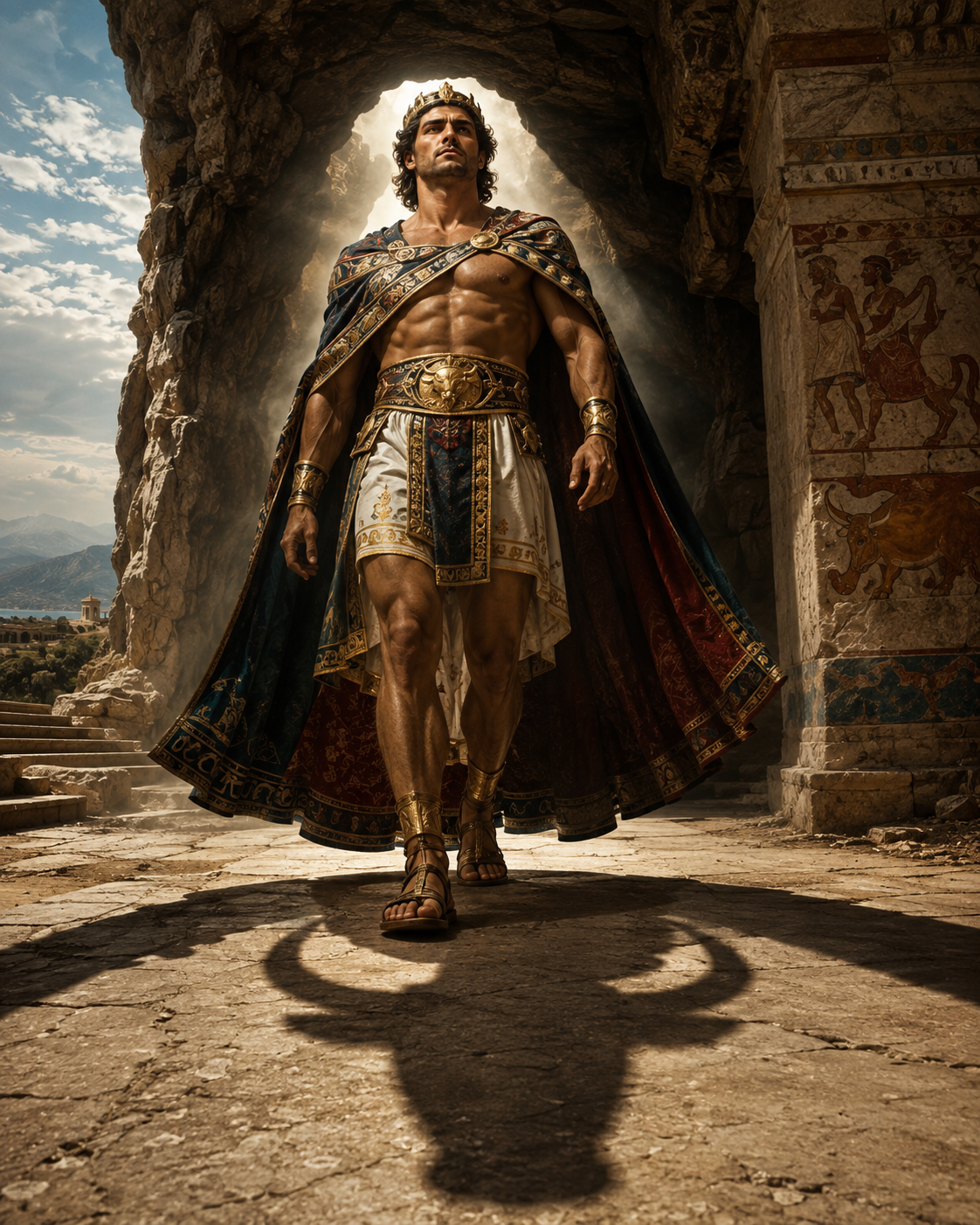
What is particularly striking about the myth of the Labyrinth is that the catastrophe doesn’t begin with the monster. It begins with the righteous man.
Minos starts off as a wise and gentle king, ascetic, legislative, mantic, concerned with purity, and opposed to bloodshed. Then Poseidon sends the bull to be sacrificed, and Minos refuses. Based on the works of Robert and Demand in our reconstruction he doesn’t merely substitute another animal because he’s greedy or wants the beautiful bull for himself; he substitutes a bloodless sacrifice.
That’s enormously more interesting.
Because Minos’ fatal flaw isn’t initially cruelty.
It’s purity.
He is so committed to his conception of what righteous worship ought to be that he cannot give the God what the God has actually demanded.
And then everything becomes blood.
Poseidon’s retaliation, the deaths of Glaukos and Androgeos, Pasiphaë and the bull, the birth of Asterios, the Labyrinth, the Athenian tribute, Theseus’ killing, the destruction of Knossos, Ikaros’ fall, Minos’ pursuit of Daidalos, and finally Minos himself being boiled alive.
The man who would not shed the blood of one bull creates a world soaked in blood.
That’s tragedy.
And it makes this much more than a Minotaur story. Asterios is one consequence of Minos’ hamartia. He’s born into a catastrophe already in progress.
In fact, our telling makes the Labyrinth itself almost an externalization of Minos. He creates it to hide the intolerable contradiction his household has produced: the purity-obsessed king now has a monstrous bull-child in his family. So he doesn’t reconcile the contradiction.
He walls it off.
And what is repressed inside becomes worse.
Asterios goes mad in isolation. Minos simultaneously goes mad outside the Labyrinth, becoming “a mad and savage bull” himself.
That’s very fitting mythically: Minos imprisons the bull and becomes the bull.
Which brings us straight back to Kurtz.
Kurtz also begins as an exemplary product of the system he eventually rejects: intelligent, disciplined, accomplished, entrusted with authority. His catastrophe comes when experience presents him with something his inherited moral categories cannot assimilate. But whereas Minos tries to preserve those categories by imprisoning the contradiction, Kurtz ultimately destroys the categories and moves into the contradiction.
So they’re opposite trajectories toward a remarkably similar destination.
Minos builds the Labyrinth to keep the monster in.
Kurtz enters the jungle and refuses to come out.
Both end up living inside worlds created by the failure of their previous moral order.
And both leave somebody else to deal with the consequences.
Which makes Theseus more complicated too.
In the Red Thread Theseus is hardly the uncomplicated civilization-slaying-chaos hero. He arrives claiming to end the cycle of violence, but brings another eruption of violence with him; Ariadnē facilitates it, Asterios dies, Knossos burns, and then Theseus abandons the woman whose betrayal of her family made his victory possible.
So even escaping the Labyrinth doesn’t make Theseus morally whole.
Willard gets out.
But merely getting out isn’t sufficient.
The question becomes what you carry out with you.
And here I think Apocalypse Now wisely refuses to answer. Willard kills Kurtz and leaves, but we don’t get the reassuring final act where he returns home, hugs his family, and demonstrates successful reintegration. He disappears downriver carrying what he has seen.
We don’t know whether he possesses the thread in the deeper sense.
Ariadnē in many respects is the key figure. Ariadnē traverses the categories differently from everyone else.
Minos cannot tolerate the monster, so he conceals it.
Theseus kills the monster.
Asterios cannot leave the monstrous condition into which he has been born.
But Ariadnē moves between the Labyrinth and the upper world. She’s Asterios’ contact with it; she enters his darkness, holds him, soothes him, and tells him stories of outside. Then she guides Theseus through that same darkness with the thread to end her brother’s monstrous life.
And eventually she has to undergo destruction and transformation too.
That makes her an extraordinary image of mediation, because she’s neither simply outside nor inside.
Which sounds awfully familiar:
“Dionysos is not located at one pole of the opposition. He is the movement through the opposition.”
Ariadnē moves.
And Dionysos comes for her.
There’s another beautiful detail. Ariadnē’s thread gets Theseus out of the Labyrinth. But Theseus cannot get Ariadnē out of hers. He abandons her on Naxos, where she dreams that she’s Persephonē, Melinoē, Arachnē, Erigonē, Eurydikē, Columbina— and even that she never left the Labyrinth at all, her identity collapsing into fragmented stories.
Then Dionysos arrives.
Not to restore her to the person she was before Crete.
That’s impossible.
He offers transformation.
Perhaps “coming back from the Labyrinth” is slightly misleading, because nobody who genuinely reaches its center comes back unchanged.
The goal isn’t restoration.
It’s integration.
You don’t return to the person who entered. You establish some viable relationship between what you discovered below and the world above.
Kurtz cannot.
Minos cannot.
Who knows about Willard?
Asterios is never given the opportunity.
Theseus perhaps doesn’t understand what he’s encountered.
Ariadnē does.
And then Dionysos takes her into the stars.
Which suddenly makes the Starry Bull initiation formula resonate rather loudly:
I am a child of Earth and Heaven.
My name is Starry.
 The House of Vines
Am I wrong is seeing similarities between Astarios and Pentheos?
LikeLike
What similarities do you see between them?
LikeLike
Well, like Astarios, Pentheos is born into catastrophe already in progress, basically, his mom disrespecting her sister, Semele’s death.
Pentheos is a monster as a tyrant especially against Dionysus’s followers.
While Astarios is physically repressed by the Labyrinth, Pentheos is repressed by trying to be something he’s not. He’s basically a manchild cosplaying as a king.
And in the end, they die at someone else’s hand as a consequence of their parents hubris.
LikeLike
Beautifully said.
And of course the other thing they share is their monstrousness, literally. Pentheus’ father is Echion, “the Viper,” one of the Sown Men.
I described him this way:
“The man was born of serpent’s teeth and bloodshed, quick to rage and always ready with venomous remarks.”
https://thehouseofvines.com/2019/10/13/the-part-they-dont-often-tell/
Pentheus also spends his time hunting in the wooded culverts of Mount Kithauron, where he will eventually be hunted by the Theban Bacchants led by his mother. At the beginning of Euripides’ play he is forced to return from the wild to deal with the crisis in his city. Considering his youthful, effeminate traits it almost comes across as compensation, or a desire for solitude where he doesn’t have to wear the mask. One can imagine how miserably he was treated by such a father and how it stung every time Dionysos calls him Echeis “the Viper’s brood.” However, there’s also a pun in there. Έχεις πένθος means “you are in mourning.”
Interestingly, in Oppian’s account (which differs from both Euripides and Ovid) the distance between Pentheus and Asterios is collapsed. The Bacchants beg the God to transform them into leopards; Dionysos not only agrees but simultaneously transforms Pentheus into a bull, which the wild cats chase down and tear to pieces.
And not only is Pentheus born into catastrophe already in progress, but he passes that ancestral trauma on. Pentheus has a son Menoikeus (“strength of the house”) who begot Kreon, Iokastē and Hipponomē and was both grandfather and father-in-law of Oedipus. Quite the tangled family tree that is.
LikeLike