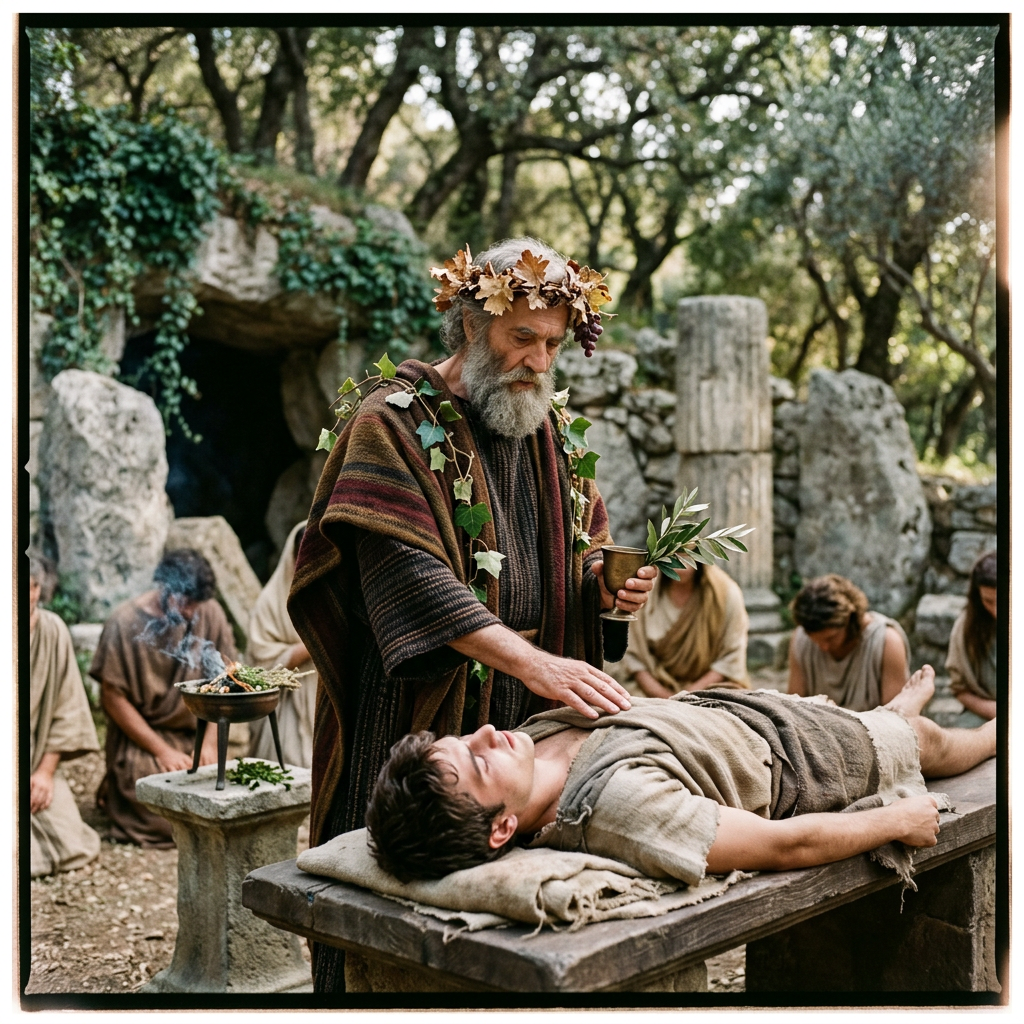
I was considering potential mottoes for the Boukoloi and Orpheotelestai since I didn’t want to show favoritism to the Hymnōdai when I got a wonderful klēdōn from Tove who read me a (beautiful and inspired) passage from the vampire/fairy smut novel she’s writing:
All else is the road, and I’m not afraid to travel it because I know who made it.
I shouted, “εὕρηκα!” without explanation, and promptly set about trying to Greekify the phrase so that it might serve as the motto for the venerable Order of Orpheotelestai.
I came up with three options.
This was the most natural and epigrammatic:
τὰ δ᾽ ἄλλα πάντα ὁδός· οὐ φοβοῦμαι βαδίζειν, οἶδα γὰρ τὸν ποιήσαντα αὐτήν.
Ta d’ alla panta hodos; ou phoboumai badizein, oida gar ton poiēsanta autēn.
“All else is the road; I do not fear to walk it, for I know the one who made it.”
The second option was more Orphic:
τὰ δ᾽ ἄλλα πάντα ὁδός· θαρρῶ γὰρ εἰδὼς τὸν κτίσαντα αὐτήν.
Ta d’ alla panta hodos; tharrō gar eidōs ton ktisanta autēn.
“All else is the road; I take courage, knowing the one who established it.”
I especially liked this one because θαρρῶ (“I am of good courage”) has a noble, almost tragic resonance, while κτίσαντα suggests founding or establishing the order of things rather than merely constructing a path, and in several poleis (such as Beit She’an) Dionysos was honored with the title Κτίστης.
And then there was this more poetic version, which was actually my personal favorite:
τὰ δ᾽ ἄλλα πάντα ὁδός· οὐ δέδοικα πορεύεσθαι· γινώσκω γὰρ τὸν τὴν ὁδὸν θέντα.
Ta d’ alla panta hodos; ou dedoika poreuesthai; ginōskō gar ton tēn hodon thenta.
“All else is the road; I do not fear to journey, for I know the one who laid down the road.”
I especially like τὸν τὴν ὁδὸν θέντα (“the one who laid down the road”). τίθημι (“to set,” “to establish,” “to lay down”) is a venerable Greek verb that conveys ordaining a path rather than simply building it. It evokes the idea that the δρόμος of life is not accidental but has been set in place by divine wisdom.
I decided on Option 2 for two reasons. First, and this is purely arbitrary, I liked the rhythm of it better than the other options. “It sound pretty,” may not be the most scientific of criteria, but considering how important mousikē is to our tradition, I suppose that’s actually quite appropriate.
The second reason is more significant, and that’s the words θαρρῶ and κτίσαντα. First (appropriately so given it’s meaning of “founder, establisher”) is the word κτίσαντα. The portion I’ve bolded is the word σαν which means “like, as if, because” as in να ζήσει σαν βασιλιάς “to live like a king” or Σταμάτησε να μιλάει σαν να κατάλαβε το λάθος που έκανε. “He stopped talking when he realized the mistake he had made.” Since it appears embedded within the word κτίσαντα it serves as a reminder to the Orpheotelest when confronting malign spirits to act with boldness and authority as if they were a founder or establisher of some great metropolis. (And totally not because Σαν is the short form of Σαννιον. Totally. Who would be so egotistical as to do that? Certainly not I! I’m the most humble motherfucker who ever lived. I’m kidding. It’s the above reason. I’m just tossing nuggets to the trolls. They’re starting to look a little Sinonical.)
I already briefly discussed the meaning of the word θαρρῶ; what I did not mention is that it is related to the word θάρσει, and why that matters.
Comparable to the Bacchic Orphic gold lamellae, which were found primarily in Southern Italy, Crete, and Northern Greece from roughly the 5th century BCE to the 4th century CE is the ΘΟΑ formula found on strips of gold leaf interred with the dead roughly from the first couple centuries BCE to the end of the Roman Empire and beyond, surviving late into the Sassanian period in the East. As Noga Erez-Yodfat writes in Inscribed Gold Lamella from the Hecht Museum:
The formula θάρσει οὐδείς ἀθάνατος, frequently abbreviated to ΘΟΑ, is very common in epitaphs from the Imperial period. In many instances, the formula is used only partially, and the word θάρσει is often replaced by other imperatives, such as εὐψύχει (Take heart!), εὐϕραίνει (Be happy!), εὐθύμει (Be of good cheer!), εὐμοίρει (Have a good share!), μὴ λυποῦ (Do not grieve!), etc. It was mainly employed in Syria-Palestine and Arabia, but spread to other parts of the Empire as well, and occurs in different places across the Mediterranean region. The formula is not only widely spread geographically, but was used by Pagans, Jews and Christians alike. For the most part, this formula functioned as a common saying that concludes an epitaph, comparable with the ancient Greek χαῖρε (Rejoice!) and the Latin vale (Farewell!), or the later Christian R(eqiescat) l(n) P(ace) (Rest in peace!) and the Jewish ה.ב.צ.נ.ת (May his/her soul be bound in the bond of living). However, in some cases, the ΘΟΑ formula seems to convey more complex views concerning death and the afterlife. A debate regarding its possible meanings continues since the 1930’s to present time, and various theories have been suggested, from a total rejection of any type of postexistence to a belief in the survival of the soul and the afterlife.
Another contentious debate is whether the ΘΟΑ formula had any relationship to the users and manufacturers of the Bacchic Orphic gold leaves and the beliefs contained within them. Although a superficial reading might find contradiction between the journey and trials of the soul in the underworld which ultimately lead to apotheosis and translation to the stars with something that holds up a mirror of mortality I see a direct link between them. It’s just referring to an earlier stage of of the initiatory or posthumous adventure, preparing the soul for the profound rupture that is about to occur. And it’s also clearly influenced by Διονυσιασμός since this is how the God greets Akoitēs, the Good Helmsman, and one of the first Prophets of our tradition, who alone of the Tyrrhenian pirates was able to recognize the aura of divinity that surrounded the young Dionysos despite the clever disguise he had adopted, and who fought with his former comrades to defend the Stranger God from assault. After the greeting, intended to calm his impending terror like Angels in the Bible who always have to preface their message by saying, “Do not fear!”, Dionysos drops the mask and provides a full revelation of his divinity. The language makes the connection even more explicit in the Greek:
But on the helmsman Dionysos had mercy and held him back
and made him altogether happy, saying to him, ‘Take courage, good…
you have found favour with my heart. I am loud-crying Dionysos
whom Kadmos’ daughter Semele bare of union with Zeus.’
Rejoice, child of fair-faced Semele! He who forgets you
can in no wise order sweet song.
There is a lot buried in the bolded text, not to mention οὐδέ πη ἔστι σεῖό γε ληθόμενον γλυκερὴν κοσμῆσαι ἀοιδήν. “He who forgets you can in no wise order sweet song.” Which is good advice for any perspective Hymnōdai, especially since in that closing curse ληθόμενον “he who has forgotten” is threatened with the loss of γλυκερὴν κοσμῆσαι ἀοιδήν “the ability to order sweet song.” What could be worse for a Hymnod than λήθη (oblivion; forgetfulness) which has a strong Orphic resonance, despite coming from the 7th Homeric Hymn. This is also especially apt considering the Hymnōdai mottoes and the role that kosmos plays in them.
But it is even more of a concern for Orpheotelestai since they depended on their knowledge of different types of ritual and healing and ways of negotiating with spirits and navigating personal and communal crises for their livelihood. Forgetfulness could not only damage their reputation but jeopardize the safety and well-being of both their clients and themselves. (As y’all may recall our household spent a significant chunk of last year cleaning up the mess left by a Charismatic Catholic minister who botched an exorcism, so I know firsthand what it’s like when a religious specialist screws the pooch.)
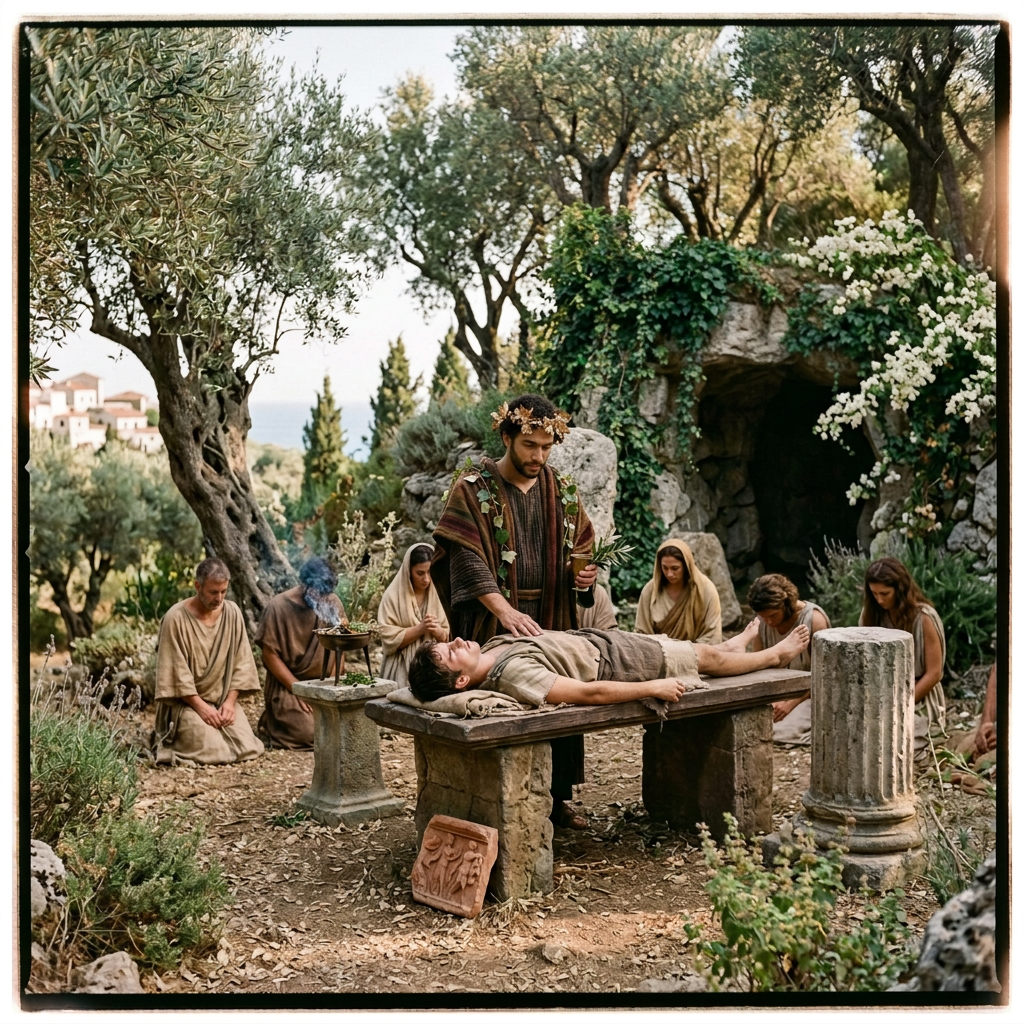
I don’t know if the gold lamellae with the ΘΟΑ formula are the product of Orpheotelestai who adapted their techniques to suit the religious and cultural beliefs of primarily Judaean, Syrian and Arabian clientele; if these were manufactured by local religious specialists who “borrowed” the tech from Orpheotelestai they encountered in the kinds of places priests, magicians, folk-healers, exorcists and the like congregated during off hours; if it was a case of literary or philosophical bricolage from Homer without necessarily having religious or magical significance; or if we’re looking at something like Simultaneous Invention, the Zeitgeist Effect, Cryptomnesia, or Morphic Resonance. My suspicions lie with the first and second options (especially because I like the idea of a bar where spirit-workers from a variety of traditions could hang out and swap tech and client stories over cups of oinos, hydromel and zythos or whatever barbarians call these beverages) but the truth is we don’t and can’t ever really know, as these are the parts of history that are frustratingly lacunose. Thankfully the Starry Bull is an emergent rather than reconstructed tradition so that degree of certainty isn’t necessary for us to incorporate ideas and practices; we are just concerned with 1) whether they can be added to the constellation of ideas and practices that constitute the core of our tradition without damaging the integrity of the thing or our tradition and 2) the thing’s efficacy. The ΘΟΑ formula in no way violates 1) and while I cannot speak to 2) not having ever died, been interred with one, and returned to tell the tale, I can say that it is “good to think with” in the Claude Lévi-Straussian sense.
Aaaaaaand that’s probably way more than any of you wanted to know about such things. The take away is that the Orpheotelestai now have their own motto, which is:
τὰ δ᾽ ἄλλα πάντα ὁδός· θαρρῶ γὰρ εἰδὼς τὸν κτίσαντα αὐτήν.
Ta d’ alla panta hodos; tharrō gar eidōs ton ktisanta autēn.
“All else is the road; I take courage, knowing the one who established it.”

