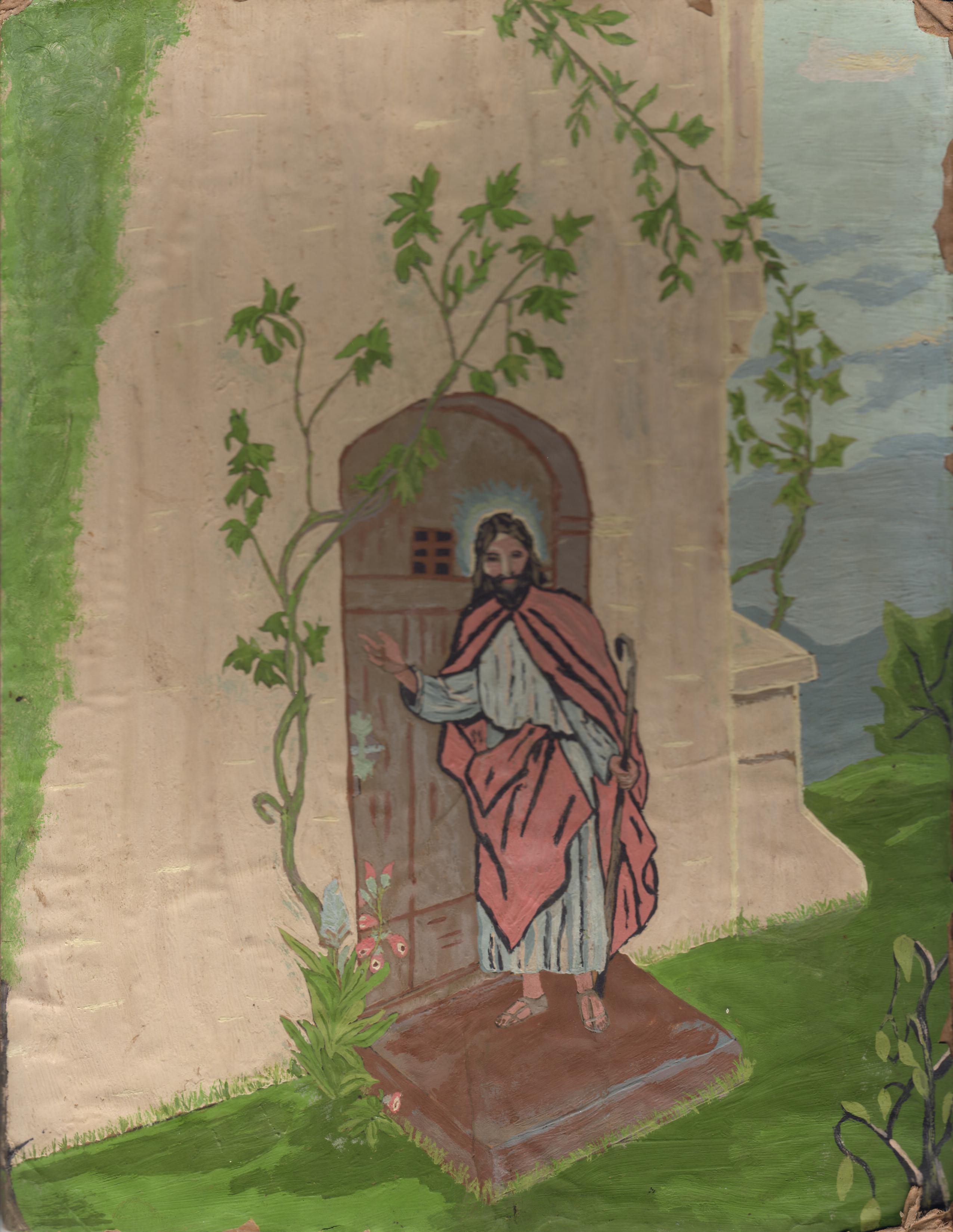
I was having a conversation with a friend, and made the passing remark that I considered Jesus to be a colleague, which they said was hubristic (although they are a polytheist of Jewish extraction, and not even a Christian.) I certainly didn’t mean it that way.
I consider Jesus, in addition to being a religious teacher with Essene and Pharisee sympathies, to have been an itinerant spirit-worker and magician who specialized in exorcism and healing, and was able to carry his God and lived out the “Neos Dionysos” archetype to a T. In other words he was basically a Jewish Orpheotelest, one of many who were active in 1st century Judaea. (In addition to the plethora of magical texts and paraphernalia that have come to light, a bunch of people were buried with gold lamellae similar to the Bacchic Orphic ones found in graves in Northern Greece, Crete, and Southern Italy. In fact, the Judaean examples most closely resemble the Cretan, especially since both employed epistomia.) The Talmud even says that Jesus studied magic in Egypt, and had charaktēres cut/tattooed on his forearms by which he was able to perform miraculous feats. I wonder if that preserves an authentic tradition that circulated about Jesus, or if the Rabbis had in mind Ptolemy’s pathway to citizenship offer which necessitated undergoing initiation into the Dionysian mysteries and receiving the ivy-leaf tattoo of the Bakchoi which many of the Hellenized Jews accepted, pissing off the Hasmonean (and pro-Seleukid) camp. Incidentally, I have six tattoos on my forearms, potent symbols representing mysteries of the Starry Bull tradition. I won’t say whether they have magical functions as well.
When I drew a comparison I wasn’t thinking about his posthumous apotheosis. Which isn’t problematic for me, since at least half of the divinities I venerate either started off as human, or had human incarnations (Dionysos included) though I’ll leave it to the Christians to work out the specifics of Jesus’ Godhead. I didn’t factor it in because I am not currently or have any intention of becoming any sort of God (unless merging with Dionysos is on the table, which it could be if you interpret Bacchic eschatology a certain way.)
So I’m not really sure where the charge of hubris came from. I don’t believe that I’m obligated to adopt the Christian view of Jesus (especially since there have always been a plurality of Christianities with competing conceptions) so I don’t see anything wrong with interpreting his mission through a Bacchic Orphic lens i.e. as a wonder-working itinerant religious specialist like Melampos, Empedokles, Apollonios or of course Orpheus himself. For me that is a respectable category to be placed in.
 The House of Vines
Hubristic? How can it be hubris to call Jesus a colleague when He literally called His worshippers His family in Matthew 12:46-50?
LikeLike
Not to mention John 15:15
LikeLike
Abundance of caution, perhaps? Although both miss the mark Jesus would have wanted, it’s probably better to be too respectful than not respectful enough. I’m also not sure if they were using hubris correctly,because I didn’t get the chance to properly interrogate their language, but it’s something I’ve been thinking about since the conversation, hence the post. It’s good to think about these things, regardless.
LikeLike
I mean, sure, it’s better to err on the side of caution. But in the case of Jesus I think it’s pretty harmless what you said. Because as you already pointed out, He WAS the same category of person you are as far as religious role is concerned. Yes, Jesus is a deity but He is a very specific type of deity (as far as our faith is concerned) and that type of lends itself to a bit of familiarity. Especially if you are doing the same kind of work They did. Would your friend have cried hubris if you had said the same about Empedocles or Apollonios? They were worshipped as Gods too.
LikeLike
You’re not wrong. Though the name of Jesus has a certain valence in our society, even among non-Christians.
LikeLike
Because they haven’t Paganized their minds. Which is a perennial problem in this community. People don’t think like our ancestors and it’s the source of the vast majority of our problems
LikeLike