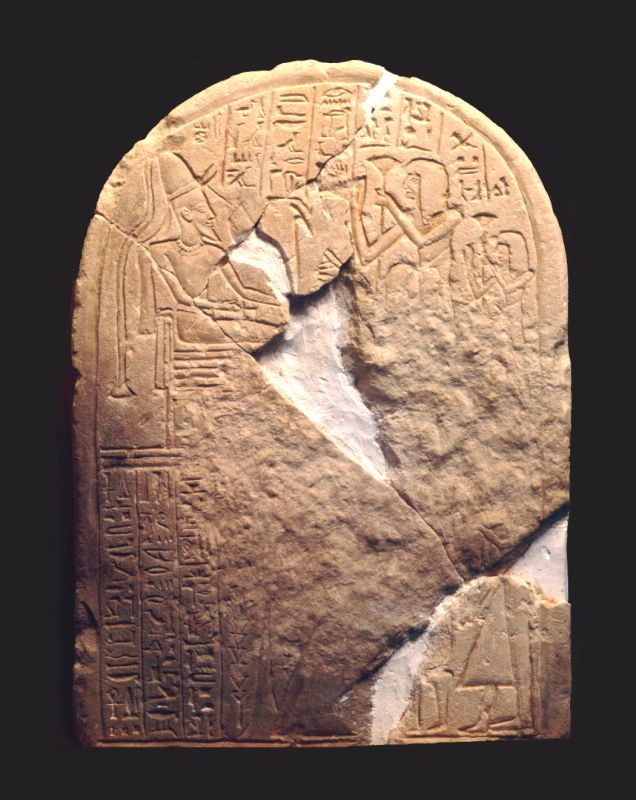
The Mekal stele (PM VII, 377, Fig. 1) is a New Kingdom Egyptian funerary stele found in 1928 in Beit She’an, during excavations directed by Alan Rowe of the University of Pennsylvania. The Israel Museum, where it is currently on display, describes it as a Late Bronze Age (13th century BCE) standing stone representing the Canaanite God Mekal who wields Egyptian symbols of life and death, reflecting the duality of the domain he governs.
The hieroglyphs read:
Above the God
Mekal, the Great God, Lord of Beth-Shean.
Lower Register
Royal offering for Mekal, the Great God, that he might grant you life, power, health, sharp vision, honor, love, a discerning mouth, freedom of movement, until you have reached the state of venerable in peace. For the ka of the honored of his God, the architect Amenemopet, justified, by his son Paraemheb.
The Scene
In the upper register, the God is shown seated on a throne, holding a was sceptre and a flower in his left hand, and an ankh cross in his right. He is faced by two adoring figures, depicted with typical Egyptian dress and headdress. They are both standing with their right hand facing the God in adoration, holding a lotus flower in their left hands. The larger figure is identified by the inscription above him as the deceased, Amenemopet, and the smaller figure behind him as his son, Paraemheb, dedicator of the stele. Traces of two floral features can be seen between the God and the deceased. These floral features probably emerged from an offering stand (now lost) situated in the space between the God and the deceased.
The God. Mekal. The stele’s scene could be seen as a typical Egyptian funerary scene except for the particular iconography of the God. The God’s depiction mixes typical Egyptian elements (e.g. was sceptre and ankh cross) with elements from the Levantine repertoire. Among the latter, his most specific attribute is his conical tiara (roughly reminiscent of the Egyptian white crown) terminated by a long streamer descending until knee level, with a headband attached around the tiara’s base, ending in a ribbon descending along the God’s back. Two horns rise from the front of the God’s headband. The God’s beard is a real “Asiatic type” as opposed to the classical Egyptian fake beard. As the Mekal stele provides the only known depiction of the God, authors have naturally compared his depiction to that of the two other main Levantine Gods attested in New Kingdom iconography, namely Baal and Reshef.
The most interesting feature of our stele lies in the mysterious identity of Mekal, a God apparently unknown from Egyptian and Levantine epigraphy, and from the literary tradition. Several Semitic roots have been proposed as bases for explaining Mekal’s name, including the verb ykl (“be able, be powerful”) and the root ‘kl (“eat”), with a meaning of “fierce devourer.”
The spelling of the city of Beth-Shean appears here with the r sign even though all Hebrew spellings of the name — as well as its unique attestation in the Amarna letters (bit ša-a-ni in EA 289:20) feature a Semitic n sound, a sound which is normally transcribed by the n hieroglyph.
Several authors have claimed that Mekal is attested in a series of 5th–3rd centuries BCE Phoenician inscriptions from Cyprus. These inscriptions comprise an epigraphic series from Idalion mentioning a God called RŠPMKL (CIS I, 89–91, 93–94), and a heterogeneous set of other Cyprian inscriptions featuring the expression MKL.
The above was taken from Eythan Levy’s A Fresh Look at the Mekal Stele. It’s a good overview of the little we know about the mysterious Levantine divinity Mekal, although I don’t agree with any of his attempts to equate him with Baal-Seth, Rešeph, Moloch or Apollo Amyklaios because that’s pretty obviously Dionysos there.
You’ve got tainia, bull’s horns, flowers, hairiness, the coincidentia oppositorum of life and death, a name that means “fierce devourer,” ties to Cyprus, and deep roots in Beit She’an. It’s not the only allonym used in the region but I think it’s an important one, especially considering how old it is. Interestingly, contemporaneous Mycenaean amphorae and other trade goods were discovered in Beit She’an, attesting widespread contacts throughout the Aegean and not just Cyprus.


Hail Mekal!
LikeLiked by 1 person
Does anyone see a link with the archangel Michael?
LikeLiked by 1 person
I don’t recall if it was in that article by Eythan Levy or something else I read on Mekal, but the theory was brought up and then discarded, and not for very good reasons if my memory holds.
LikeLiked by 1 person
If it’s because they’re wedded to the etymology “Who-is-like-El” for Michael, that seems to me strictly devotional hermeneutics. And why wouldn’t we expect a figure as significant as the archangel to have independent cultus?
LikeLike
Oh, he absolutely does. You see Michael show up in the magical papyri, venerated by Jews, Polytheists and Christians in Phrygia, later the Lombards consecrated a holy cave in Northern Italy which had been used for incubation and healing to him, and oodles more examples. While this one doesn’t mention Michael by name, I suspect he was included:
Sozomen, Historia Ecclesiastica II, 4.1–8
Here the inhabitants of the country and of the regions round Palestine, the Phoenicians, and the Arabians, assemble annually during the summer season to keep a brilliant feast (…) this feast is diligently frequented by all nations: by the Jews, because they boast of their descent from the patriarch Abraham; by the Pagans, because angels there appeared to men; and by Christians, because he who for the salvation of mankind was born of a virgin, afterwards manifested himself there to a Godly man. This place was moreover honored fittingly with religious exercises. Here some prayed to the God of all; some called upon the angels, poured out wine, burnt incense, or offered an ox, or he-goat, a sheep, or a cock.
LikeLike
Is the Stele the only mention of Mekal?
LikeLike
Levy said there’s nothing in the epigraphic or literary record, so unless something turns up (always a possibility) it sounds like it. Makes me wonder about the father and son. Were they involved in a local or family cult?
LikeLike
My money is on both.
LikeLike