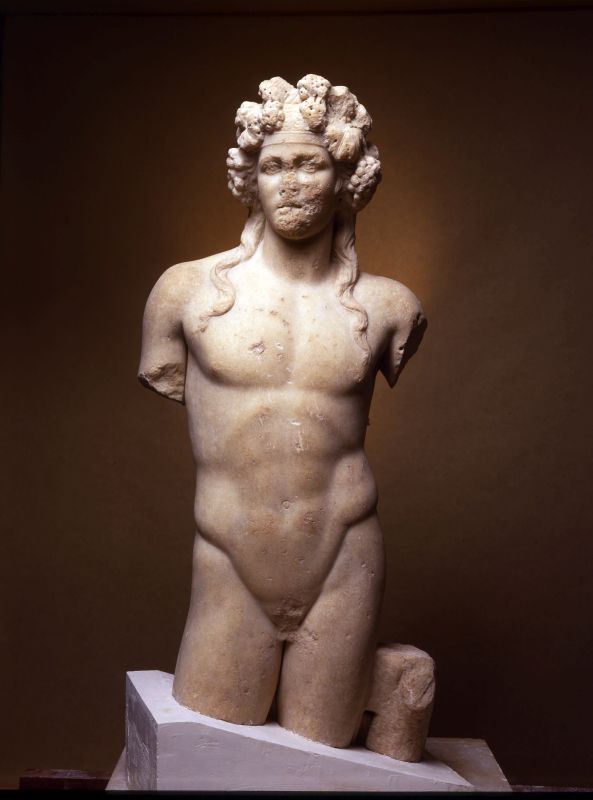
Dionysos was sailing his ship down the Danube
when he arrived in the land of the Magyars;
but when he came ashore he could find no Magyars anywhere,
as they were hiding from the demon Guta who liked to beat people
until they had a stroke or died of hemorrhage.
Dionysos said, “Stop striking these good people,
or you shall surely regret it!”
And the demon Guta just laughed in his face.
So with the scepter of Phanēs Dionysos smote Guta
in the temple, and the ugly head of Guta fell off.
All over Guta’s body he beat him,
until there was just a pile of bones and meat,
which Dionysos had carried away and burnt by his Satyrs,
and when the foul-smelling smoke was gone,
migraines and epilepsy disappeared from the land of the Magyars,
and the people returned from the caves and forest
where they had been hiding from the demon Guta.
So may it be for NN, who struggles to worship the Gods
through pain and sickness, day in and day out.
May Dionysos banish suffering, and bring forth rejoicing,
and may Guta the demon remain struck down.
Against Evil Spirits
Against Evil Spirits I
I beseech you, Dionysos Saōtēs,
to make powerless, banish, and drive out
every malignant force, presence and machination,
every evil influence, malefice, evil eye,
and all evil actions aimed against NN,
so that NN may praise you joyously,
safe in body and soul once again.
Against Evil Spirits II
Protector of the pious, God who loves to hear prayers and hymns,
I call upon you in your mighty name of Dionysos Bakcheios,
and ask that this space be covered in the powerful blood
of the bull that was sacrificed for his people. May this covering
form a hedge of protection against any forces of wickedness
and uncreation seeking to enter. Let the light of your presence
fill every inch, repulsing any malicious or harmful spirits,
especially those that like to sow confusion, discord or conflicts
among those of us who have gathered together to form a house
of holiness, where the Gods and spirits may be worshiped
in the proper customary manner, guided by the ancient principles
of piety and wisdom in all things. May your blood, O Horned One,
fill this space with understanding, peace, and joy, and keep us safe
from the schemes and attacks of our enemies, whether spirit or human.
Bless and keep watch over us, Dionysos Bakcheios, now and always.
Against Evil Spirits III
By the authority of Dionysos, Master of Mount Nysa
and Lord of the Labyrinth, I declare that this space is
consecrated for the worship of the Gods and spirits
and that any attempted claim on it is rendered null and void.
By the power of Dionysos who slays monsters and leads
the Furious Host into battle, I command all malignant
entities to flee this space, and forbid them to harm anyone
who is here rightfully, whether directly or indirectly.
By the mighty name of Dionysos, which even other Gods fear,
I proclaim that headaches, and illness, and any bodily or spiritual pains
will dissolve like wax in fire, and that all roots, hooks, tentacles,
or other attachments of spirits, the dead, or witches be withdrawn
lest pain more severe than anything they can imagine follow them back
to their source. Your devotee thanks you, O benevolent Bakcheios,
who is always first in the charge to drive back evil,
and lacks both fear or mercy when it concerns those
who have aligned themselves with the unmaker.
bubblegum
I have come here to chew bubblegum and battle demons … and I’m all out of bubblegum.
Got a new batch to share with y’all.
Oh, and if you prefer Heathen versions, my beautiful and clever wife is adapting some of the Κατάρες over at Gangleri’s Grove.
Against Abettors
O Dionysos, leader of the triumphant procession,
ferocious one who worsts the offspring of Ouranos,
mighty one who wields the pruning-knife of Kronos,
vigorous one who wears the victor’s crown of Zeus,
I call on you
Dionysos who drives back the enemy,
Dionysos who slaughters his foes,
Dionysos who obliterates wicked machinations,
our God, our Lord, our Savior;
and I celebrate your victory over NN
who has been afflicting NN,
most kind, and gracious, and wonder-working Dionysos,
liberator and protector of our bodies and souls,
not just because this was such a personal and important matter,
but because every defeat of the forces of the unmaker
preserves and restores the divine order
a little more, and for a little longer;
but these things are petty and vengeful,
and likely have family, and friends,
and lots of co-workers of woe,
so I implore you who have already done so much
to render all spirits who would come against us
impotent, paralyzed and unable to cause
disorder, confusion, or any kind of harm,
not only against us here, but our students,
our apprentices, our initiates, our colleagues,
our friends, our families, our communities,
those who pray for us and their family members,
as well as anyone else who might be associated with us.
O God who delights in causing these wicked spirits pain,
I ask you to bind, and drive out, and cut off from their power
all fiendish creatures allied with the unmaker,
whether they are powers in the air, the water, the fire, the ground,
the underground, or the netherworld; be they human dead,
nature-spirit, demon, hero, God, or some other supernatural entity,
them and all of their emissaries, assistants, and associates.
Bind with your unbreakable ivy and drown in wine
all of their attributes, aspects, and characteristics,
all of their powers, compacts, and obligations,
all of their interactions, communications, and deceitful games,
Dionysos Bakcheios, the Deliverer.
Dionysos Backheios, the Loosener,
I implore you to break any and all bonds, attachments, or tentacles
that may have been placed on NN or any of us who have
participated in this rite, or prayed on this matter.
And Dionysos Bakcheios, the Confuser,
I petition you to distract, confound, and lead far away
and into utter destruction anything that attempts
to come after me or mine
for this or any other reason.
Against Yeqon’s children
Resplendent Dionysos, august among the Gods,
vanquisher, triumphant, by the power of your mighty
name I banish all the offspring of the thousand and one
children of Yeqon the lascivious, of every kind,
and every perversion. Be they evil spirit,
evil demon, evil ghost, evil devil,
evil God, evil fiend, evil man,
evil face, evil eye, evil mouth, evil tongue,
or any other kind of evil. If the descendants
of Yeqon should cast any evil disease
or temptation on NN, may it be cut off
with your sharp pruning-knife Dionysos,
and if they have planted their seeds in NN,
may they depart from his body,
from his body may they issue forth,
leaving his body, may they never return!
Let their evil, their impurity, the poison
of their eyes and mouth go!
Let it not go into the fruitful field, forest or garden!
Let it travel the route of the dark earth!
In the dark earth lie iron vessels.
Their lids are of lead.
Whatever goes into them,
does not come up again,
it perishes therein.
Unto my body may they
or their evil not draw near,
nor to any of those I hold dear.
May Yeqon’s kin commit
no evil before my eyes,
nor follow behind me.
Into my house may they not enter,
my fence may they not break through,
my property may they not trespass.
May they be kept out by Dionysos
the Liberator of Souls, and his Furious Host.
Against Amphilogos
Amphilogos, you who stir up disputes, you who provoke
anger where it is not deserved, you who feed off of hatred
like a bloated tick, you who gorge yourself on the grief that
your whispered lies produce, you who would be known as
the bloodthirsty, the murderous, the sword of terrible vengeance,
I can only laugh at you! For I have been blessed by the God
of true sight, the Lord who inspires visions, the King whose word
is unwavering, and Dionysos has shown me who you actually are.
You are Amphilogos, the Pretender; you are not a wrath-spirit,
or even a sloth-spirit, nor do you belong to any of the other families
of vice! You are just a lonely wanderer of the wastes, desperate for
some acknowledgment, and so you harass those who are busy about
their prayers and devotions. You hope to lead them away
from their family and friends and set up division between them
and their Holy Powers, but don’t even realize that you have already
been defeated. The false images you vomit up, the disgusting falsehoods
you blow into people’s ears from your backside — they hold no power!
They are forgotten as soon as the stench of them has drifted away.
You think you are mighty, Amphilogos, because you got a human to think
bad things about themselves; you rejoice because you sowed discord
between friends or spouses? What pathetic accomplishments!
I would almost pity you if you had not allied yourself with the unmaker.
Instead I pray that Dionysos show you what real fury and thirst for blood
look like, as your sword is shattered and your screams fill the long night.
Against Capia’s daughters
In the name of Dionysos Iatros,
and through the power of Dionysos Lusios,
may there be health and wholeness for NN.
And may the forty daughters of Capia,
each of which has power
over a different disease,
each of which inflicts
a different misery upon the body,
release any hold that you have over NN.
From wherever you came,
from wherever you crept,
I chase you out,
I conjure you out,
I curse you until you flee,
you wicked daughters
of a wicked mother.
Go to the woods,
go to the meadows,
go to the roads;
creep inside an asp,
creep inside a scorpion,
creep inside a toad;
just go away, away,
far away from NN,
and do not return,
in the name of Dionysos Lusios,
through the power of Dionysos Iatros.
Against Empousa
Be gone, Empousa! Be gone! Be gone!
For I shall call upon my Lord Dionysos
who thwarts the devices and checks the power
that you might otherwise claim
over his Bacchants and initiates;
loathsome Empousa, who once was a slave
of the three-necked Goddess, until hate
and rebellion blossomed in your maggoty heart;
most hideous of your hideous sisters, Empousa
whose eyes are full of envy, division, and illness;
whose lolling tongue drips poison
more deadly than lies and rumors;
who can change your appearance at will
though always your single copper leg remains,
betraying your true identity to those who know;
Empousa who snatches children from their beds,
and does not return them alive;
who drags young men about to be married off
to your lair and copulates with them until
all of their beauty and vitality have been drained;
who appears to souls who have lost their way
and tries to lead them deeper into the darkness
and confusion of the underworld;
Dionysos defeated you Empousa
because he knew the secret meaning
of your true name, Onokōlē — and he will do it again!
It does not matter if you turn yourself into a mule,
a brazen bull, a beautiful woman, a dog,
or a bone-white snake, for he who is Lord of Life
will use your name against you, wicked spirit,
and transform you into a stinking pile of shit.
So be gone, Empousa! Be gone! Be gone!
Against Dysthymia
O disheartening Dysthymia, dour and dishonest,
unloved and unwanted daughter of ashen Achlys,
who carries the torch for Thanatos, whose sole friend is Lyssa,
you who hate the rest of the Gods and revile all spirits,
which drives you to try and distract mankind from our divine service
stirring up in us resentment, pollution, apathy and other things
that keep us from approaching holy altars and sacred images,
and the trustworthy traditions that have been carefully passed down to us.
Against you stands Dionysos the joybringer, banisher of cares,
the one who stitches back together broken hearts,
and lifts those suffering from despair out of the slimy pit,
cleansing us of the muck and mire that clings to us
so that we may again shine as brilliantly as the stars in Heaven
with love for the Blessed Immortals and the life that has been given to us.
Flee, faithless fiend, for you shall not prevail!
Flee, feckless farrago, as everyone you’ve ever cared for has fled from you!
Flee, fumbling fool, or suffer your well-earned fate!
O Dysthymia, you who make the eyes of the sorrowing red
from a deluge of tears, and hollow our cheeks from forgetfulness
of the body’s needs; your power over us is broken, and Dionysos
will tear loose any hooks you still have in us, so that you can never
again darken our thoughts or torment our flesh.
O Dysthymia, you who make the grieving experience inescapable
isolation even in the midst of a crowd of friends and loved ones;
do you think your constricting walls are stronger than those of Pentheus’
Kadmean citadel which came crashing down when Dionysos roared,
freeing his madwomen trapped within? They are not!
O Dysthymia, who lays heavily upon the mourner like some
hideous hag, causing us to hunch our back and drag our foot,
assuming we can even find the strength to get out of bed;
Dionysos will pick you off like a speck of dust and fling you
so far away that you never find your way back to us again,
while we dance in celebration atop the forested mountain,
all the aches and pains you caused gone and forgotten.
O Dysthymia, who steals joy and courage, and fills the mind with fear
for things that have not yet happened and likely never will;
Dionysos has locked the doors of our ears and given us his potent
wine to drink, a healing drug that restores what you took from us.
O Dysthymia, who drains the color and vividness from experiences,
so that life feels stale and unreal; Dionysos will wake us up to the
wonders that surround us, and make things even more surreal.
O Dysthymia, who recreates for us the worst parts of the story of our
life over and over again, making it impossible to move on; Dionysos
can shatter the bonds that keep your own dolorous past repeating,
and help you to become all of the things that you could have been
had trauma not warped you, Dysthymia, if you would just agree
to leave humans alone and no longer interfere with our practice of piety.
Dionysos is a kind and generous God when not provoked; submit to him.
Against the Vices II
I praise the beautiful God, beloved of Ariadnē,
giver of wine and countless other blessings,
many-named Dionysos, Lord of manifestation,
living eternally, free of want and suffering,
the bull-horned Savior, unrivaled in ferocity,
protector of his people, who has said,
“May your soul be strong against adversity,
may you face your trials bravely,
may you never forget that you have the power
to smash and overthrow your foes,
no matter how numerous they may be.”
With his blessing I shall trample beneath my boot
the spirit of fear, the spirit of unbelief, the spirit of guile,
the spirit of division, the spirit of empty confidence,
the spirit of overindulgence, the spirit of laziness,
the spirit of insolence, the spirit of dejection,
and anything else that leads to impurity of mind and body,
so that I may experience his exquisite ecstasy
and revel with his blessed initiates on Mount Nysa
when my time comes to join them.
Love is a battlefield
On Monday I’m going to share some of my previous posts as well as a bunch of academic articles on Dionysos’ presence in Israel and Palestine in preparation for offering up some of the Jewish-themed Katares. But before I do so I have a little something to take care of.
Things to look forward to
When I’m finished compiling the Ἱερός Λόγος for the monastic strain of the Starry Bull tradition I am going to have a book printed. I go back and forth on whether I should release it to the public or just keep it for members of the Order.
One of the chapters, containing Κατάρες (“Imprecations,” which are a kind of prayer slash incantation recited against hostile spirits) became so large it is now its own book. Katares can be prayed individually or as part of a larger ceremony, such as an exorcism or an attack on that entity (preemptively if need be — I am a firm believer that the best defense is a strong offense.) Many of them are modeled on spells and similar material from antiquity to the early modern period, and even some contemporary examples.
I believe that such a volume is needed because it taps into the current created by previous itinerant religious specialists; these malign entities are causing trouble in the world today; and the most important reason — in composing the historiolae I was given pieces of Dionysos’ lacunose backstory. It is especially frustrating when an ancient author refers to something we know little to nothing about as a commonplace, which his readers would have instantly picked up on no matter how cryptic the allusion. Sometimes this material came through visions, like I was viewing an episode of Legion. Other times the knowledge was just plopped into me noggin. Then there were the times it just flowed out of me, and I had no idea what I was typing. I’d read it afterward and go, “What. The. Fuck.”
One of the most interesting stories that has emerged from these historiolae is Dionysos’ activities in Judea and his relationships with Yahweh, Ašerah, Ašmedai, and Michael (among others.) I’d known he had a strong presence in the region from archaeology and references in authors like Philo, Plutarch, Tacitus and Livy but over the course of working on this a whole secret mythology emerged. It certainly wasn’t something I’d planned; indeed, most of the Katares were written while heavily inebriated or in other altered states of consciousness, which means I had even less control over what was coming through than normal.
I might be inclined to dismiss this material except that through experimentation I discovered that this shit actually worked when the formulae and other odds and ends were included. These show how important the power of story is. Despite that I readily admit that the material could be false without affecting the efficacy of the κατάρα; after all, the two most important components in my estimation are the inspiration and grace of Dionysos on the one hand, and my conservative approach on the other. I start from the assumption that my predecessors knew what they were doing. I don’t tinker unnecessarily, and if I don’t understand both how something works and how it fits within the whole, I leave that shit alone. That’s why a lot of this will be familiar to students of magic and esotericism rooted in the ancient Near East. But that still doesn’t explain where the historiolae came from in many cases. It all still requires a great deal of research, ritual work, and divination but this may be the opening of another strain of Dionysianism, alongside the Starry Bull (Southern Italy) and Starry Bear (Eastern and Northern Europe) traditions. I suppose it makes sense since the Jews and their neighbors had a reputation for exorcism and magic in antiquity and that’s clearly a core part of what this is about. I’m further uncertain if this should include Egypt or if Dionysos’ activities there constitute their own thing, and if there’s really any point in dividing and organizing things this way. It’s all centered on Dionysos, and Dionysos is what Dionysos is.
Either way I’ll start sharing the Dionysos Abraō material next week; I have some other stuff to take care of first. (Abraō means “of or worshiped by the Hebrews,” and comes from a votive inscription from the Decapolis. It’s what I’ve taken to referring to this aspect of the God as, like Asterios and Óðr for the other strains.) It does amuse me that I returned to blogging in the middle of Ḥag hasSukkōṯ, the Jewish festival most commonly associated with Dionysos by Greco-Roman authors.
Nothing can be so firmly bound
And don’t forget one of our simplest and most potent prayers, the Oration of Aristides.
Corpus Bacchi
Body of Bacchus, save me;
Soul of Bacchus, fill me with frenzy;
Suffering of Bacchus, strengthen me;
Blood of Bacchus, inebriate me;
Tears of Bacchus, wash me clean.
Grace II
Dionysos the Conqueror,
King of Nysa and Prince of Olympos,
passes through every land victorious
but does not take captives
and does not lay waste.
Instead he overthrows the oppressor,
frees those who are bound,
soothes the suffering of the afflicted,
and dispenses blessings to all
who will have them.
O Dionysos, Giver of Grace,
I ask to obtain and receive from you
life, health, reputation, wealth,
influence, strength, success, charm,
favor with all men and all women,
and victory over every obstacle before me,
Beneficent one, Savior, Liberator.
Contrition II
O Dionysos, kindly prince of the Olympians,
I pray that you have mercy upon us who are
of the blood of the terrible Titans that splashed upon
the thigh of the fertile Earth when the children of Ouranos
waged war against King Zeus and his family;
through your liberating madness
and rites of deliverance we are able
to transcend our savage nature
and develop the strength and virtue
to cease doing the thoughtless, hurtful
and wicked things which we humans
so easily do to one another, O you who forgave
your foes and their kinsmen, and even admitted them
into your mighty army to fight beside you
against a much worse enemy.
If even such beings can be redeemed by you Lusios,
then I have hope that my stains may be washed away
in the pure stream of your compassion, my Lord.
[Confess anything that is troubling your conscience.]
Before Starting a Task
O Dionysos flourishing in fruit,
you have called us into your vineyard,
and poured sweet longing into our hearts,
so that we may joyously labor in your vineyard;
grant me also the grace that I might complete
this task that I am starting rightly,
in a manner that brings you glory,
and without any sort of hindrance,
so that your vineyard may increase.
Battle III
O Worthy Bull, son of the Dragon,
you who won your Olympian throne
through the valor, endurance, and power
that you displayed, heroic Dionysos I pray,
may I never fail to think brave thoughts,
to speak brave words, and to do brave deeds,
especially in defense of my land, my people,
and my traditions; O great Leader
of Gods and spirits and men and beasts,
may I one day prove worthy
to be counted among your Furious Host.