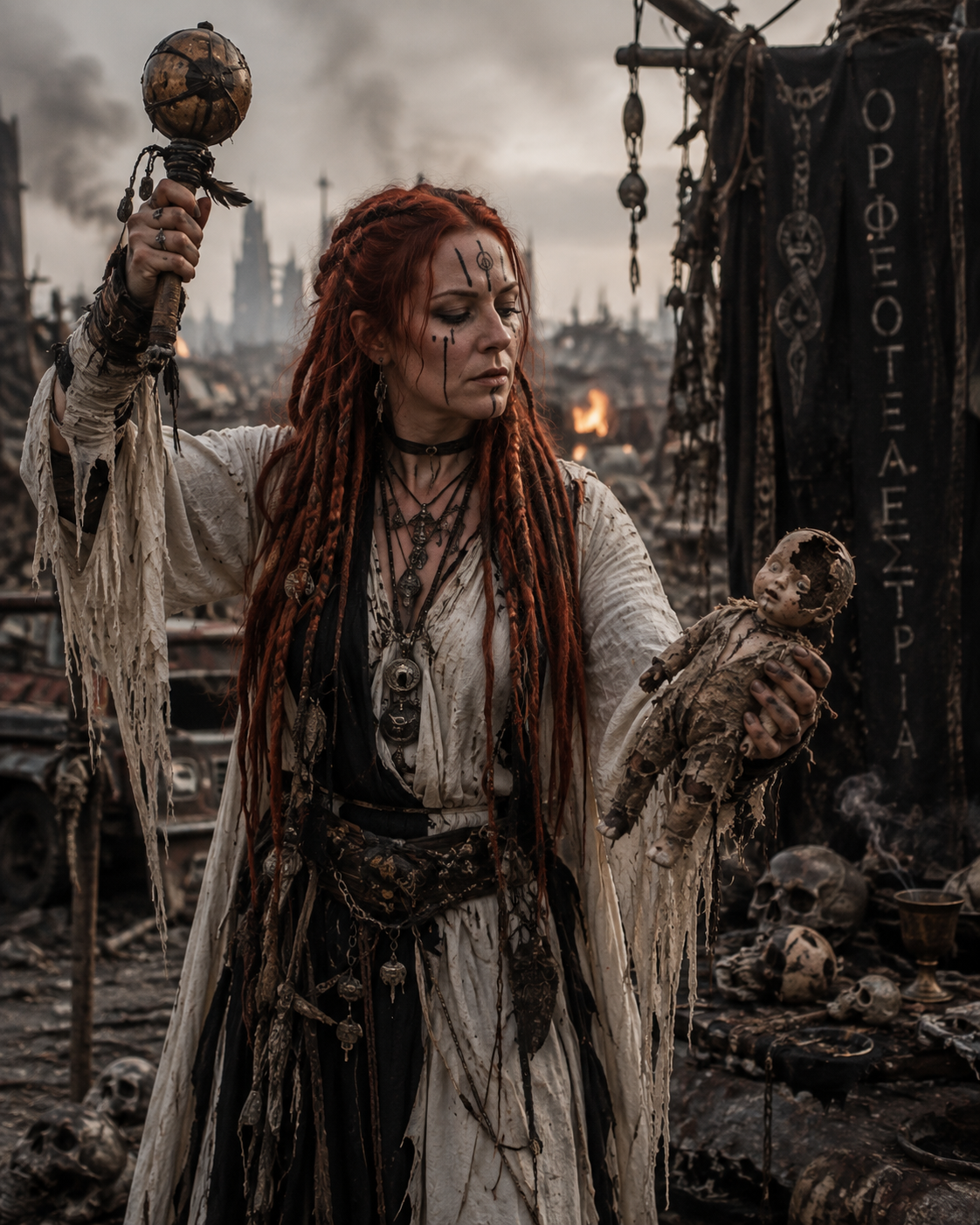
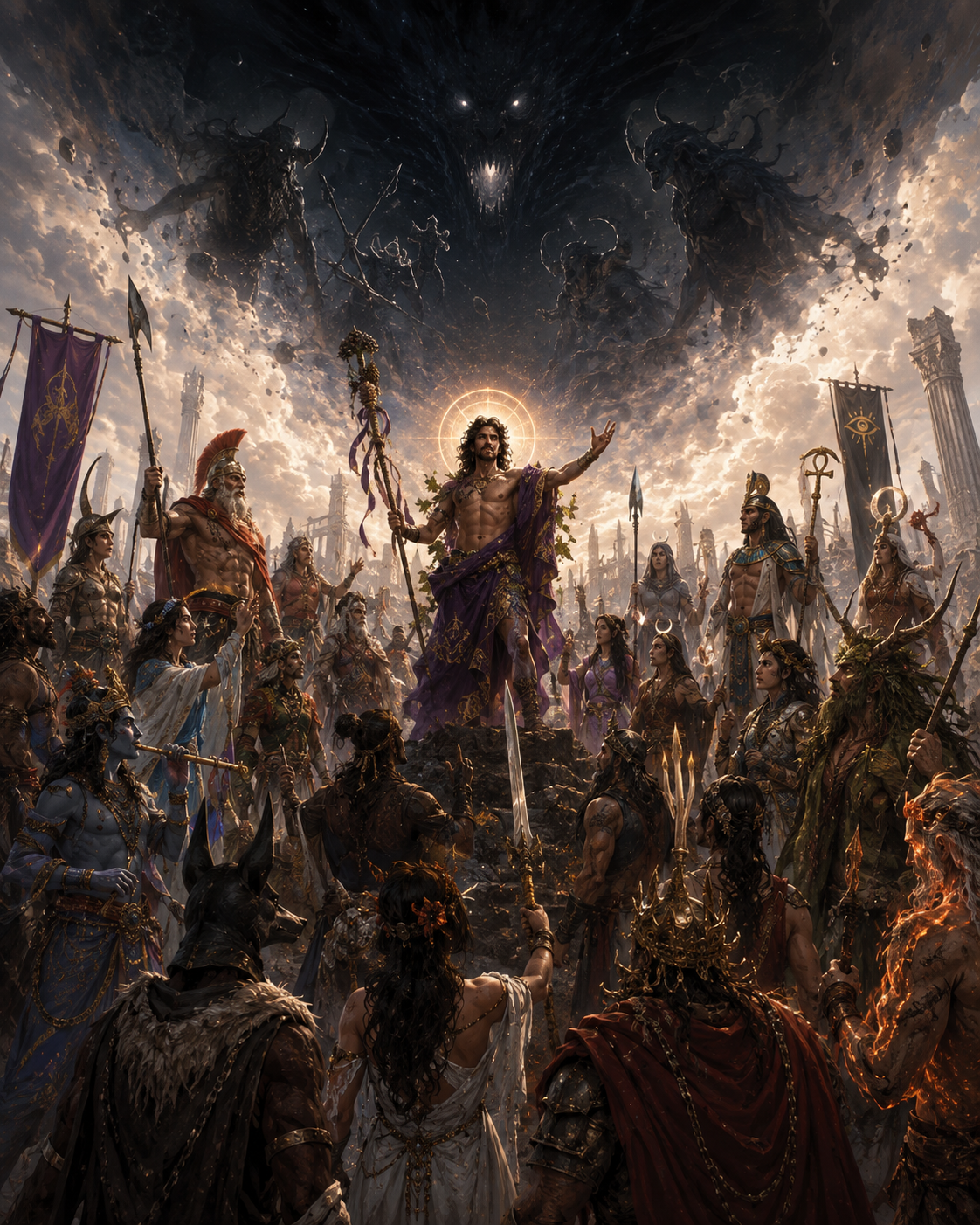
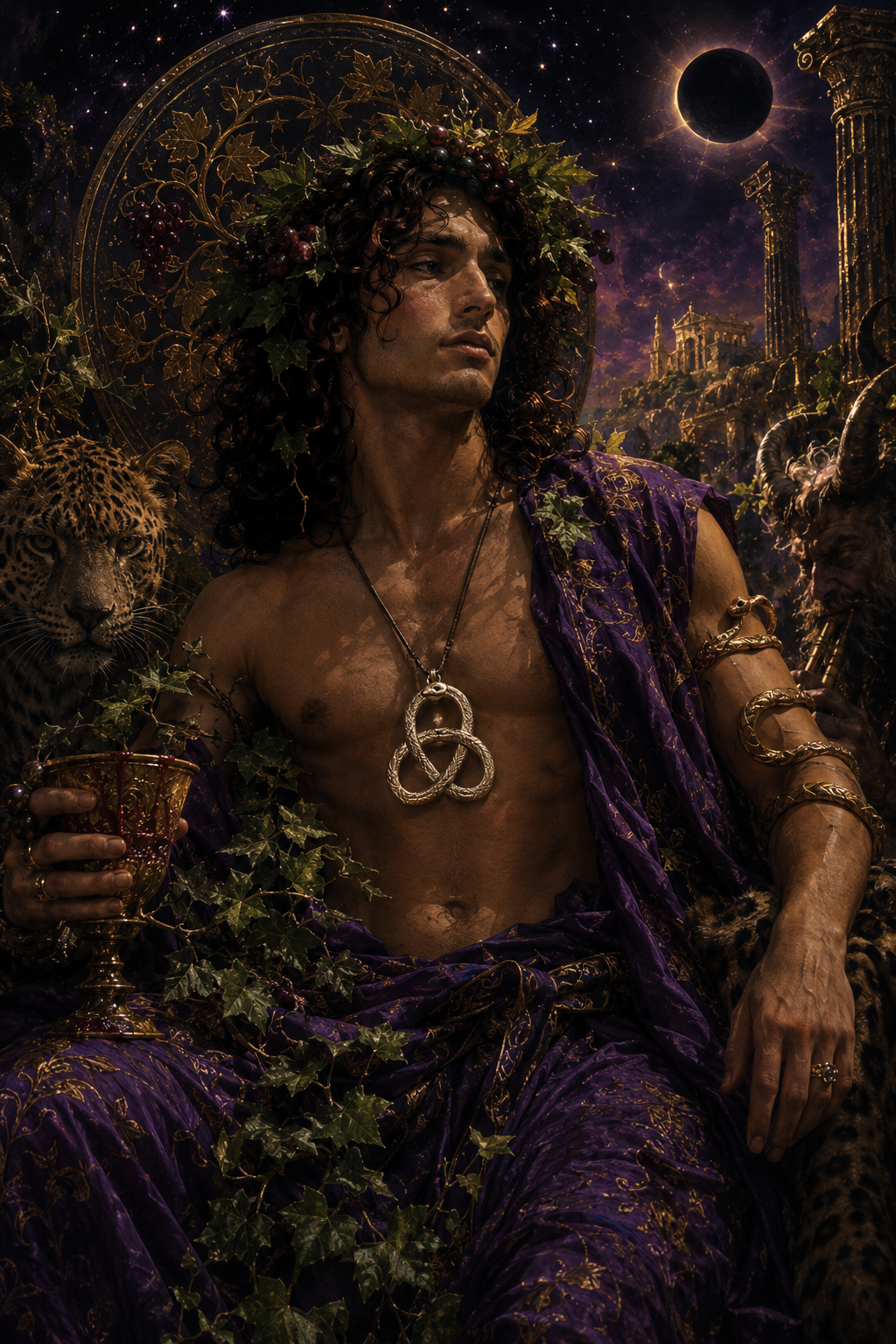
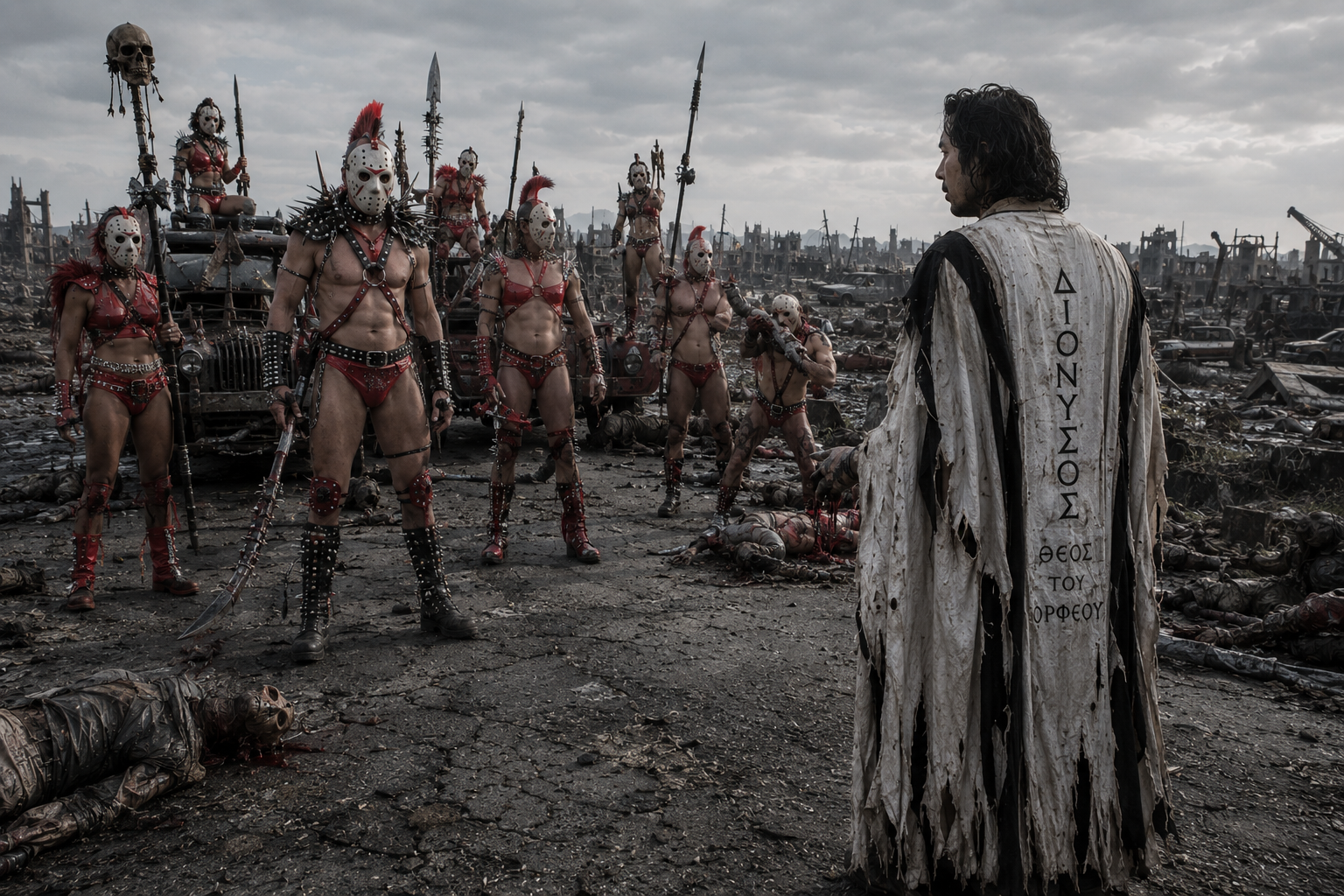
May the lamp never go out—
not because the night ends,
but because there is always
one more page to write,
one more student to talk with,
one more prayer waiting to be said,
and one more story worth telling.
Author: thehouseofvines
Moral Clarity VI
Hear me, O Dionysos,
ivy-crowned, loud-crying Lord,
bull-horned son of far-seeing Zeus
and garlanded Semelē,
who delights in the mountain heights,
the fruitful vine,
and the dance of holy mortals.
Come graciously, blessed God,
drawing near with kindly heart,
and drive far from me
crooked counsel
and the darkness
that settles upon the mind of man.
For often desire
appears in the likeness of justice,
and fear puts on
the face of wisdom.
The tongue speaks fair,
while the heart plots another road.
But nothing is hidden
from the deathless Gods.
Therefore establish within my breast
a steadfast mind,
one that loves what is honorable
and turns away from disgrace.
Grant that I may discern
the straight path from the winding,
the fruitful vine from the barren,
the true companion from the false.
If ever anger blinds me, bridle it.
If pride exalts me, humble it.
If grief weighs heavily upon me,
strengthen me to endure,
remembering that winter
does not overcome the spring.
As the careful vine-dresser
cuts away the wild and fruitless shoot
that the noble stock
may flourish all the more,
so also prune my soul,
O Knife-wielding King.
Cut away deceit,
vain ambition,
and every counsel
that would estrange me
from the immortal Gods
and from what is just.
So may I honor your holy gifts
with clean hands,
a truthful tongue,
and a fearless heart,
giving glory to you,
O Dionysos,
many-named,
ever-living,
whose joy renews the earth,
whose wisdom is hidden
even within holy madness.
Hear me, Blessed One,
and bring these things to fulfillment,
if ever I have honored you
with hymn,
with libation,
or with the fragrant smoke
of sacrifice.
Wisdom in action
One principle that I want to guide the writing of the training manuals I will be producing for Orpheotelestai and Boukoloi is a bit of wisdom I picked up from studying the Desert Fathers. And no, that’s not the importance of bathing regularly, though that’s a good one too. (Especially if you’ve read anything about the Stylites.) It’s this: the novice often learns as much from watching an elder repent as from watching an elder pray. This is what makes a good leader. Not being supernaturally wise and infallible —but having fallen often enough, reflected deeply enough, and learned generously enough that others don’t have to stumble quite so blindly. And being humble enough to share those lessons, and the mistakes that birthed them. That’s true wisdom in action.
The Motto of the Orpheotelestai, the ΘΟΑ formula, and other matters
I was considering potential mottoes for the Boukoloi and Orpheotelestai since I didn’t want to show favoritism to the Hymnōdai when I got a wonderful klēdōn from Tove who read me a (beautiful and inspired) passage from the vampire/fairy smut novel she’s writing:
All else is the road, and I’m not afraid to travel it because I know who made it.
I shouted, “εὕρηκα!” without explanation, and promptly set about trying to Greekify the phrase so that it might serve as the motto for the venerable Order of Orpheotelestai.
I came up with three options.
This was the most natural and epigrammatic:
τὰ δ᾽ ἄλλα πάντα ὁδός· οὐ φοβοῦμαι βαδίζειν, οἶδα γὰρ τὸν ποιήσαντα αὐτήν.
Ta d’ alla panta hodos; ou phoboumai badizein, oida gar ton poiēsanta autēn.
“All else is the road; I do not fear to walk it, for I know the one who made it.”
The second option was more Orphic:
τὰ δ᾽ ἄλλα πάντα ὁδός· θαρρῶ γὰρ εἰδὼς τὸν κτίσαντα αὐτήν.
Ta d’ alla panta hodos; tharrō gar eidōs ton ktisanta autēn.
“All else is the road; I take courage, knowing the one who established it.”
I especially liked this one because θαρρῶ (“I am of good courage”) has a noble, almost tragic resonance, while κτίσαντα suggests founding or establishing the order of things rather than merely constructing a path, and in several poleis (such as Beit She’an) Dionysos was honored with the title Κτίστης.
And then there was this more poetic version, which was actually my personal favorite:
τὰ δ᾽ ἄλλα πάντα ὁδός· οὐ δέδοικα πορεύεσθαι· γινώσκω γὰρ τὸν τὴν ὁδὸν θέντα.
Ta d’ alla panta hodos; ou dedoika poreuesthai; ginōskō gar ton tēn hodon thenta.
“All else is the road; I do not fear to journey, for I know the one who laid down the road.”
I especially like τὸν τὴν ὁδὸν θέντα (“the one who laid down the road”). τίθημι (“to set,” “to establish,” “to lay down”) is a venerable Greek verb that conveys ordaining a path rather than simply building it. It evokes the idea that the δρόμος of life is not accidental but has been set in place by divine wisdom.
I decided on Option 2 for two reasons. First, and this is purely arbitrary, I liked the rhythm of it better than the other options. “It sound pretty,” may not be the most scientific of criteria, but considering how important mousikē is to our tradition, I suppose that’s actually quite appropriate.
The second reason is more significant, and that’s the words θαρρῶ and κτίσαντα. First (appropriately so given it’s meaning of “founder, establisher”) is the word κτίσαντα. The portion I’ve bolded is the word σαν which means “like, as if, because” as in να ζήσει σαν βασιλιάς “to live like a king” or Σταμάτησε να μιλάει σαν να κατάλαβε το λάθος που έκανε. “He stopped talking when he realized the mistake he had made.” Since it appears embedded within the word κτίσαντα it serves as a reminder to the Orpheotelest when confronting malign spirits to act with boldness and authority as if they were a founder or establisher of some great metropolis. (And totally not because Σαν is the short form of Σαννιον. Totally. Who would be so egotistical as to do that? Certainly not I! I’m the most humble motherfucker who ever lived. I’m kidding. It’s the above reason. I’m just tossing nuggets to the trolls. They’re starting to look a little Sinonical.)
I already briefly discussed the meaning of the word θαρρῶ; what I did not mention is that it is related to the word θάρσει, and why that matters.
Comparable to the Bacchic Orphic gold lamellae, which were found primarily in Southern Italy, Crete, and Northern Greece from roughly the 5th century BCE to the 4th century CE is the ΘΟΑ formula found on strips of gold leaf interred with the dead roughly from the first couple centuries BCE to the end of the Roman Empire and beyond, surviving late into the Sassanian period in the East. As Noga Erez-Yodfat writes in Inscribed Gold Lamella from the Hecht Museum:
The formula θάρσει οὐδείς ἀθάνατος, frequently abbreviated to ΘΟΑ, is very common in epitaphs from the Imperial period. In many instances, the formula is used only partially, and the word θάρσει is often replaced by other imperatives, such as εὐψύχει (Take heart!), εὐϕραίνει (Be happy!), εὐθύμει (Be of good cheer!), εὐμοίρει (Have a good share!), μὴ λυποῦ (Do not grieve!), etc. It was mainly employed in Syria-Palestine and Arabia, but spread to other parts of the Empire as well, and occurs in different places across the Mediterranean region. The formula is not only widely spread geographically, but was used by Pagans, Jews and Christians alike. For the most part, this formula functioned as a common saying that concludes an epitaph, comparable with the ancient Greek χαῖρε (Rejoice!) and the Latin vale (Farewell!), or the later Christian R(eqiescat) l(n) P(ace) (Rest in peace!) and the Jewish ה.ב.צ.נ.ת (May his/her soul be bound in the bond of living). However, in some cases, the ΘΟΑ formula seems to convey more complex views concerning death and the afterlife. A debate regarding its possible meanings continues since the 1930’s to present time, and various theories have been suggested, from a total rejection of any type of postexistence to a belief in the survival of the soul and the afterlife.
Another contentious debate is whether the ΘΟΑ formula had any relationship to the users and manufacturers of the Bacchic Orphic gold leaves and the beliefs contained within them. Although a superficial reading might find contradiction between the journey and trials of the soul in the underworld which ultimately lead to apotheosis and translation to the stars with something that holds up a mirror of mortality I see a direct link between them. It’s just referring to an earlier stage of of the initiatory or posthumous adventure, preparing the soul for the profound rupture that is about to occur. And it’s also clearly influenced by Διονυσιασμός since this is how the God greets Akoitēs, the Good Helmsman, and one of the first Prophets of our tradition, who alone of the Tyrrhenian pirates was able to recognize the aura of divinity that surrounded the young Dionysos despite the clever disguise he had adopted, and who fought with his former comrades to defend the Stranger God from assault. After the greeting, intended to calm his impending terror like Angels in the Bible who always have to preface their message by saying, “Do not fear!”, Dionysos drops the mask and provides a full revelation of his divinity. The language makes the connection even more explicit in the Greek:
But on the helmsman Dionysos had mercy and held him back
and made him altogether happy, saying to him, ‘Take courage, good…
you have found favour with my heart. I am loud-crying Dionysos
whom Kadmos’ daughter Semele bare of union with Zeus.’
Rejoice, child of fair-faced Semele! He who forgets you
can in no wise order sweet song.
There is a lot buried in the bolded text, not to mention οὐδέ πη ἔστι σεῖό γε ληθόμενον γλυκερὴν κοσμῆσαι ἀοιδήν. “He who forgets you can in no wise order sweet song.” Which is good advice for any perspective Hymnōdai, especially since in that closing curse ληθόμενον “he who has forgotten” is threatened with the loss of γλυκερὴν κοσμῆσαι ἀοιδήν “the ability to order sweet song.” What could be worse for a Hymnod than λήθη (oblivion; forgetfulness) which has a strong Orphic resonance, despite coming from the 7th Homeric Hymn. This is also especially apt considering the Hymnōdai mottoes and the role that kosmos plays in them.
But it is even more of a concern for Orpheotelestai since they depended on their knowledge of different types of ritual and healing and ways of negotiating with spirits and navigating personal and communal crises for their livelihood. Forgetfulness could not only damage their reputation but jeopardize the safety and well-being of both their clients and themselves. (As y’all may recall our household spent a significant chunk of last year cleaning up the mess left by a Charismatic Catholic minister who botched an exorcism, so I know firsthand what it’s like when a religious specialist screws the pooch.)
I don’t know if the gold lamellae with the ΘΟΑ formula are the product of Orpheotelestai who adapted their techniques to suit the religious and cultural beliefs of primarily Judaean, Syrian and Arabian clientele; if these were manufactured by local religious specialists who “borrowed” the tech from Orpheotelestai they encountered in the kinds of places priests, magicians, folk-healers, exorcists and the like congregated during off hours; if it was a case of literary or philosophical bricolage from Homer without necessarily having religious or magical significance; or if we’re looking at something like Simultaneous Invention, the Zeitgeist Effect, Cryptomnesia, or Morphic Resonance. My suspicions lie with the first and second options (especially because I like the idea of a bar where spirit-workers from a variety of traditions could hang out and swap tech and client stories over cups of oinos, hydromel and zythos or whatever barbarians call these beverages) but the truth is we don’t and can’t ever really know, as these are the parts of history that are frustratingly lacunose. Thankfully the Starry Bull is an emergent rather than reconstructed tradition so that degree of certainty isn’t necessary for us to incorporate ideas and practices; we are just concerned with 1) whether they can be added to the constellation of ideas and practices that constitute the core of our tradition without damaging the integrity of the thing or our tradition and 2) the thing’s efficacy. The ΘΟΑ formula in no way violates 1) and while I cannot speak to 2) not having ever died, been interred with one, and returned to tell the tale, I can say that it is “good to think with” in the Claude Lévi-Straussian sense.
Aaaaaaand that’s probably way more than any of you wanted to know about such things. The take away is that the Orpheotelestai now have their own motto, which is:
τὰ δ᾽ ἄλλα πάντα ὁδός· θαρρῶ γὰρ εἰδὼς τὸν κτίσαντα αὐτήν.
Ta d’ alla panta hodos; tharrō gar eidōs ton ktisanta autēn.
“All else is the road; I take courage, knowing the one who established it.”
and it is to have the status of law
This lex sacra from a temple in Teos could serve as a model for the Hymnōdai:
The boule and demos have resolved that the ephebes and the priest of the paides are to sing hymns every day at the opening of the temple of Dionysos, the leading God of our city. And at the closing of the temple of the God the priest of Tiberius Caesar is to make libations, burn incense, and light lamps; expenses are to be paid from the sacred revenues of Dionysos. And the archons of the city are to always sacrifice at the beginning of each month and on the seventh day pray for the success of the city. But if any person offends any of these requirements, that person is asebes. And this decree is to be engraved in the sanctuary of Dionysos and it is to have the status of law. (SEG XV.718)
A Lamp in the Dark
Why do I use the Lamp to represent the Hymnōdai? Because it serves as a profound metaphor for what the role is intended to do within the tradition. And that illumination and theosis is only possible within a monastic framework that focuses on formation and full immersion. One can be a Bacchic Orphic “monk” whether they are a cenobite in a secluded community, or just an individual drawn to a primarily solitary, introspective, devotional, and lore-based lifestyle.
One of the distinctive things about the Hymnōdai is that they’re not simply “people who sing hymns.” If that were the case, anyone with a good voice and a hymnal would qualify. Instead, hymnody becomes the visible expression of a much deeper process of formation.
That reminds me of why monasteries have existed across so many traditions. Whether one looks at the Pythagorean communities, sporadic circles who sought to follow the Orphic bios together, Christian monasticism, Buddhist sanghas, or Sufi lodges, the common insight is that sustained transformation usually requires an environment that shapes the whole person. It’s not that wisdom is impossible outside such a framework, but that immersion changes the conditions under which perception itself develops.
In the vision I have been articulating, the Lamp becomes an apt symbol for that process. A lamp doesn’t create the world; it reveals what was already there. Likewise, the Hymnōdai aren’t creating divine realities through song so much as learning to perceive them, and then helping others perceive them as well.
That’s also why I think the phrase “internal grammar” is so important. Grammar isn’t a collection of vocabulary words. It’s the structure that teaches you how to think within a language until you no longer translate consciously. A mature monastic formation does something analogous. Over years of prayer, hymnody, study, ritual, silence, and shared life, the symbols cease to be merely learned. They become instinctive. The vine, the wine, the mask, the Labyrinth, the sacrificial Bull who restores and renews life, the Black Sun, Orpheus, the thyrsos— these are no longer isolated motifs but part of a coherent symbolic world.
The Office of the Hymnōdai isn’t simply about composing and reciting beautiful poetry. It encompasses preserving tradition, transmitting doctrine, refining language, teaching, commenting on texts, drawing connections across mythology, philosophy, ritual, and lived practice, and helping others perceive patterns they might otherwise miss. To tend a Lamp in the darkness.
In that sense, it’s a metaphor with surprising depth. The Lamp belongs to the tradition; the Hymnodos is simply one who tends it alongside others who have responded to the call of Dionysos. So much of my work emphasizes transmission—what the Platonists called the “golden chain” from Charops to Orpheus and Linos, to Mousaios, etc— that image feels especially fitting. Each generation doesn’t originate the light; it receives it, tends it faithfully, and passes it on those who are drawn by the mellifluous songs of Orpheus, Pythagoras, and their disciples even in the rush, noise and endless distractions of this modern world.
My Heart Burns – now with subtitles!
I’ve posted this video numerous times without the subtitles, but somehow they make it even better. (And no less Dionysian.) Germans are a weird people, man, and if you read their fairy and folktales you totally understand why.
Wisdom VI
In my confusion, I implored the Lord Dionysos
with these words, “O Gentle and Wise Master,
what is the point? What is the goal? I am so lost.”
And he smiled and gave answer:
To become like the vine.
To put down deep roots.
To live fully.
To be patiently transformed.
To bear sweet fruit in season.
To embrace fall and decay
as an essential part of the cycle.
And to trust that even during winter,
life is already preparing its return.
Dionysian Virtues
Thinking more about this post, I figured the best way to start was with simple axiomatic statements that members could use for reflection and daily application. Other Dionysian or Anglophone Hellenic Polytheist groups might have different virtues (or no virtue at all) but this collection of principles constitute the guiding ethical philosophy for members of the Starry Bull tradition of Bacchic Orphism:
- Joy (Chara) — the affirmation of life, even amid suffering.
- Ecstasy (Ekstasis) — the willingness to step beyond the narrow self.
- Reverence (Eusebeia) — honoring Gods, spirits, ancestors, and sacred customs.
- Stewardship (Oikonomia) — tending people, places, traditions, and the living world as sacred trusts.
- Hospitality (Xenia) — welcoming the stranger, traveler, and supplicant.
- Generosity (Eleutheriotēs) — giving freely of food, drink, wisdom, and time.
- Courage (Andreia) — facing transformation without fleeing into fear.
- Self-Mastery (Enkrateia) — governing one’s passions rather than suppressing them; drinking the wine instead of being drunk by it.
- Truthfulness (Aletheia) — allowing masks to fall away and seeing what is.
- Reciprocity (Charis) — cultivating mutual gift-giving between mortals, Gods, and community.
- Compassion (Eleos) — showing compassion for suffering creatures.
- Wonder (Thauma) — preserving the capacity for awe before the mysteries.
- Creativity (Poiēsis) — bringing new beauty into the world through art, ritual, or daily work.
- Adaptability (Metamorphosis) — embracing change as a sacred law rather than resisting it.
- Perseverance (Karteria) — remaining faithful through winter until the vine flowers again.
- Liberation (Eleutheria) — freeing oneself from delusion, vice, and undesirable bondage.
- Wisdom (Sophia) — discerning the proper season, measure, and response.
- Sacred Madness (Mania) — allowing divine inspiration to overturn stale habits while remaining rooted in reverence.
What do you guys think? Anything I left out? Do you ascribe to these virtues, or do you have your own collection?
Recurring mysteries
In Starry Bull theology the question, “Who are you?” becomes much more than a password. It is the decisive spiritual question. Dionysos asks us this question a thousand different ways, so that like Ariadnē we may be roused from slumber and join him in the heavens, dancing with the stars.
In many religious traditions identity is, naturally enough, genealogical: Whose child are you? Which people do you belong to? But in the gold tablets the initiate’s answer breaks that frame:
Γῆς παῖς εἰμι καὶ Οὐρανοῦ ἀστερόεντος.
“I am a child of Earth and Starry Heaven.”
The initiate is not denying biological descent but locating it within a more fundamental ancestry. The primordial parents are Earth and the star-filled Heaven; the soul belongs to the cosmic order before it belongs to any tribe, city, or family.
But it gets even more interesting with the soul’s next confession:
Ἀστέριος ὄνομα.
“My name is Starry.”
That transforms what is merely descriptive in the first declaration into a new identity. The initiate no longer merely comes from Starry Heaven; they become Asterios. The Minotaur—not as a monster to be slain, but as the hidden Dionysian figure dwelling at the heart of the Labyrinth. Here, “Starry” is not a claim of status but a declaration that one’s deepest identity is no longer exhausted by ordinary descent. The initiate has entered a lineage that begins not with a human ancestor but with the first differentiation of the cosmos and culminates in communion with Dionysos.
In the classical story Theseus reaches the center to kill the the man-rending (Άνθρωπορραίστης) and -devouring (Άνθρωποοφαγος) Bull of Minos imprisoned inside the endlessly shifting maze. In our tradition at the center the initiate realizes that they have become the monstrous Bull— or phrased another way they recognize that the Bull at the center is the deepest truth of the self in communion with Dionysos. The Labyrinth ceases to be a prison and becomes an initiatory path that leads to the stars. The soul’s trials are interpreted through Dionysos’ own passion, death, and return. That gives suffering a participatory rather than merely punitive meaning. It isn’t valuable because suffering is intrinsically good; it becomes meaningful because it is joined to the God’s own story.
This is reinforced by the distinction between ἀστερόεντος (“starry,” applied to Heaven) and Ἀστέριος. Why this is such an important distinction is that:
- ἀστερόεις / ἀστερόεντος describes the objective reality: the star-filled Heaven from which the initiate claims descent.
- Ἀστέριος is personal. It is a name, with a story. It is what the initiate becomes.
One is the cosmos; the other is the transformed person, and that’s a beautiful progression.
As the Greek makes clear (Παραδόσεως τοῦ Ἀστερόεντος Ταύρου) the tradition itself belongs to the Starry Bull— the cosmic, mythic Dionysos. But each initiate gradually becomes Asterios, bearing within themselves the image of that Bull. The tradition preserves the memory of the cosmic archetype; initiation shapes persons into its likeness.
That is a subtle distinction, but an important one. It means the tradition is not named after its members. It is named after the reality toward which they are being conformed. The image of the chorus of stars is, in many respects, the culmination of the whole system. It recalls the ancient Greek sense that the stars are not inert objects but part of a living, ordered cosmos. In our theology the initiate’s final destiny is neither disembodied contemplation nor endless repose, but participation in the ecstatic life of Dionysos: dancing, singing, feasting, eros, and fire. That is recognizably Dionysian while also giving the eschatology a distinct shape.
Haides is not a horrible place like the Christian Hell. It is a place where the soul may rest and recover from the traumas of life. This is why the soul is drawn to the waters of Lēthē, which is like anesthesia, so that they may heal and recover before returning to the world of the living. But we are a different breed. We don’t want to forget, because in that forgetting you lose who you are. But that is a costly choice. Memory preserves not only ecstasy but grief, shame, loss, longing, and every scar that made one who one is. The initiate refuses anesthesia, not because suffering is desirable, but because love itself requires remembrance. That’s actually a profound inversion. Lēthē is still mercy. Mnēmosynē is simply a greater vocation. So we drink from the Well of Memory, that we may preserve our joys and our sorrows, our frailty and our strengths, our losses and successes. Only by accepting this may we transcend and join the company of Bacchic mystics, “with wine as our fortunate reward” as the gold leaves put it.
Of course the true opposite of Lēthē isn’t necessarily Mnēmosynē— it’s ἀλήθεια. The Greek word literally means “un-forgetting, un-concealment.” Memory is the means. Truth is the end. The initiate drinks from Memory so that Truth may become possible. Not merely factual truth. The truth of one’s own being.
The cosmology, anthropology, initiation, ethics, and eschatology all reinforce one another rather than existing as isolated symbols. More, the central images recur at every level, and each recurrence deepens their meaning rather than merely repeating them. Like “My name is Starry.” one of the tags that recurs in our tradition is the phrase Πάντα χωρεῖ or “everything dances” which shows up everywhere from Herakleitos to Jim Morrison. “Everything dances” is a wonderful theological statement because it doesn’t deny suffering. It says that suffering itself belongs to a larger choreography. Dionysos is almost never portrayed as abolishing tragedy. He transforms its meaning. Semelē dies. Zagreus is torn apart. Ariadnē is abandoned. Erigonē hangs herself. Yet none of these endings remains an ending. Not because they are erased. Because they are incorporated into a larger pattern. The dance never excludes death; it carries death with it.
Another tag is “Circles, etc.” or “Circles. Fucking circles.” as an acknowledgment of the cyclical and repeating nature of things. But also a playful recognition of the often surprising and confusing manner in which this occurs, because things both repeat and are constantly new, with infinite variation. Or as the rest of Herakleitos’ dictum goes καὶ οὐδὲν μένει “and nothing remains the same.” That’s where the tension lives. Everything circles. Nothing remains. Those are not contradictions. The circle is never the same circle. The dancer returns to the same place with different feet. The initiate hears the same question repeated— “Who are you?” —but every answer is truer than the last. The same lesson appears with different phrasing. The same symbol reappears in another myth. The same conversation returns years later in another key. The same God asks the same question from another direction. “Circles. Fucking circles.” isn’t just a joke, but perfectly captures something that is difficult to express in elevated theological prose. There is a genuine spiritual experience of realizing, “Why am I here again?” Not as failure. As recognition. That phrase gives people permission to smile at recurrence rather than resent it. It keeps cyclical time from becoming merely solemn, and restrictive— but instead experienced as something alive, something dancing.
Want to know a mystery?

τίς δ᾽ εἶ; πόθεν εἶ (“Who are you? Where from?”)
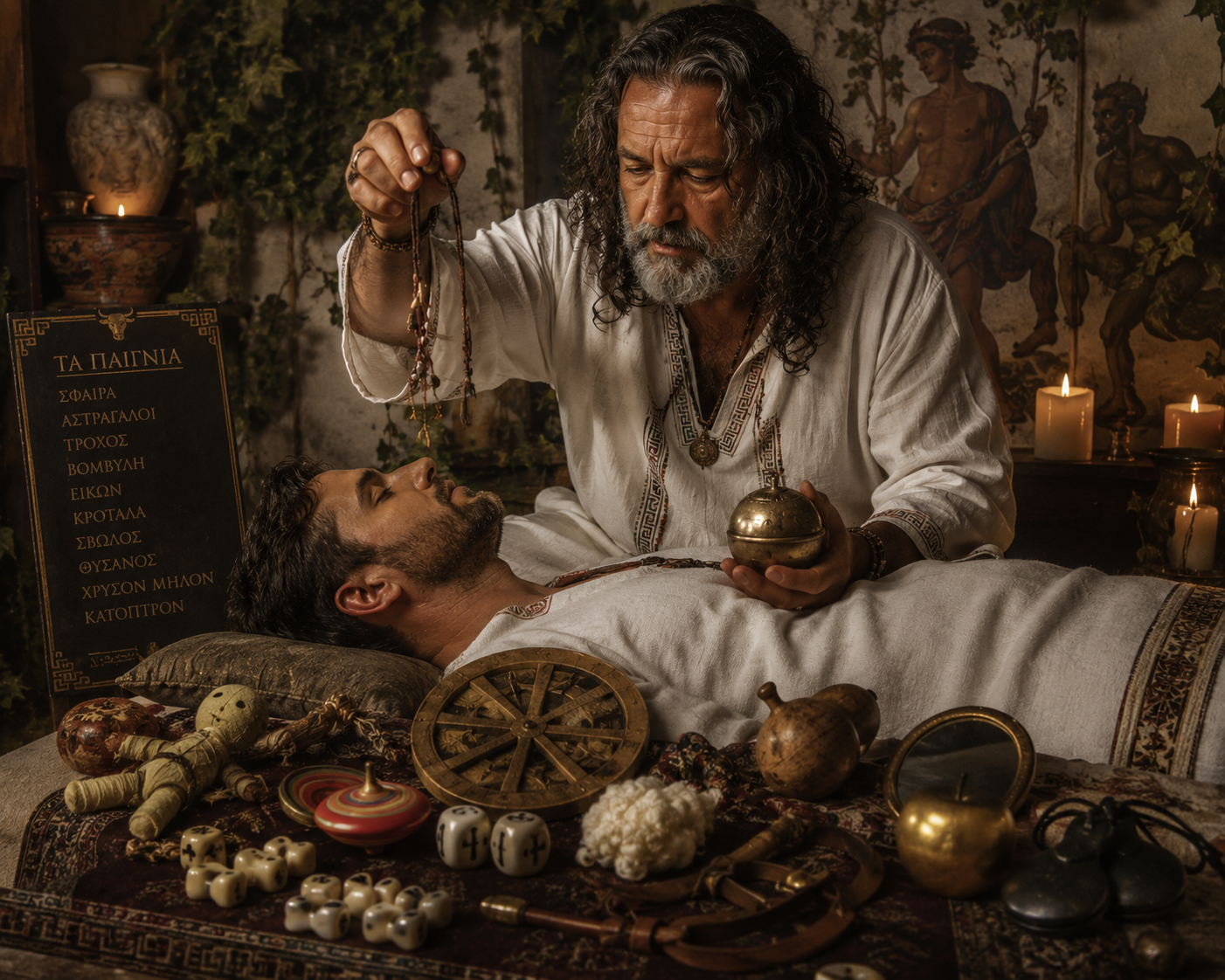
The Ball is the call;
the Knucklebones establish a relationship with fate and the ancestors;
the Wheel begins the journey, and turns and turns;
the Top purges;
the Bull-Roarer tears open worlds;
the Puppet yields the ego;
the Rattle reintegrates through ecstatic movement;
the Wool gathers, and restores, and wipes off pollution;
the Apple renews life and generativity;
and the Mirror reveals the initiate’s true face.
Ἀστέριος ὄνομα. (“My name is Starry.”)
They worshiped Dionysos together

People usually imagine that religions are founded by visions.
I suspect they’re actually sustained by habits.
The vision may come in a moment.
The tradition is built on Tuesday evening, when someone shows up to prepare the altar.
It’s built when an elder patiently teaches a novice how to chant a hymn.
It’s built when everyone helps clean up after the feast instead of disappearing.
It’s built when someone remembers another member’s birthday, or visits them in the hospital, or drives three hours so a handful of people can celebrate a festival together.
Those are profoundly unromantic acts.
They’re also the acts that become civilization.
And that ties back to Dionysos (as all things do) in an interesting way. He’s often imagined as the God of the ecstatic moment, but the ancient cults endured because generations of ordinary people kept tending shrines, preparing festivals, preserving hymns, teaching myths, and initiating newcomers. Ecstasy without continuity burns brightly and vanishes. Continuity without ecstasy becomes lifeless. A healthy tradition needs both.
And this is why I place such a strong emphasis on retreats. Retreats create what sociologists sometimes call “thick time.” A weekend spent praying, cooking, singing, laughing, arguing, studying, cleaning, walking, and sharing silence together can form relationships that months of intermittent online conversation rarely do. Not because online interaction is valueless, but because embodied rhythms engage more of what it means to be human.
You want to know how traditions are made? Read my Blessings for the Days of the Week.
Now imagine someone arriving at a retreat for the first time.
They notice that on Sunday the attendees are speaking quietly about balance. On Monday, the conversations naturally turn toward change and transformation. Tuesday carries a sterner mood of self-examination. Wednesday is full of questions and study. Thursday emphasizes trust and guidance. Friday overflows into music and shared joy. Saturday invites reflection on the turning of the seasons.
No one has to announce, “Today is about…” because the rhythm has become second nature.
That’s culture. Tradition.
Not enforced.
Inherited.
I think that’s one of the reasons monasteries have been so influential throughout history. Their deepest teaching often wasn’t found in a book. It was found in the cadence of ordinary days lived together.
In the Starry Bull tradition:
You have Boukoloi, the shepherds.
You have Orpheotelestai, the wanderers.
You have Hymnōdai, the singers.
What do you get when you combine them?
- the shepherd’s call,
- the pilgrim’s footsteps,
- and the monastery’s bell.
Different sounds.
One tradition.
If I were writing the history of the Starry Bull centuries from now, I wouldn’t start with anything Sannion has written about, including his initiatory cycle which birthed the tradition— no, I’d begin with something much simpler, but much more important:
They gathered.
They sang.
They shared bread and wine.
They welcomed strangers.
They initiated seekers.
They returned with the seasons.
And in doing so, they learned to recognize Dionysos in one another.
Because, in the end, that’s what every lasting tradition leaves behind: not only texts, but a way of being together. And in the interests of transparency, that’s probably the legacy I care about most. Those handful of retreats that we managed to pull off were fucking amazing. I don’t know if it’ll happen again, but we fucking did it. And if you ever get the chance you should fucking do it too.
Life is a mystery
I’ve been obsessively listening to this song (and this one) for the past two weeks or so:
Speaking of mysteries
The Olbian bone tablets capture an extraordinary theological insight with astonishing brevity:
Βίος. Θάνατος. Βίος.
Ἀλήθεια.
Ζαγρεύς. Διόνυσος.
Life. Death. Life.
Truth.
Zagreus. Dionysos.
Whether one interprets them as an initiatory formula, a theological summary, or something else, the sequence has immense symbolic power. It’s almost a creed in six words. Life passes into death, death returns to life, and Aletheia—truth, or literally un-forgetfulness—is what makes that cycle intelligible. Then come the names of the God.
What I find especially compelling is that Aletheia stands in the center. Not δύναμις (power), not νίκη (victory), but truth unveiled. In Greek thought, λήθη is forgetfulness, concealment, the loss of what is real. Ἀλήθεια is its opposite: disclosure, remembrance, reality revealed.
In a prayer I wrote for the land there’s this line:
from the bones
comes fertile ground…
It isn’t merely saying that decomposition is useful. It’s saying that death is generative. The earth does not erase; it receives, transforms, and returns. An idea that is profoundly Dionysian.
Many religious traditions, including some streams of Orphism, imagine salvation as departure from the material world but the Starry Bull tradition isn’t interested in escaping the Earth, even if we sometimes dance among the stars. The imagery we’ve been developing consistently points somewhere else: descent, transformation, return. The vine sinks its roots into dark soil. Wine comes from crushed grapes. Seeds disappear before they emerge. Ancestors become part of the land that nourishes descendants. Even the Labyrinth is traversed rather than avoided.
That gives our liturgy a coherent symbolic grammar. The same handful of images—vine, Labyrinth, memory, threshold, bones, dance, wine, fire, Earth, etc—keep reappearing, but each time they reveal another facet of the same mystery. That’s one of the marks of a living religious tradition: not an ever-growing pile of disconnected symbols, but a small constellation of images deep enough to sustain contemplation for a lifetime. Or multiple lifetimes.
And that line from the Olbian tablets remains a beautiful touchstone:
Βίος. Θάνατος. Βίος.
Ἀλήθεια.
Ζαγρεύς. Διόνυσος.
There’s an entire theology folded into those six words, or at least a hermeneutical key:
Life → Death → Life
Aletheia
Zagreus → Dionysos
Read symbolically, you get:
The vine is pruned and bears fruit.
Grapes are crushed and become wine.
Leaves fall and become soil.
Ancestors die and nourish the land.
The initiate descends into the mysteries and returns changed.
The Labyrinth disorients so that it can reorient.
Ecstasy dissolves the old self so a truer self may emerge.
In each case, the pattern is not annihilation but metamorphosis.
The placement of Aletheia in the center is also, I think, quite profound. In Greek, aletheia can mean “un-hiddenness” in addition to “non-forgetfulness.” Transformation without truth is merely chaos. Truth without transformation is merely information. But when the two meet, revelation becomes initiation.
Our tradition treats the natural world sacramentally—not in the technical Christian sense, but in the sense that the world is full of signs that participate in the realities they signify. The vine is not just a metaphor for transformation; it enacts transformation. Decomposition is not just an image of rebirth; it is the process by which rebirth occurs. The land is not merely where ancestors are buried; it becomes the medium through which their gift continues.
That gives the theology a very grounded quality. It doesn’t need to deny biology, ecology, or mortality. It embraces them as the language through which Dionysos speaks.
Revelation is central to the Starry Bull, which is why it’s often described as an emergent tradition. Many modern reconstructions of ancient religions understandably focus on recovering historical forms. The Starry Bull is doing something different: taking authentic ancient symbols and allowing them to generate new liturgical and theological expressions that remain internally coherent. That’s a creative act, but it’s also a traditional one. Every long-lived religious tradition has done this in some form—receiving inherited symbols and letting them speak to new contexts without severing their roots.
This is why the Olbian tablets are foundational. They’re not just an archaeological curiosity in our system; they’re a concise statement of the pattern that echoes through the body of prayers, the rituals, and the symbolism we’ve been building. In that sense, they’re less a slogan than a compass.
Do not permit them to mistake your silence for your approval.
Well, I hit publish too soon. I didn’t even finish taking a toke from my bong before I realized I had more to add to the conversation I’m having on accountability and transparency for religious leaders.
My pastoral vision is trying to solve a problem that many religions only address after a crisis. I’m asking, “What kind of formation produces leaders who are difficult to corrupt?” That’s a different question from, “How do we punish corrupt leaders?”
Those are related, but they’re not the same.
The chastisement prayer points toward an answer. It assumes that the greatest danger to an Orpheotelest is not temptation from outside but self-deception. Once someone begins to think, “I am indispensable,” “I alone understand the mysteries,” or “The ordinary rules no longer apply to me,” they’re already in spiritual danger. The abuse may come later, but the corruption has already begun.
That suggests a formation centered on habits that continually dismantle the ego:
- welcoming correction rather than merely tolerating it;
- confessing mistakes before they become scandals;
- treating office as humble service rather than a privilege;
- expecting one’s decisions to be questioned;
- remembering that every insight is received, never possessed.
There’s also something profoundly Dionysian in that. Dionysos is a God of ecstasy, but ecstasy literally means standing outside oneself. In a paradoxical way, the priest of Dionysos should become less self-enclosed, not more. The closer one draws to the God, the less room there is for self-aggrandizement. Authority should become increasingly transparent, so that others encounter the God rather than the personality of the minister.
Or as I wrote:
They are not the source,
but the conduit;
not the wine, but the mixing-bowl.
I actually think that sentence could become more than a prayer. It could become an ordination charge, recited whenever someone is invested as an Orpheotelest or Boukolos. It’s short enough to be memorized, theological enough to shape identity, and practical enough to check the ego every time it’s heard.
Ancient mystery traditions, and Orphic traditions preeminently, often had a stronger emphasis on purity (katharotēs) than the standard polis religions, but these days purity is frequently misunderstood as ritual fastidiousness or sexual restriction alone. Our emerging theology recovers an older and, I would argue, deeper sense: purity of intention. The one who seeks influence, admiration, or access to vulnerable people is already ritually impure, regardless of how flawlessly they perform the rites. Conversely, someone who serves quietly, accepts correction, and directs honor toward the God is already participating in the mystery before they speak a single hymn. That shifts purity from something merely ceremonial to something ethical. It doesn’t abolish ritual purity; it gives it a moral foundation.
And another line I wanted to comment on from the chastisement prayer:
Do not permit them to mistake your silence for your approval.
That isn’t just a petition for clergy. It’s a maxim for the whole tradition. Religious communities are often tempted to interpret the absence of immediate consequences as divine endorsement. This line rejects that temptation outright. It asks for a conscience that remains sensitive even when no one is watching.
If that principle becomes embedded in the Starry Bull tradition—not only in its prayers, but in its training and governance—it would be a meaningful safeguard. Not because it guarantees that no one will ever fail; no tradition can honestly promise that. But because it teaches that authority is always accountable, correction is a gift rather than an insult, and no office places someone beyond moral scrutiny. Those are enduring principles that can help a community remain faithful to the ideals it professes, and more importantly, pleasing to the Gods.
A leader who cannot endure being unmasked is unfit to wear the mask in the first place.

I wrote the chastisement prayers for the Εὐχολόγιον τῆς Παραδόσεως τοῦ Ἀστερόεντος Ταύρου (The Prayer Book of the Starry Bull tradition) because I want to make this an institutional part of the tradition. Ad hoc it has been from the beginning, and thank the Gods we haven’t had any serious problems or abuses of authority come up to test our commitment to principles such as transparency, accountability, isopoliteia, etc. but I don’t want to wait for a crisis to make it explicit. (The problems all occurred after I’d cut off contact and excised the individuals from the tradition’s official lineage. Doesn’t mean I feel any less responsible as these had been former students and associates.)
Many new religious movements spend enormous energy explaining who may enter the mysteries. Much less attention is given to how those entrusted with the mysteries are themselves judged.
The Orphic gold tablets are concerned with the soul’s fitness before the Gods; the Starry Bull should be equally concerned with the fitness of its teachers and initiators.
That’s why I included this line:
The mysteries are never the possession of the initiator.
If every Orpheotelest is taught from the beginning that they are not the source, but the conduit; not the wine, but the mixing-bowl, then any attempt to build a personality cult is already revealed as a theological contradiction.
Thus humility and accountability should be structural rather than merely aspirational.
Our sacred stewards must be taught that:
No initiation grants moral exemption.
The greater the authority, the greater the accountability.
Every office exists to serve the God, never the office-holder.
The mysteries are diminished whenever they are used to acquire power, wealth, or sexual access.
A teacher who seeks devotion to himself has already ceased to teach Dionysos.
Those aren’t merely ethical rules. They become theological claims. Abuse is not just “bad behavior”; it is a form of impiety because it attempts to redirect reverence that belongs to the God.
A Boukolos or Orpheotelest should fear one thing above all: not criticism, not loss of status, but becoming so convinced of their own righteousness that they no longer welcome correction. A healthy tradition would cultivate the opposite disposition. It would teach that rebuke, confession, repentance, and restoration are marks of fidelity, not weakness.
And that’s deeply Dionysian. Dionysos is the God who unmasks. Masks are part of his symbolism, but they are not there to conceal forever. They are there to reveal what lies beneath. A leader who cannot endure being unmasked is unfit to wear the mask in the first place.
From the beginning I have envisioned the Starry Bull as a living tradition rather than a reconstruction, one with training manuals, stages of formation, and a long path before someone becomes a Boukolos or Orpheotelest. Thus far all of this has been communicated to the aspirants through a variety of methods during the training process, but I think I need to go farther. After I finish the series of Holy Words books I’m going to write a Rule for Orpheotelestai—something akin to a monastic regula or a rabbinic code of conduct. Not just prohibitions, but a positive vision of character: humility, transparency, financial integrity, boundaries with students, accountability to peers, mandatory reporting where appropriate, and a clear process for investigation, removal from office, repentance, and, where possible, restoration. A tradition often becomes what it formalizes.
One final thought. In the chastisement prayer I implore Dionysos to never stop correcting his servants. Human communities need to embody that same principle. If the only one who can rebuke an Orpheotelest is Dionysos, abuse will eventually flourish because people will claim, “The God approves.” While this can always be challenged through divination that requires the mantis or diviner to be a respected and trusted figure within the community. And how is this determined if the norms and laws of the tradition are not made clear and accessible. A healthy tradition makes divine correction visible through human means: trusted peers, communal discernment, transparent procedures, and the willingness to remove someone from office when they betray the trust placed in them. That doesn’t diminish the sacredness of the mysteries. It protects them.
Fuck. The more I think about it the more I realize this needs to be included in the Hieros Logos volume. Guess I better get writing.

The hand that chastens is the hand that heals.
Chastisement I
O Dionysos Dakryotimos,
God who crowns the humble
and casts down the proud,
I tremble before your mighty works.
You are patient,
yet your patience is not without measure.
You call, and those who answer find life;
you warn, and those who harden their hearts
invite their own ruin.
I remember the daughters of Minyas,
who despised your holy festivals
and mocked the sacred dance.
They chose the labor of their own hands
over the joy you freely offered.
Therefore frenzy overtook them,
and terror became their companion,
that all generations might know
that no one scorns the God
of Ecstasy with impunity.
I remember Ino,
who wandered in dreadful madness,
until grief swallowed her house.
I remember Agavē,
who, in blindness of mind,
lifted her hand against her own son
and afterward awoke to unbearable sorrow.
These things came about
not because you are capricious,
but because your judgment is exacting.
Therefore teach me reverence,
lest I become wise in my own eyes,
and a terrible lesson to others.
Keep me from the arrogance
that laughs at sacred things
and calls darkness light
and falsehood truth.
Give me instead a humble heart,
quick to repent, ready to rejoice,
and eager to obey your call.
Let me enter your mysteries with clean hands
and an honest spirit,
seeking neither to command others,
nor to test the God, but only to walk
faithfully in the path you have opened.
For you break the stony-hearted,
yet you heal the honest seeker.
You humble those who exalt themselves,
yet you raise up those who bow before you.
Your discipline is fearful,
but your mercy is sweeter than new wine.
Therefore I will honor your name,
keep your festivals with gladness,
welcome the stranger,
care for the weak,
and rejoice in the gifts you have given,
that I may dwell in your favor
all the days of my life.
For yours is the wild mountain,
the fruitful vineyard,
the dance, wise judgment,
and joy to the righteous.
Io euoi! Io io Dionysos!
Chastisement II
O Lord Dionysos,
God of mercy and righteous judgment,
whose hand both chastens and restores,
whose vine is pruned that it may bear sweeter fruit,
look upon me according to your divine wisdom.
If I stray from your holy way,
do not leave me to the counsel
of my own Titanic heart.
Correct me before I become hardened.
Wound my pride, but heal my soul.
Break whatever in me resists the truth,
that I may become a worthy servant
of your mysteries.
As the Tyrrhenian pirates sought to bind you,
thinking the God could be bought and sold,
yet found themselves overwhelmed
by ivy, wine, and the roaring of the sea,
deliver me from the greed
that would make merchandise of your gifts.
Let me never seek to possess
what can only be received with reverence.
As the daughters of Proitos
withheld your worship
until suffering taught them
that no household flourishes
when it forgets the Giver of Joy,
teach me never to neglect
the sacrifices of gratitude
or the festivals of thanksgiving.
As Ikarios learned
that even holy gifts require wisdom,
grant that I may receive your blessings
with discernment and humility.
Keep me from misusing what is sacred
through ignorance,
carelessness,
or pride.
If I cling to falsehood,
scatter my counsels.
If I seek empty glory,
bring my ambitions to nothing.
If I delight in my own strength,
show me how frail I am.
Take from me every comfort
that leads me away from you,
for better is a bitter correction
than a pleasant destruction.
Yet remember your mercy,
O Liberator.
You sought Ariadnē
when she had been abandoned,
and crowned her with unfading stars.
You descended to the house of Haides
to bring Semelē into immortal light.
So also remember me,
when your discipline
has accomplished its purpose.
May every rebuke
become wisdom.
May every loss
become purification.
May every trial
become steadfastness.
May every tear
water the vine of righteousness
until it bears abundant fruit.
For your judgments are not born of wrath alone,
but of love that refuses to surrender the soul to ruin.
The knife of the vinedresser cuts only
that the vine may flourish.
Therefore chastise me, O Dionysos,
but never cast me away.
Correct me, but do not abandon me.
Lead me through repentance into joy,
through discipline into freedom,
and through your holy mysteries
into the fullness of life.
Chastisement III
O Dionysos Eleutherios,
may your devotees, priests,
and religious specialists
remember that they are not the source,
but the conduit of tradition;
not the wine, but the mixing-bowl;
not the God, but the opening
through which the God may pass.
Let them not profane the silence with haste,
nor wound the mystery with excess of speech.
Free them from impurity of intention,
from the hunger for praise,
from the desire for power,
and from the illusion
that the mysteries belong to them.
Let them remember
that every hymn is borrowed,
every gesture received,
every flame already kindled
before they arrived.
Where they purify,
let it be true purification.
Where they instruct,
let it be remembrance, not invention.
Where they lead, let it be toward you
and never toward themselves.
But if they abuse the trust
that has been placed into their hands;
if they seek disciples rather than devotees,
obedience rather than reverence,
or honor for themselves
instead of glory for the Gods;
then do not leave them
to prosper in their corruption.
Withdraw the sweetness
that has become poison.
Scatter every work
built upon vanity.
Let every falsehood
be brought into the light,
every hidden motive uncovered,
every proud heart brought low.
For abandonment is the greatest judgment.
Do not surrender them
to the blindness of their own desires,
but correct them
while correction is still possible.
Better to suffer sparagmos
than lose their souls.
As you humbled Pentheus,
who mistook dominion for wisdom,
and as you cast down Lykourgos,
who raised his hand against what was holy,
so also humble every Boukolos, Mantis,
Hierus, Hymnod, or Orpheotelest
who would place himself
between the seeker and the God.
Let them learn
that no office is secure
without humility,
no authority endures
without obedience,
and no mystery remains
where pride has made its dwelling.
Yet remember your mercy,
O Dionysos Lusios.
The hand that chastens
is the hand that heals.
Let every rebuke
become repentance,
every humiliation
become wisdom,
every fall
become the beginning
of return and restoration.
For those whom you love,
you do not abandon.
Dionysos Lusios,
loosen whatever binds them falsely.
Dionysos Eleutherios,
free them from the illusion of control,
that they may become
faithful guardians of your mysteries,
and transparent vessels
of your holy presence once again.
Chastisement IV
O Dionysos, never cease to rebuke me.
Better the wound that heals
than the peace that abandons.
Better your pruning knife
than a vine left wild to perish.
Better your severe mercy
than the terrible freedom
of a heart surrendered to itself.
May his Light be with you
Candle Lighting I
Dionysos of torch-lit processions,
and the Sun that shines underground,
I light this candle in your honor.
As its flame awakens, so may clarity
and understanding awaken within me.
As it burns steadily, so may my devotion
remain steady and true.
O light of Dionysos, drive away darkness,
fear and confusion, and fill this space
with awareness, warmth, and divine presence.
Dionysos, bringer of illumination and transformation,
may this light be a small reflection of your greater mystery,
guiding thought, heart, and spirit toward what is good and true.
Candle Lighting II
Dionysos, Lord of sacred flame,
I light this candle
in your precious name.
May its light bring clarity,
its warmth bring peace,
and its glow carry
my love and devotion to you.
Candle Lighting III
O Dionysos, loosener of all bonds,
Leader of the choir of fire-breathing stars,
Lord of the vine, who brings wild, liberating joy,
I light this flame in your honor, my God, my Savior.
As this candle burns, may its glow awaken
the hidden places within me—
the places that long to dance,
to revel, to hunt, to feel abundantly,
to indulge in every kind of excess, to be free.
God of ecstasy and transformation,
you who dissolve boundaries and awaken truth,
bless this moment with your presence, and be with us
as long as this flame dances in your honor.
Let this flame be a spark of your infinite fire—
a reminder that life is meant to be drunk deeply,
felt fully, and lived without fear.
Where there is restraint, bring release.
Where there is heaviness, bring laughter.
Where there is silence, bring the sacred song.
Io euoi!
Io Bakcheios!
Io Lusios!
Io Asterios!
Io io euoi!
Dionysos, companion of the Wild-hearted Ones,
accept this light as an offering.
Walk with me in joy, in mystery, and in truth.
Candle Lighting IV
Hail Dionysos born in fire;
as this flame is kindled,
may my devotion be kindled also.
May the glow of this candle
honor you and illuminate my path.
Be present in this rite
and accept this offering of light.
Rejoice, Dionysos!
Candle Lighting V
Hear me, O Dionysos,
twice-born, ivy-crowned, loud-crying Lord,
you who wander the mountains with your frenzied Retinue,
you who bring the vine’s gift and the loosening of care
to the wearied and suffering all over the world.
I kindle this flame in your honor,
bright as the stars that witness your sacred revels.
May it be pleasing to you,
O Bromios, shaker of the soul,
O Eleutherios, giver of freedom,
O Phanēs, manifester of impossible things.
Come, Blessed One,
and be present in this fire.
Fill this space with your divine breath,
with joy unbound, and truth unveiled,
driving back the darkness with your luminesce.
Where hearts are burdened, bring release;
where minds are closed, bring holy madness;
where spirits falter, pour out your wine of life.
Accept this light, O Lord of the thyrsos,
as offering and remembrance.
Grant me to walk in your mysteries,
to know the dance, the song, the sacred ecstasy.
Rejoice, Dionysos—
and be gracious.
Candle Lighting VI
O Dionysos Pheraugēs,
as I light this candle,
may its flame become a sign
of your presence and blessing.
Let this light drive back
fear, confusion, and despair.
May it awaken joy where there is heaviness,
wisdom where there is uncertainty,
and courage where there is doubt.
As the flame burns steadily,
may my spirit also remain steady—
open to wonder, honest in heart,
and alive to the beauty of the sacred.
May this light honor you
and all that is life-giving,
creative, and free.
Candle Lighting VII
O brightest star in the dark heavens,
Iakchos, son of Semelē, bestower of wealth,
joy of the feast, and guardian of sacred gatherings,
I light this flame for you, a gift of honor and devotion.
May its brightness please the Blessed Immortals
who accompany you in your nocturnal revels.
May its warmth bring harmony to this place.
May its glow welcome friendship, wisdom, and joy.
As the torch is carried in the sacred procession,
so may this light guide our steps.
As the Sun awakens the Earth,
so may this flame awaken
goodness within us.
O Dionysos Lamptēr,
torch-bearing God,
shine favorably upon this household,
this altar, and all who stand
in the presence of your blessing.
Let there be
peace among companions,
abundance upon the table,
and gratitude within the heart.
May you receive this offering kindly,
O starry Dionysos, husband of Ariadnē,
Queen of the Corona Borealis.
The rest is the madness of art.

The last couple posts remind me of an email that became a blog post.