Hail to you dweller in the yew dales, Lord of the Silver Bow,
son of Sif and Þórr’s stepson, glorious Ullr who holds sway
in Ásgarðr whenever Óðinn is away. Far-strider, expert tracker,
friend of chilly Kári, Ullr, you who can cross the valley
swifter than a heron, master of Sámi sorcery who carves Runes
on the bones of your enemies and then wears them as shoes.
Ullr whose word is unbreakable as a sheet of ice over a lake.
Ullr who is invoked to give the ring-oath sanctity.
Ullr who loves to race Skaði down the snowy mountainside.
Ullr whose coat is made of the pelts of every animal you’ve hunted.
Ullr who learned seafaring and ice-fishing from the kind-hearted
Old Man of the Vanir, Njörðr who delights in the company
of your mother whose smile is warm and bright as Sunna at midday.
Ullr who accompanied mad-making Óðr on his quest to icy Jötunheimr
to steal back his beloved Freyja, and left behind many a Giant corpse
full of your death-dealing arrows in trade – God of these and so many
other wonderful things, hear my praises and know that you
are deeply revered in this household, O Ullr the Winter King.
Author: thehouseofvines
To Horus Behdety
I praise exultantly Horus Behdety,
whose plumage is colorful as the first blossoms of spring,
whose terror is in the hearts of evil-doers everywhere,
whose ardor produces an inundation in the loins of the Golden One.
May you always trample the serpent under your kingly boot!
To Ares Who Leads Home
Hail gallant Ares, God hymned by women
rejoicing in floral crowns and fragrant offerings,
when you bring their dear husbands
safely home from distant lands,
hardened by Enyo but enjoying all the more
the sweet things of Hestia’s domain.
Wise was Homer when he showed you, Thracian,
in the bed of the Paphian Queen
– ten months hence will witness a rich harvest of children
after these sleepless nights of welcome return.
To Sigyn
O Sigyn, as you stood beneath the serpent,
catching its terrible venom in your bowl,
with resolute will, unshakable and immovable
as a mountain, to alleviate the suffering
of your sharp-tongued husband, so I pray Goddess
lend me your strength that I might stand firm
against my foes, doing what is right and just,
so I can protect my family and friends,
and never shirk my duties,
no matter how full of fear, or doubt,
or a desire to flee I may be.
To Hœnir
Hail to you Hœnir, Marsh Lord, swift as thought,
keeper of secrets, God who gifted our ancestors
with cognition and the precious wisdom
that comes of quiet deliberation,
O King of the Vanir and travel-companion of Óðinn,
protector of Mímir’s head and master of many
types of divination, may you be hailed and always welcome
at the feast, Hœnir, long-legged brother of Loðurr.
To Heimdallr
Heimdallr who hears all, hear my prayer
from the turrets of Himinbjörg where
shimmering Bifröst meets the sky
and leads to numerous other realms
like a second mighty World Tree.
You see all that transpires
in these far-off places, scanning
the horizon for signs of Ragnarök’s arrival
when you will sound Gjallarhorn
and rouse the Gods to battle
against that which would threaten
the divine order established by the Three Brothers
from the remnants of their Giant ancestor
long, long ago.
You hold in your mind an image
of how things should be,
and act to bring things into alignment
with their ideal pattern,
creating order and harmony,
hale and concord
where there was chaos, violent
disagreement, defect and disease.
I beseech you, Heimdallr, drive out
these negative influences and anything else
that might cause me to stray
from my destined path of devotion to the Holy Powers,
and restore what is missing or damaged within me
so that I might better fulfill the will of my Gods and Spirits.
This I ask, Heimdallr, you who traveled about in secret,
propagating the lines of humanity,
and all their distinct crafts and customs,
and so know what it is for us to strive
and through great focus and direction of will
attain our particular glory.
Hail to you, most radiant God,
strong and stubborn as a ram on his mountain,
whether it pleases you to be called Heimdallr,
Rig, Hallinskiði, Gullintanni, Vindhlér
or any of the many other names you have adopted
during your journeys with Loki, Þórr and the Alföðr;
may your praises always be upon my lips
and your shrine piled with plentiful offerings,
O whitest Ás, and son of Nine Mothers.
Det bästa till andar föräras [The best part is gifted to spirits]
There’s an interesting poem which folklorist B.G. Carshult published in his monograph Undenäsbygden genom tiderna concerning rites carried out at the Trollkyrka or “Troll’s church” in Tiveden, Sweden:
Kärken smyger på slingrande stig [The procession creeps on a meandering path]
helst osedd till Trollebergen. [preferably unseen to the Troll mountains/hills.]
Mässa skall hållas i dagarna tre, [A mass shall be held for three days,]
det varde början på helgen. [this will be the beginning of the holiday.]
Kolten är sid, så den nåder vid marken, [The frock is long, so it reaches down to the ground,]
håsorna äro i topparna vassa, [the socks are sharply pointed,]
hättan dras ned, så hålen för ögonen passa. [the hood is pulled down so that the holes fit for the eyes.]
Alla är lika förutom på längda, [Everybody looks alike except for the height,]
prelatus han räknar på mängda. [the prelate counts their number.]
Lösen den gives i lågmälder ton, [The password is given in a low voice,]
prelatus han bjuder tre stötar i horn. [the prelate blows three times in a horn.]
Elden den “köllas” av nio slags ved, [The fire is kindled with nine kinds of wood,]
det är gammal sed. [that is old custom.]
Offer till andarna skänkes, [A sacrifice is offered to the spirits,]
med blodet sig allom bestänkes. [everyone is sprinkled with the blood.]
Det bästa till andar föräras, [The best part is gifted to spirits,]
det som blir över skall av männerna täras. [what remains is to be consumed by the men.]
Uti midnattens timma [In the midnight hour]
då sjärnor beglimma, [when stars glitter,]
prelatus han tystnaden bjuder [the prelate asks for silence]
och männerna alla det lyder. [and this is obeyed by all the men.]
De falla till markone ner, [They fall down onto the ground,]
prelatus han bistert mot rymderna ser. [the prelate looks grimly at the heavens.]
Och svärjan och formlar i dälderna skallar [And incantations and summons echo in the dells]
prelatus han kallar på andar. [the prelate is summoning spirits.]
Allom de fick på sitt spörje ett svar, [Everyone received an answer to their question,]
ingen av androm fick då höra varom det var. [nobody got to hear from the other what that question regarded.]
That sure sounds Starry Bear as fuck.
But wait, it gets better!
Trollkyrka (“Troll’s church”) is a secluded butte-like rock in the heart of the National Park of Tiveden, Sweden, which served as a pagan sacrificial ground (horgr, see also blót) for centuries after Christianity became the dominant religion in Scandinavia. It may have been used as late as the 19th century, when popular tradition still held the mountain to be off-limits for Christians. According to H. Lidman (Gudanatt, dagar och nätter i Tiveden, Askild & Kärnekull, Stockholm. 1972:52) old people used to say: “No Christian can go there. The mountains of the troll church belong to the heathen trolls. If a Christian ventures there, he will come to grief.” In fact, local tradition relates that the mountain was used not long ago for heathen rites and that anyone who was not initiated and saw it risked either to be buried in a bog in the forest or sworn into the brotherhood. These precautions clearly indicate that the rites took place as late as the period 1604–1735, which was a time when there was a penalty of death on practising such rituals. (Wikipedia s.v. Trollkyrka)
[Respect my restraint in not titling this “Take me to Trollkyrka.”]
To Abaris
Hail holy Abaris, son of Seuthes the sage ruler
of the long-lived Hyperboreans who have their
dwelling at the headwaters of starry Eridanos,
and one of the Swan Maidens, priestesses who serve
the Archer God in his circular temple while Parnassos
is covered in snow and Pytho’s oracular tripod has fallen silent;
that temple where the arrow of Apollon was stored,
double of the constellation Oistos which was put in the sky
to commemorate the time when Leto’s son slew the Kyklopes,
fashioners of Zeus’ fiery bolts, and was exiled from heaven for it.
Apollon wandered far and wide until he had left behind
even the mighty sons of the North Wind, and arrived
in the land of Gryphons and birch forests and the Midnight Sun.
Covered in dust from the road, blood of the One-Eyed smiths,
ash that was all that remained of his son Asklepios,
and the tears he’d shed for him, Apollon waded into
Eridanos’ swiftly-rushing current and cleansed himself,
reducing everything to nothing in the white-capped waves
except his tears which became lovely honey-gold amber,
most prized among men. On the spot where Apollon’s
sandaled feet first stepped ashore after his cleansing,
your tribe built for him the great circular temple,
and he left his arrow in the custody of those who were chosen
as Neokoroi. Though Seuthes desired for you to follow
in his footsteps it was clear to see, Abaris, that even as a child
your religious vocation was deep and true, and so with his blessing
you began your studies with the Neokoroi, becoming
expert in the sacred lore, healing songs, divination
by weather and the entrails of sacrificial animals,
dream interpretation, purifications and all manner of cures.
You became a confidant of Apollon, a Nympholept,
a prophet, a philosopher, and an ascetic with unshorn hair
who could spend days in meditation without breaking
and shunned all mortal food, including alcohol, dairy,
and produce of the fields and wilds. Never had the Neokoroi
and Swan Maidens seen your like before, nor had anyone else
among your tribe – and you Hyperboreans are famed
throughout the world for your exceptional piety.
In such labor would you have gladly spent the remainder
of your days if the Archineokoros had not dreamed
that Apollon visited him and handed him the arrow from the temple,
saying that a great plague was about to befall mankind,
and he was sending you forth as his representative
to bring healing and cleansing to the world.
Humbly did you refuse at first, O Abaris, for you
did not think yourself deserving of such attention, but then
the Archineokoros bid you enter the adyton of the temple
and take up the arrow as a token of your office.
Obediently you did as he requested of you
and no sooner had your hand touched the shaft
then you were lifted up into the clouds. Hanging on
for dear life you were speedily conveyed over mountains
and steppes, across lakes and rivers, on through the territory
of the Kimmerians, Skythians, Thrakians and Keltoi
until you reached the borders of the Greek lands.
You drove out the plague, performed city-wide purifications,
discovered previously unknown Gods and Heroes
and instituted cults for them, reformed laws and customs,
conversed with wise men such as Pythagoras and Phalaris,
and after constructing the temple of Persephone at Sparta,
you straddled the arrow and rode off to share your teachings
and wonders with the Barbarian races, never to be seen
by a Greek again. Hail to you Abaris, best of the Hyperboreans,
and may you come visit our country too, for never has a people
been more in need of moral correction, pious instruction,
cures for countless ailments, and the blessings of Apollon
the Archer which you administer, than we are
in this time and place, O Abaris, the man of holiness.
The fun of practical polytheism
A couple of explanatory notes are in order. First, the Hymn to Haides I posted is an older piece I’ll be including in the Polytheist Hymnal, not the hymn that Aidonian (who has been incredibly patient) commissioned, which I’m still trying to get to coalesce. Currently I’ve just got fleeting images and associations of a more localized expression of the God floating about.
I took some poetic license with the Hymn to Herkyna. Persephone’s goose is an iconographic motif found predominantly in Magna Graecian art; the only other place I’ve seen it is in connection with an obscure figure associated with the cult of Trophonios in Lebadeia, and that’s assuming that the two geese are the same. Which we have little reason for doing since the one is found in Boiotia, Central Greece and the other in Southern Italy, regions that had few cultural and other contacts; furthermore this local version of the Rape of Kore has her carried off by the river rather than being abducted while out picking flowers, which generally isn’t found in the Persephone traditions of Greater Greece (except possibly in the Grotta Caruso at Lokroi Epizephyrii.) Despoina, Demeter’s other daughter, who helps in the search is borrowed from the Lykosura Mystery cult in Arkadia, which has no connection to either locale as far as I’m aware. Demeter placing the soul of Herkyna in the body of a goose is a bit of an inside joke. The Trophonios cult bears a strong Pythagorean Orphic influence, as opposed to the more Bacchic strain of Orphism which the Starry Bull tradition is an expression of. The Pythagorean Orphikoi believed in reincarnation as well as the more general metempsychosis i.e. the transmigration or movement of a soul into different bodies – including those of animals, hence their putative vegetarianism. The distinction between the two is significant, though often elided among contemporary scholars and practitioners. (But not in the Starry Bull tradition where we believe in metempsychosis but not necessarily reincarnation; likewise, our tradition most assuredly is not vegetarian – especially considering the central role that thusia or animal sacrifice plays in it – though individual members are free to abstain, or to have a personal belief in reincarnation as they see fit.)
The Hymn to Váli contains some inside jokes as well – for instance the comparison of the Jötunn Rindr to a Ruthenian, which is a tweak on Saxo Grammaticus’ euhemerist account in the Gesta Danorum. Likewise in Saxo Óðinn consults three seers to learn what to do about the matter of Baldr; as an animist I don’t see why those three seers have to be human(oid) and so had the Sorcerer God ingest some amanita muscaria for the purpose instead. I also depart from Snorri who claims that Váli’s sole function was to avenge Baldr. Why would Óðinn have had to go to the extraordinary lengths of using seiðr to rape him into existence on Rindr when the Bölverkr could have simply slain Höðr himself or gotten some other Æsir, Vanir, Jötnar, Álfar, etc. to do it for him if he needed to avoid shedding the blood of kinfolk, or Höðr in particular, for some reason. Clearly, then, there had to be a dire need for him to take such drastic action, especially since the charming fellow is usually more patient and let’s say suave when he goes awooing. (Action that could have had undesired consequences such as provoking a war with the Jötnar.) Plus the other important detail that Snorri provides us about Váli is that he makes it through Ragnarök, when Gods such as Óðinn and Þórr do not. That certainly suggests to me that something more than simple vengeance is going on. Also I wanted to reflect Váli’s mixed Ás and Jötunn ancestry (though many forget that Óðinn is part-Jötunn himself) hence the allusions to ice, stone and avalanche in my description of him. As much as I respect Váli and enjoyed writing this hymn (part of my series on the sons of Óðinn) particularly since he is not among the popular Gods of contemporary Heathenry – it was also difficult as I have an immense fondness for Loki and have sworn to honor his family on account of the close bond between him and my God Dionysos. So you can be certain that there’ll be a hymn honoring Loki’s kin collectively, in addition to the individual pieces for Sigyn, Hel, etc. Ah, the fun (and at times conflicting interests) of practical polytheism.
There is more I wanted to say but that will have to suffice for now.
To Váli
Hail Váli, whose eyes are cold as ice,
whose heart is hard as stone,
and whose hands can be destructive
as an avalanche, except when you’re angry –
then it’s much, much worse.
Oh Váli who bears the magical sword
that once belonged to Höðr the Blind,
you who were born of a loveless union
between Óðinn the Binder and Rindr the Giantess
beautiful as a Ruthenian princess,
for a singular purpose your father foresaw
after eating a bunch of amanitas.
Oh Váli, daring in battle and excellent marksman,
it is said that your first kill occurred
on your first night after birth,
before your hair was combed,
before you were even bathed in fact,
you had sent Baldr’s adversary to the funeral fire.
Oh Váli who wanders the wintry wastes alone,
on your second day of life they say you held Loki tight
and made him watch as his son Nari was torn asunder
by his other son, your namesake, who had been
transformed into a wolf. Then you took his son’s entrails
and bound the lie-smith to three large stones with them,
the gut-threads becoming iron so that he could not escape
until the going dark of the Gods is upon us.
Oh Váli whose back and shoulders are strong enough
to carry the burden of the destiny you were cruelly conceived
to fulfill, you have spent every day since training
and preparing for the battle that is to come,
during which your reason for being will be manifest.
Until that fateful day and after I shall say
hail to the son whose father couldn’t be prouder,
Váli the valiant defender of Ásgarðr!
To Herkyna
Hail Goddess Herkyna, you who loaned your name
to the river in Lebadeia where those who wish to consult
the oracle of your father Trophonios first must bathe.
They say that the river came to be in the following manner;
before she was the wife of Haides and the Chthonic Queen
Kore who delights in flowers was your girlhood friend,
and often the two of you would play among the vales
and caverns near your home. As a token of affection you gave
her a goose from your father’s pen as a pet, and for weeks
thereafter she was never seen without it. But then one day
as she was plaiting crowns in a meadow and you were dancing
to entertain the daughter of Demeter the goose jumped from her
lap and ran away, with you girls giving chase. It found its way
into a cave and hid under a rock until Kore came and lifted up
the rock. Then a great gush of water sprang from where the rock
had been, carrying her far away to another land. As day
turned into night and then back into day you searched all
along the muddy banks of the river with Despoina and her
grieving mother but found no sign of where dear Kore had gone.
Driven mad from despair and fear that she would never be found,
you flung yourself from the heights and into the rushing water
where you drowned, and thereafter the river came to be known
by your name. Because you had loved her daughter so
Demeter placed your soul in the body of the goose
she loved above all things, and gave you to Persephone
at her marriage feast, so that you could remain by her side
even when she was down below with Haides.
So hail to you Herkyna, companion and trusted confidant,
and I pray, please say a kind word concerning me
when it is my time to come before the infernal tribunal.
To Haides
Hail to you Haides,
somber Lord of the silent lands,
where the chthonic Nymphs dance
on the shores of the Stygian river,
and the souls of great men dwell in gloom,
dreaming of their days upon the earth
when the Sun shone warmly on their faces.
You see all that transpires in your shadowy realm,
as you sit on your basalt throne
and stroke the shaggy heads of the fearsome hound.
The only light that you tolerate
are the gleaming cheeks of your bride,
pale like the moon on a clear summer’s night.
And her sweet smile is the only thing
capable of warming your heart:
otherwise you are cold and still
like the murky depths of the Styx.
But you are not a cruel God:
not once has Haides closed his doors to a suppliant soul.
You give shelter to all, regardless of their fame or fortune in life.
And to many, death’s oblivion comes as a welcome balm,
soothing their suffering and making an end to heartache.
Though you surround yourself with sterility,
you are in truth the Fertile One,
your black head crowned with myrtle
and holding plump grapes in your palm.
You nourish the seed that is planted in the earth,
and send forth ripe fruit in due season.
Without the first burial there could be no life –
and the second burial ensures the promise of future wealth.
So hail to you Haides, elder brother of Zeus,
worthy of equal honors to those of the Heavenly King.
Regardless of how much you’re worshiped here and now,
in time all men come to make offerings at your altar
and hail you as Lord and unrivaled Master.
To Bragi
Hail to you long-bearded Bragi, quick to the feast
and life of the party, who can keep your head
no matter how deep in your cups you get,
witness of oaths and boasts, always ready
with a joke, a story, or a song, you whose father
drank from the mead of poesy, you who have
Runes graven on your tongue, you who were able
to woo Iðunn, wordsmith, even after you slew her brother
and feuded with the remaining sons of Ivaldi.
You, Bragi, greet great warriors as they arrive in Valhöll
and ensure that the names and deeds of brave kings endure
forever, if only as kennings which the poets of today
have forgotten the meanings of so many centuries later.
When conflict arises, O Bragi, between Ásgarðr
and one of the other of the Nine Realms, it is to you
and your half-brother clever Hermóðr that Óðinn looks,
sending you out as emissaries, spies, or assassins as needed.
Such an important role would not have been given you
had you not proven yourself worthy of it; something Loki
should have considered before getting on your bad side.
Once it got going no Ás, Álf or Jötunn could pry you two apart,
and before it was done he claimed you owed him weregild
for the maiming you gave him, and so, Bragi, you offered Laufey’s
son your swiftest horse, your finest sword, and an arm-ring
forged for you by Ivaldi himself, all of which Loki refused.
Instead he demanded as recompense that you compose
a praise-song for Sigyn, his beloved and steadfast wife,
and when you finished singing it before the entire divine assembly
there wasn’t a single dry eye in that hall and Loki, satisfied,
could not recall why you Gods, closest of comrades,
had started fighting at all. So hail to you Bragi,
and may many more songs flow forth from you.
To Forseti
For Karl.
To Forseti
Hail to you clear-eyed Forseti, wise son of Baldr
the beloved and faithful Nanna, with a voice
that puts to sleep quarrels and a mind like a whirling stream,
able to solve the hardest of puzzles and settle any dispute
brought before you, no matter how tangled,
O you who preside over the law-court of the Æsir,
impartial, balanced, unbribable, justice-loving one
who leaves all parties feeling heard,
who stills strife and ends bloody feuds,
who can tell false from the true, Forseti,
Lord of the silver-roofed hall Glitnir with golden pillars,
where the aggrieved gather to hear you pass sound judgments
and give sage counsel to all, hear my prayer O gracious God,
and bring stillness, clarity, understanding and resolution
to a mind that is a jangle of contradictions,
wrong in its convictions, fearful, puffed up with pride
or whatever else is keeping me from seeing,
knowing, and doing what I should.
To Taras
Hail to you O dolphin-riding Taras,
bearer of the torch of the Mysteries
like Iakchos whom you resemble,
and a spindle full of the best Apulian
wool dyed purple, as if you were
Kloster, the child of dance-loving Arachne;
but, as everyone knows, you are the son
of Poseidon of Tainaron whose temple
lies near the cave where Orpheus emerged
from the underworld and Satyria, beautiful
as a marsh flower, the daughter of Minos,
proud ruler of Knossos, the Troy of the West.
You, Lord, are a bane to pirates, kidnappers
and cheats, those honorless wolves of the sea,
and a blessing to honest folk who just want
to fish and sail off the coasts of lovely Italy,
for you Taras, have been given the power
to summon winds and send forth the wave-horses
of your father, as well as the ability to calm them.
Though you show yourself as a plump, naked boy
like you were when your ship was smashed to pieces
and you were cast ashore on the spot where,
years later, Phalanthos would lead his virgin-born men to,
after many adventures and many losses, founding
a Lakedaimonian colony named Taras after you,
that would, with your assistance, grow into
one of the greatest cities of Greater Greece –
but that is merely how you seem, for you, Taras,
are mighty indeed, and quick to hear and quick to respond
to the prayers of those in need, master of the gymnasium
and one who marches at the head of the Tarantine army,
fighting hard to bring them victory and safely home to their families,
protector of the lands around your city, and all the sheep, bees,
and vineyards that they contain, Taras the friend of Bakcheios
who cures destructive madness with secret dances and strange
nocturnal rites that will bring your fine city fame for centuries
to come. Hail Taras, tireless hero, may you thrive
as you make your people to thrive.
To Óttar
I call to you Óttar, Instein’s son, forever young, vanquisher
of Angantyr, ferocious warrior who knows the frenzy of the boar,
you who won your kingdom through cleverness and valor,
and governed your people with equanimity and just laws,
maintaining the peace of the Gods which causes the flocks
and fields to flourish. Óttar, favorite of Freyja the Vanadís,
though you performed many glorious deeds and your ancestry
is truly illustrious, filled with men such as Halfdan foremost
of the Skjöldungar, Isolf and Osolf the sons of mighty Ólmóðr,
Gunnar the Bulwark, Hrörek Ring-giver, and Sigurðr the slayer of Fafnir –
these and so many other heroes of yore that it proved difficult labor
for even the Etin Völva Hyndla to give an account of your line
going all the way back to Embla and Askr – and yet all of that
is overshadowed by your exemplary piety, Óttar the blessed,
you who built a shrine of stones for the Ásynjur that turned to glass
from the frequent altar-fires you lit to send the choicest portion
of the sacrifice wafting up to heaven as fragrant smoke,
and the hörgr was stained red from all the blood you spilled there
for the Ladies of Ásgarðr, the Álfar, and the Landvættir –
and that’s how you caught the eye of Freyja,
Blótgyðja and Mistress of the arts of Seiðr and Spá.
Óttar, while still a mortal lad utterly ignorant of who you were
and where you came from, you became her protégé
and shared the empty bed of the immortal Goddess of love and war
because what you did know well was all the ways of worship
and how to compose beautiful praise-songs for the whole host
of Holy Powers, and Freyja has always had a thing for poets,
which is why she married the God of inspired verse.
Óttar, I pray, help me to find the right words and ceremonies
to express how much I love my Gods and Spirits,
and how thankful I am for the multitude of blessings
they daily pour into our lives. Help strengthen my devotion
and make it constant as stone, so that I may walk true in their ways
and my thoughts and deeds always reflect the virtues and values
that are dear to their hearts. May I cherish and take great care
with the traditions that have been handed down to me
so that I have something of worth to pass on to those who come after.
Óttar I thank you, and will etch the memory of you in my heart
so that I may carry it with me as a reminder of how to be
for the remainder of my days, O guide and helper of polytheists.
Dua Bast!
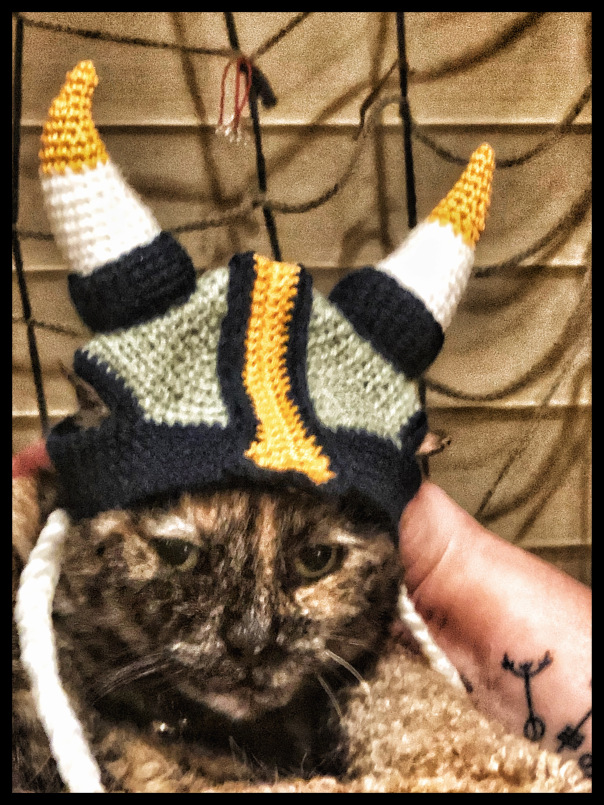
Although our cat is clearly a Heathen (with a fondness for Thor and Frigga,) she maintains cultus for Bast and even tends her own shrine for the Goddess. Dua Bast, and may you continue to bless and keep our dear one healthy and safe!
To Bast
For Teka Lynn
To Bast
Hail Bast who bears the was-scepter
and the precious alabaster jar
with which you anointed the body of Horus
after he bathed in your sacred lake at Boubastis,
you who wear the aegis that puts to flight
all manner of demons, on which the terrifying
visage of your son Maahes the Render
can be seen, O Bast, alluring consort
of Ptah, the maker of many splendid things,
Daughter of Rē, Protector of Lower Egypt,
Sekhmet’s companion in the hunt. wanderer
in the land of Punt, soothed by the sistrum
of Hathor, O Bast of many names and many roles.
For in Memphis you are known as Mistress of Ointments
and the one who delights in fragrant perfumes.
When the women of Thebes are getting married
they ask that you bless them with fertility and good luck
so they may bear a litter’s worth of fine offspring,
and later they call to you in the midst of their labor,
and afterwards beg you to watch over their young
so that they may grow healthy and strong.
To the Heliopolitans you are the Slasher, the avenger of Rē.
The learned scribes of Hermopolis have deduced
that you are the soul of Isis through clever wordplay.
And the Greek inhabitants of Alexandria name you
Aílouros in their tongue, she who wags her tail
and the Egyptian Artemis who adores the chase
and the light of the moon. O Bast, you are all of these things
and so much more, and I pray always that I am worthy
in your eyes to be a caretaker for one (or more!) of your children.
Year 5 of the Bakcheion
Although I’ve had wall calendars printed every year since the opening of the Bakcheion (and for several before that) this time around I’ve opted not to. We’ll still be marking the passage of the seasons and doing stuff to celebrate Dionysos’ festivals here in the temple and through the House of Vines – I’ll just be keeping track of things electronically. For those who like to plan ahead this is what Year 5 of the Bakcheion (2023 e.v.) is going to look like. Note that since we had to add the intercalanary month Eriaphioteion everything has slid forward a couple weeks. (The fun of keeping a lunisolar calendar.) Not included are the feast days of our Heroes and Heroines, which remain the same from year to year.
White Season begins (Jan 1)
Noumenia of Kissos (Jan 22)
Lenaia (Feb 2)
Noumenia of Stephanos (Feb 21)
Anthesteria: Pithoigia (Mar 3)
Anthesteria: Choes (Mar 4)
Anthesteria: Chytroi (Mar 5)
Noumenia of Thyrsos (Mar 22)
Dionysia begins (Mar 31)
Gold Season begins (Apr 1)
Dionysia ends (Apr 6)
Noumenia of Nebris (Apr 21)
Noumenia of Kantharos (May 20)
Agrionia (Jun 16)
Noumenia of Prosopon (Jun 19)
Red Season begins (Jul 1)
Aletideia (Jul 17)
Noumenia of Kothornos (Jul 18)
Noumenia of Diktya (Aug 17)
Pannychia begins (Aug 18)
Pannychia ends (Aug 19)
Noumenia of Pelekus (Sep 15)
Black Season begins (Oct 1)
Noumenia of Botrys (Oct 15)
Oschophoria (Oct 21)
Noumenia of Boukranion (Nov 14)
Lampteria (Nov 24)
Noumenia of Athyrmata (Dec 13)
Foundation Day (Dec 31)
This book is gonna be fucking insane.

I’m putting a temporary hold on the hymns for the Gods of the Week. A couple things contributed to this decision. Firstly, I wanted to include a set for the Egyptian as well as Greek and Norse Gods, and that still requires some tweaking. Secondly, I’m feeling guilty and want to get the commissioned hymns out before I start this next phase of the project. And thirdly, since I’m already delaying there’s about sixteen others I want to finish first, those being:
Commissioned:
al-Lāt
Asklepios’ family
Bast
Haides
Hekate (x4)
Persephone
The Others:
Euthymos
Freyr
Herkyna
Hybla
Jöfurr
Mousaios
Nehalennia
Phalanthos and Aithra
Phryne
Semele
The Sirens
Skírnir
Stuffo
Taras
Thoth
Thyia
And as for the informal poll, it looks like you guys are pretty decisively on the side of adding the Skythian, Slavic, Baltic and related Gods, so I’m taking it to the mat during our next divination session as there are a couple matters I need clarification on first.
You don’t want to know how big my to-do list has grown. This book is gonna be fucking insane.
I was talking with a friend about the Polytheist Hymnal and she asked:
How long does it take for you to craft one of these?
To which I replied:
That’s a really good question, and the answer depends on where certain boundaries are drawn. I begin the writing process by getting into a particular altered state through a combination of prayer, meditation and the consumption of marijuana (and less frequently alcohol or other entheogens.) Then I go through my list and see if I can connect with any of the names on it. If things click then I start writing, which can take anywhere from 30 mins to 4 hours depending on how clearly things are coming through, how well I know them, if I need to do supplementary research, etc. (Though the research – if they aren’t a deity I have prior history with – is usually done before the writing process itself starts, and consists of familiarizing myself with their history and myths, epithets and symbolism, cult practices and regional expressions, as well as their relationships with other divinities and similar details that help me flesh things out.) If I can’t get into the right state, or don’t click with the deity I don’t write because I don’t think things like hymns should be forced, and because the writing itself often has a collaborative element, where I check in and see if what I’ve got works for them or if I need to include different epithets, allusions or even if the structure of the hymn itself needs to be changed. If I can’t feel these things out I either resort to divination or set the piece aside for another time when I can.
Insane.
 The House of Vines