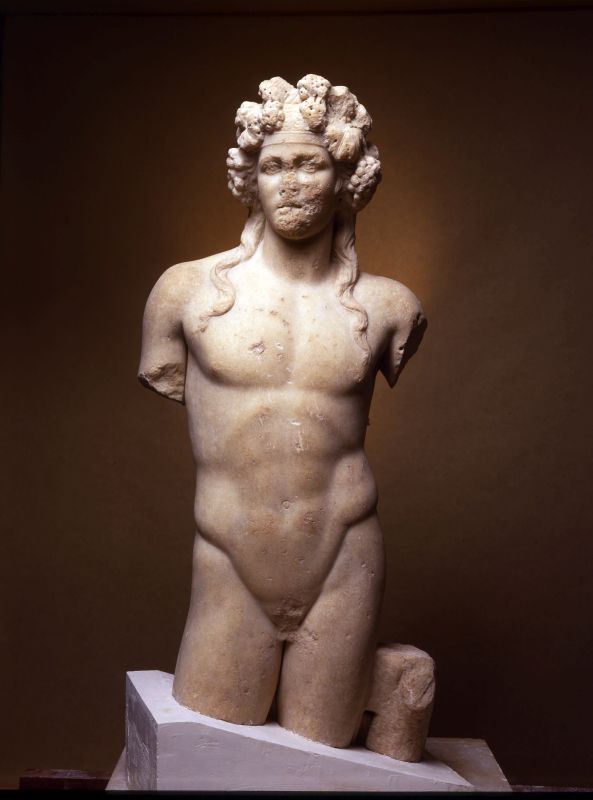
Beth She’an
Roman period, 2nd century CE
Israel Antiquities Authority
I want to share something nice with y’all after that unpleasantness, so here is a preview of a special project I have been working on, a collection of sources for the Starry Ram tradition. It is only about a third of the way complete. I have been harvesting sources like a fiend, but a lot of them require editing, formatting, standardizing, and so forth, and that is just the material I have gleaned thus far. I have 7 or 9 folders, each with dozens of links to PDFs I still need to go through. What can I say? When I research something I am thorough.
 The House of Vines
I’m curious….who is Mar?
LikeLike
That is a really good question. Mār is a storm and fertility God whose marriage to Mārāh (possibly the Goddess Nanay) was celebrated at the fort in Elephantine, Egypt where an army comprised of Judaeans, Samarians, Idoumaeans, Aramaeans, and Syrians sought refuge when shit got bad in the Persian empire during Cambyses’ reign. They had previously been deployed in Babylon and practiced a very blended polytheism, of which Yahweh and Asherah were two of the most important divinities. Mār is more of a title than a name, and means “Lord, Master” functioning like Ba’al. It was applied to a number of different deities, sometimes shifting between several in the same text. Here’s some resources that may be helpful:
https://en.wikipedia.org/wiki/Elephantine_papyri_and_ostraca
https://en.wikipedia.org/wiki/Papyrus_Amherst_63
https://repository.yu.edu/server/api/core/bitstreams/3875d533-6d21-48cb-bbe3-c1d56cdd0dda/content
https://www.academia.edu/44221003/Nanay_a_among_the_Arameans_New_Light_from_Papyrus_Amherst_63
https://www.academia.edu/32158434/Nanay_and_Her_Lover_An_Aramaic_Sacred_Marriage_Text_from_Egypt_JNES_76_2017_1_37
https://www.academia.edu/145377279/Gad_Barnea_Khnum_Is_Against_Us_The_Rise_and_Fall_of_%E1%B8%A4ananiah_and_the_Persecution_of_the_Yahwists_in_Egypt_ca_419_404
https://www.academia.edu/97443806/The_Identity_of_the_Samarian_Kingdom_s_Deity
https://www.academia.edu/77107424/Reconstructing_the_Pantheon_of_Judaean_Elephantine
Damn, I can’t find this really good one I had. I’ll look later and see if I find it again.
LikeLiked by 1 person
When you research, you really go down the rabbit hole to the end.
LikeLike
Considering how much I’m constantly learning from your posts, I really appreciate that.
But, yeah, for me these texts are like living things. Combining the remnants, and filling in the lacunae, makes the story in the text come even more alive. Often, I’m guided in filling in those lacunae through direct inspiration or UPG; I get the story, and put it aside. If I find corroboration I run with it. If not I keep it marked as an unverified theory. The amount of corroboration I end up discovering is kind of ridiculous, which is why I put my trust in this process.
LikeLike