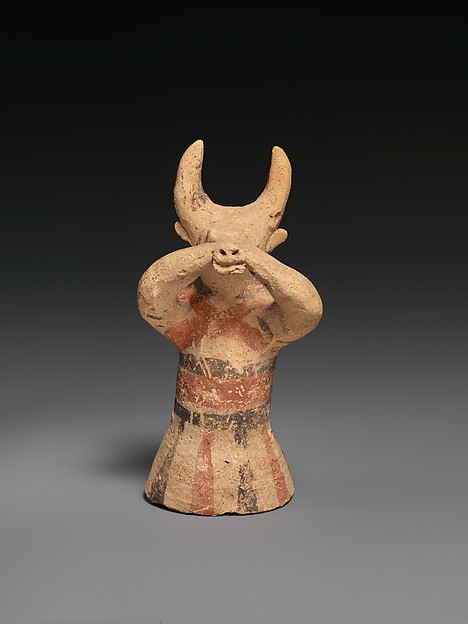
Cypriot, Cypro-Archaic I
Terracotta; H. 5 1/8 in. (13.0 cm)
The Metropolitan Museum of Art, New York, The Cesnola Collection,
There’s always more to the story. For instance, the sparagmos of Saul goes back to the war between Jeroboam and Rehoboam. And to understand Bethel you must know about Kuntillet ʿAjrud. But what lurks behind all of these?
1 Kings 12:20-33
When all the Israelites heard that Jeroboam had returned, they sent and called him to the assembly and made him king over all Israel. Only the tribe of Judah remained loyal to the house of David.
When Rehoboam arrived in Jerusalem, he mustered all Judah and the tribe of Benjamin—a hundred and eighty thousand able young men—to go to war against Israel and to regain the kingdom for Rehoboam son of Solomon.
But this word of God came to Shemaiah the man of God: “Say to Rehoboam son of Solomon king of Judah, to all Judah and Benjamin, and to the rest of the people, ‘This is what the Lord says: Do not go up to fight against your brothers, the Israelites. Go home, every one of you, for this is my doing.’” So they obeyed the word of the Lord and went home again, as the Lord had ordered.
Then Jeroboam fortified Shechem in the hill country of Ephraim and lived there. From there he went out and built up Peniel.
Jeroboam thought to himself, “The kingdom will now likely revert to the house of David. If these people go up to offer sacrifices at the temple of the Lord in Jerusalem, they will again give their allegiance to Rehoboam king of Judah, and they will kill me.”
After seeking advice, the king made two golden calves. He said to the people, “It is too much for you to go up to Jerusalem. Here are your Gods, Israel, who brought you up out of Egypt.” One he set up in Bethel, and the other in Dan. And this thing became a sin; the people came to worship the one at Bethel and went as far as Dan to worship the other.
Jeroboam built shrines on high places and appointed priests from all sorts of people, even though they were not Levites. He instituted a festival on the fifteenth day of the eighth month, like the festival held in Judah, and offered sacrifices on the altar. This he did in Bethel, sacrificing to the calves he had made. And at Bethel he also installed priests at the high places he had made. On the fifteenth day of the eighth month, a month of his own choosing, he offered sacrifices on the altar he had built at Bethel. So he instituted the festival for the Israelites and went up to the altar to make offerings.
1 Samuel 4:5-8
When the ark of the Lord’s covenant came into the camp, all Israel raised such a great shout that the ground shook. Hearing the uproar, the Philistines asked, “What’s all this shouting in the Hebrew camp?”When they learned that the ark of the Lord had come into the camp, the Philistines were afraid. “Gods have come into the camp,” they said. “Oh no! Nothing like this has happened before. We’re doomed! Who will deliver us from the hand of these mighty Gods? They are the Gods who struck the Egyptians with all kinds of plagues in the wilderness. Be strong, Philistines! Be men, or you will be subject to the Hebrews, as they have been to you. Be men, and fight!”
1 Samuel 28:13
The king said to her, “Don’t be afraid. What do you see?”
The woman said, “I see Gods coming up from the underworld.”
1 Samuel 31:1-13
Now the Philistines fought against Israel; and the men of Israel fled from before the Philistines, and fell slain on Mount Gilboa. Then the Philistines followed hard after Saul and his sons. And the Philistines killed Jonathan, Abinadab, and Malchishua, Saul’s sons. The battle became fierce against Saul. The archers hit him, and he was severely wounded by the archers. Then Saul said to his armorbearer, “Draw your sword, and thrust me through with it, lest these uncircumcised men come and thrust me through and abuse me.” But his armorbearer would not, for he was greatly afraid. Therefore Saul took a sword and fell on it. And when his armorbearer saw that Saul was dead, he also fell on his sword, and died with him. So Saul, his three sons, his armorbearer, and all his men died together that same day. And when the men of Israel who were on the other side of the valley, and those who were on the other side of the Jordan, saw that the men of Israel had fled and that Saul and his sons were dead, they forsook the cities and fled; and the Philistines came and dwelt in them. So it happened the next day, when the Philistines came to strip the slain, that they found Saul and his three sons fallen on Mount Gilboa. And they cut off his head and stripped off his armor, and sent word throughout the land of the Philistines, to proclaim it in the temple of their idols and among the people. Then they put his armor in the temple of the Ashtoreths, and they fastened his body to the wall of Beit She’an. Now when the inhabitants of Jabesh Gilead heard what the Philistines had done to Saul, all the valiant men arose and traveled all night, and took the body of Saul and the bodies of his sons from the wall of Beit She’an; and they came to Jabesh and burned them there. Then they took their bones and buried them under the tamarisk tree at Jabesh, and fasted seven days.
 The House of Vines