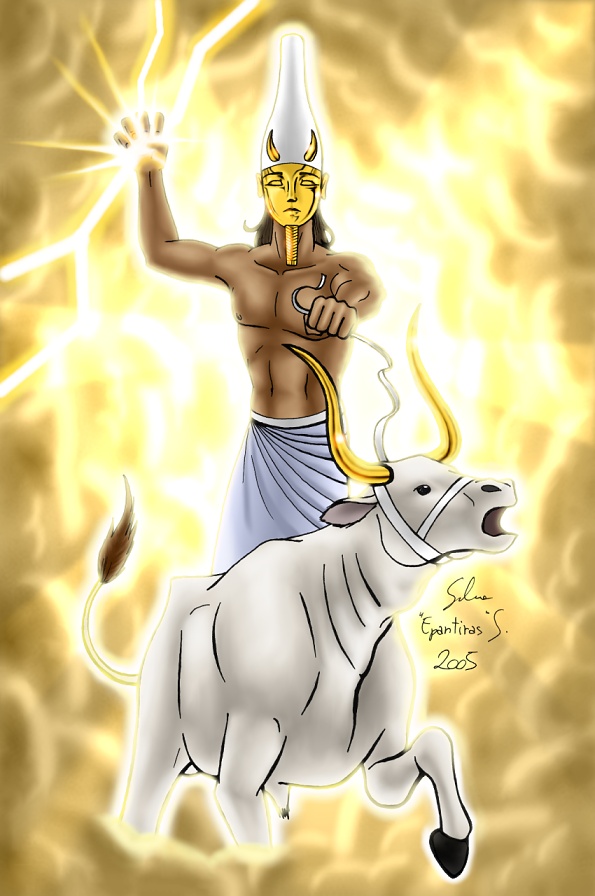
Although I’ve mostly been focusing on the history of Beith She’an and its Bacchic cults and mythology, as well as Dionysos’ interactions with Yahweh, Ašērah, Ašmedai, and Masṭēmā, among others, I suspect that a reconstructed pantheon of Israel, Judah, Samaria, and Edom (along with the Canaanite, Babylonian and Egyptian divinities who were incorporated into it) is going to be central to this whole Starry Ram thing. I don’t know that I’ll include all 70 of the bēnē Ĕlōhīm, but I don’t include all of the Greco-Italian Gods in the Starry Bull tradition or the Norse and Black Sea divinities in the Starry Bear, so I don’t think that’s such a big deal. I’m mostly sticking to the ones I’ve encountered and/or are drawn to research. It’s still producing fascinating results.
For instance, it looks like the early Israelites originally had a Council of Gods which was governed by ‘El/ʿElyōn/’Elōah and his consort Ašērah; they ruled over Qos, Aštārit, Qeteb, Deber, Mōt, Rešep̄, Anat-Bethēl and Ašam-Bethēl, Ešem-Bethēl and Herem-Bethēl, Ba’al, Šamaš, Nabû, Dagon, Yarikh, Hathor, Khnum, etc. and a relative latecomer who was the God of animals and vegetation, storms and war, volcanoes and madness, and went by Yah, Yahō, or Yahweh.
This God had a bitter (possibly sibling) rivalry with Ba’al, and after defeating a series of monsters to prove his prowess, challenged ‘El for the Kingship of the Gods. After defeating him, Yahweh absorbed his predecessor’s powers, attributes and names, and took Ašērah as his bride.
No wonder he and Dionysos get along so well!
 The House of Vines
Slightly off topic: you should check out Fortess of Lugh’s new video on the Indo-European interpretation of Jesus. A lot of it probably isn’t news to you but it was pretty neat
LikeLiked by 1 person
Fortress
LikeLike
Link?
LikeLike
LikeLike
Love the picture! Is that of Yah? It would make an awesome prayer card!
LikeLike
unfortunately not without having rights from the artist! :(
LikeLike
Yeah, there’s not a lot of ancient images of Yahweh left (one of the major ones being a coin from the Hellenistic era which incorporates iconic elements from Zeus, Dionysos, and Triptolemos.) But this modern piece was quite striking.
LikeLike
I like the exploration into early Hebrew pantheons. So much has been lost.
LikeLiked by 1 person
I’m going to do another link dump of some of the more interesting papers I’ve been reading in the next couple days. Although the Bible (in its current form) wants to present early Israelite religion as something fundamentally unique, it really looks like a branch of Canaanite religion with some Egyptian, Babylonian and Syro-Arabian influences. (Which makes sense considering it’s located at the intersection of the trade routes of these civilizations.) I had a sense of this before, but the degree is quite striking.
LikeLike
I thought as much since I do follow the Canaanite pantheon. It seems to be that the Hebrews were either Canaanites or adopted their cultures. Of course, the Old Testament says that the Hebrews wiped them out city by city.
LikeLike
Unfortunately archaeology doesn’t seem to bear that out. There’s evidence of sporadic conflicts, but not widespread genocidal conquest. I think a lot of the invasion narrative wasn’t so much ancient history as stories meant to bolster the contemporary reforms undertaken by the likes of Josiah or efforts to create cultural cohesion post-exile.
LikeLike
You are probably correct. It seems to be contradictory in places. I think it has to do the rabid Yahwehists and their monotheistic takeover of the government.
LikeLike
The Tanakh is a library written, collected, redacted, rewritten, etc by numerous groups and individuals over several hundred years working out questions of power and authority. Just some of the factions include the monarchy, the various tribal groups, the Jerusalem temple and its priesthood (not to mention other temples such as Mount Gerizim, Arad, Tel Moẓa, etc.) the various sects (Pharisee vs Sadducee vs Essene vs Nazorite and later the Hellenizers) all vying for legitimacy and control, with the common folk caught up in the middle. Once you get outside of that — say, the Jewish populations in Egypt or Babylon or along the Silk Road, you find entirely different cultural and religious concerns, with a lot less emphasis on ideological purity and monotheism, with minimal knowledge of the Tanakh (though plenty of folklore, oral and written.) Obviously things change after they lose the Roman wars, are scattered to the winds, and their only hope for survival as a people is unity and resistance to assimilation, especially with the rise of Christianity and Islam. (But even then you’ve got differences between Ashkenazim, Sephardim, Mizrahim, etc.)
LikeLike