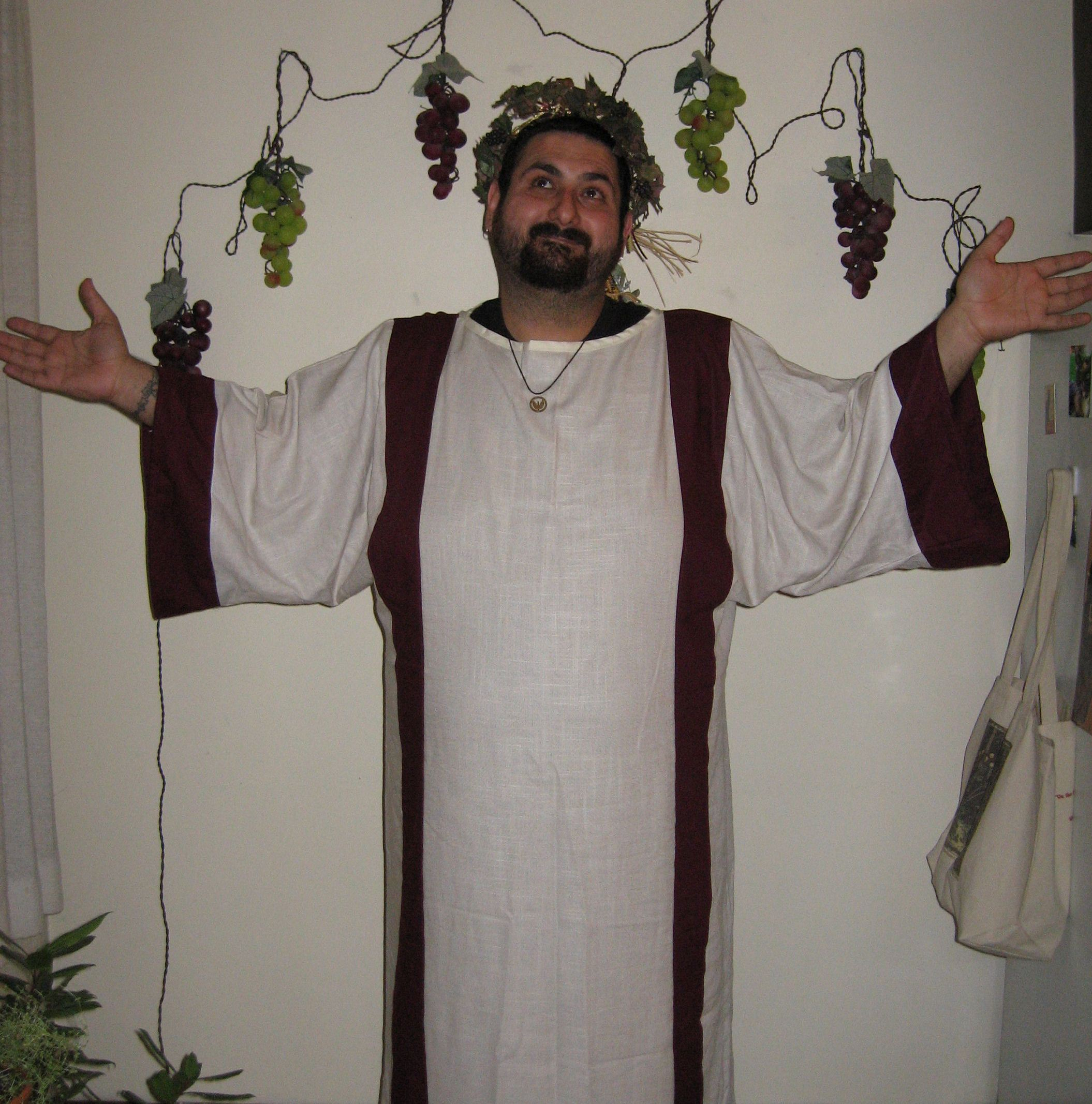
During my time away from the House of Vines I worked on codifying the Starry Bull tradition, specifically coming up with the different Grades and the six Ways. A lot of this draws on previous iterations, but is more clearly demarcated and fleshed out, so should avoid previous issues our cult has run into in the past.
I am still working on the hymns, prayers and incantations of the Hymnōdai (ὑμνῳδαί), which is a kind of monastic Bacchic Orphism. When I am finished I will have what amounts to a Bible for the White Way called Holy Words which will contain the essentials of this branch of the tradition. This book is only given to the Hymnodos after they have successfully completed the first initiation. (In its full form; I will be making a carefully redacted version available to the public.) In addition to daily rituals that have to be performed, a greater number of taboos to observe, etc. Hymnōdai must be familiar with matters of lore and able to offer exegesis, and after they have undergone the first initiation of the White Way there is a strong focus on linguistic magic, specifically the power of words to create and destroy, heal and afflict, bind and set free. If one is both an Orpheotelest and a Hymnodos one can train to be an ἐξορκιστής (exorcist) culminating in the second of the White Way initiations. So essentially the Hymnōdai are our tradition’s equivalent of the Babylonian Āšipu, Egyptian Kheri-ḥꜣb, South Italian Pythagorean and Jewish Mekubbāl.
Ironically (or perhaps not) my practice had been morphing into something like what the White Way has become even before I shuttered the House of Vines, as far back as when I decommissioned the Bakcheion and reconverted the space into my shrine-filled office, complete with tables for divination and magical operations. In fact, without intending to I set up a shrine to Dionysos of the White Way, distinct from the shrines for Dionysos Bakcheios, Lusios, and Asterios, as well as the collective shrine for the Dionysian Retinue. At first it was just a practical thing; I was doing a lot of study and writing, and I wanted to have a shrine handy so that I could honor him and make offerings while at my desk without having to get out of my comfy computer chair and walk over to one of the other shrines to burn some more incense or pour out another libation, as I tend to do that a lot while working, either out of gratitude or from a desire for inspiration or protection. But as I began fleshing out the White Way the shrine developed a personality of its own, and now I make offerings there particularly when matters pertaining to that branch of the tradition come up.
Although Holy Words will serve primarily as a guide to the White Way (including its own calendrical system and set of observances) it will also contain material from the other Ways of the Starry Bull tradition so that the Hymnodos is familiar enough with them that they can counsel Xenoi and Philoi (higher grades will be studying under an Orpheotelest, whom they can direct their questions to, and of course there will be Mystai of the various Ways who are even better positioned to provide answers, so long as doing so does not violate their oaths or betray and profane the Mysteries.)
This creates a clear divide between οἰ ἔξω (those without) and οἰ ἔσω (those within) and maintains tight control over the dissemination of information. Having taken a couple classes and hanging out in our Discord does not authorize one to speak about the Starry Bull tradition; that is reserved for Whites only. And Orpheotelestai, of course, who not only outrank them, but act both as teachers and itinerant religious specialists who serve both our community and outside clients.
Those of the White Way are masters of lore, however, and tradition trumps all so their opinion should be respected, even if one must defer to an Orpheotelest. (And one must.) If both are Orpheotelestai we take it to mantikē (divination), as this is a living faith and the Gods supersede even tradition itself. Anyone can share their personal experiences or proffer their opinion for consideration; that just isn’t worth two oboloi when it comes to the Starry Bull tradition, especially if they are οἰ ἔξω. Which is why training in the White Way will be among the most difficult and demanding in the tradition.
However their primary function will remain the οιδή (singing) of ὕμνοι (songs of praise for the Gods and spirits) per their name, as well as the recitation of prayers and making sacrifices on behalf of the community. Towards that end they must cultivate knowledge, piety and righteousness, so that their words contain greater than normal potency.
 The House of Vines
What about the Starry Bear and Judeo-Bacchic ( hell I can’t find a better term at the moment ) aspects? Will they be part of Starry Bull, or would they be separate branches?
LikeLike
We’re working out the starry bear stuff now. I was just saying to San. that “white road” is the ancestor road, red road is sacrifice in our Norse tradition so …patience, my friend, patience. we’re working on it and juggling more balls than I ever thought possible. :) San. is doing some awesome and terribly important work. I am so often in awe of him. :)
LikeLike
You’re going to make me blush.
LikeLiked by 1 person
I speak only the truth. :)
LikeLike
Sorry, I’m just really excited for this! Plus at 54 I’m not getting any younger. lol
Seriously, though, I know there’s alot going on behind the scenes. And I’m eager to see the results!
“Is everybody in? Is everybody in? Is everybody in? The ceremony is about to begin.” — Jim Morrison
LikeLiked by 1 person
When Dionysos is involved enthusiasm is to be expected. Never apologize for excitement! I’m excited too. Not just because I’m getting this glimpse of a world behind the world — stories long forgotten or suppressed or never recorded* — but because it feels like the time is ripe for it. We have had Yahweh, Asherah, Ashmedai and Michael step forward in a big (and surprising) way this last year, and at the same time witnessed a very disturbing rise in antisemitism around the world, and in leftist neopagan circles in particular. The Starry Bull stands with the Jewish people against the servants and allies of the unmaker, whether there is a formal Starry Ram strain or not. Bringing this forth has to be done properly, and that means not rushing. Think about how long the Starry Bear has taken.
* I only shared a handful of the historiolae I’ve been given, and that’s just the tip of the iceberg.
LikeLiked by 2 people
Let me echo that: the Starry Bear tradition likewise stands with the Jewish people against servants of the Enemy, against the ancient hatred and spirits of evil high and low that seek to breed antisemitism and destroy the Hebrew nation.
LikeLike
Ginesthō! Well said.
LikeLiked by 1 person
Those traditions are still in the process of development; ultimately there needs to be someone of Orpheotelest or equivalent rank to oversee the “franchise” — in Starry Bear’s case that is Galina because of her decades as a Vitki and Gythia. Currently we don’t have anyone for the Starry Ram (what I’m tentatively calling Bacchic Judaism.) But that will change when the time is right.
LikeLiked by 1 person
I was thinking of Starry Ram as a name myself.
LikeLiked by 1 person
It works so well, especially with how often rams show up in Jewish legend and the similarity between the shofar and the salpinx. Plus it keeps the asterism/zōdion theme going.
LikeLiked by 1 person
Plus it’s better than Starry Menorah which is what I was contemplating until Edward Butler made the Ram suggestion. LOL
LikeLiked by 2 people
This is off topic but it came up in a conversation recently. I was reading in your essay about the Jewish God in Alexandria about how the Septuagint became standard in the Diaspora and some Jews forgot how to read Hebrew. Does this mean Jews were reciting in Greek? Why did they stop using Hebrew?
LikeLike
How many Jews do you know today who haven’t spoken a word of Hebrew since their Bar or Bat Mitzvah? Not only was Greek the language of the political elites in the East, it was also the language of art, philosophy, science, medicine, commerce, etc. So anyone who wanted to assimilate and participate in the wider culture had to be conversant in it. This produced reactionaries such as the Maccabees and their supporters who not only opposed such cultural dilution but had serious problems with Jews who attended the theater and games, enrolled in philosophical schools, worked out in the gymnasium or spent time in the public baths. (Especially when Jews underwent cosmetic surgery to have their foreskins restored so they didn’t stand out.) Not only was this hotly debated in Jewish circles, but it could boil over into spontaneous violence and purges. Being a Greek speaker didn’t necessarily mean turning one’s back on Jewish religion or culture, however; histories, poetry, plays, etc. on Judaic themes, as well as business and legal documents, were produced. Also, many of the staunch defenders were much more conversant in Aramaic, Syriac and Persian than Hebrew which increasingly became a liturgical language. And lots of Jews in the West adopted Latin, especially as the Roman empire expanded.
LikeLiked by 2 people